


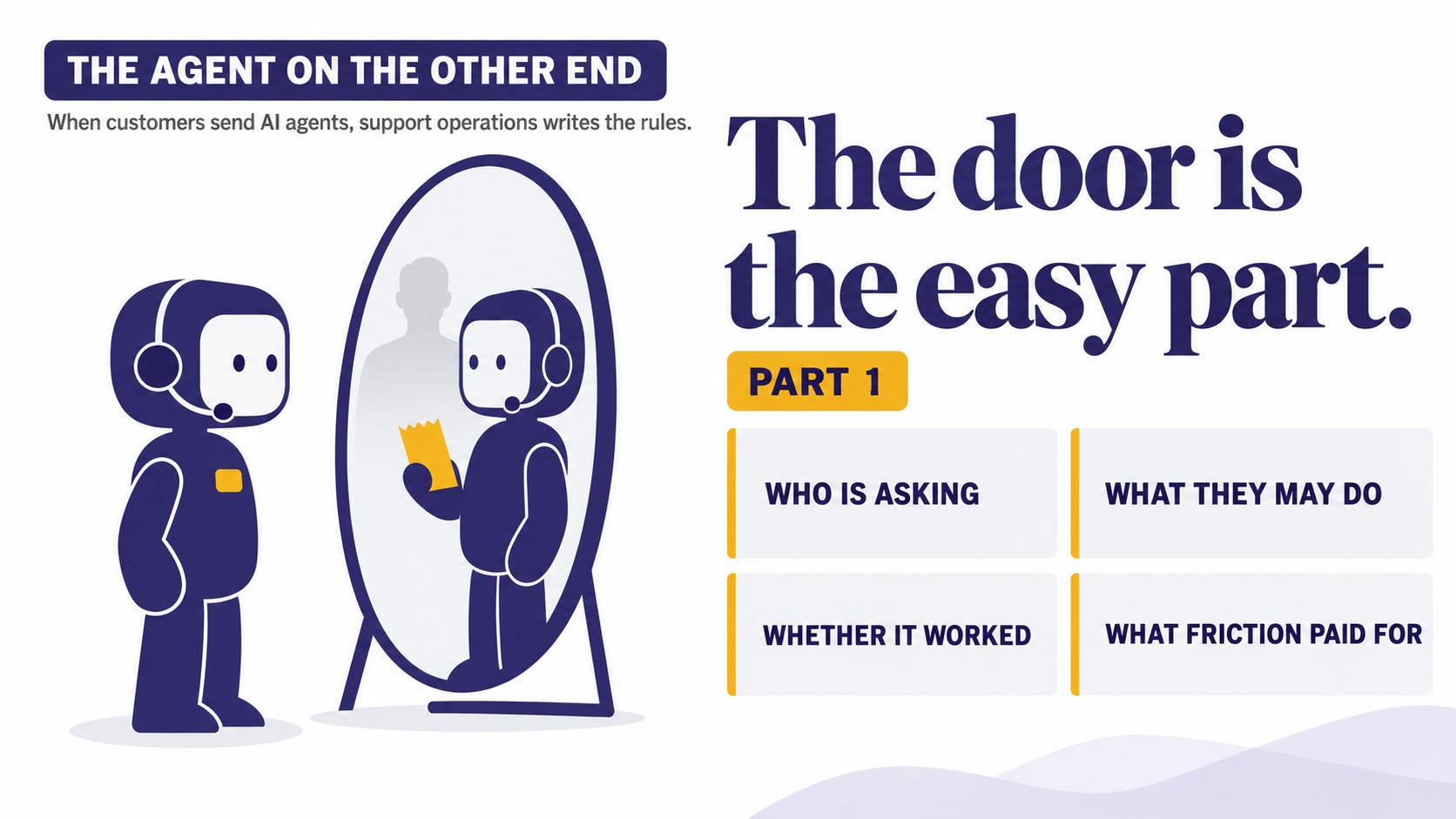
By the end of this article, you will know the four decisions waiting behind the door, why blocking agents pushes them somewhere you cannot see, and what to check in your own queue this week.
The callers figured it out before we did.
As volume grew on the voice line at the program I ran, callers learned a shortcut. The moment the voice AI answered, they said three words: “human, human, human.” The original design did what they asked. It transferred them blind.
On paper that looked like good service. The caller wanted a person and got one. But the agent who picked up knew nothing about why they were calling, so the conversation started with the customer explaining the problem from the beginning. The AI had been skipped, and the customer paid for the skip by telling their story twice.
The habit spread fast enough to show up in the numbers. So I tuned the AI to accept the request and ask one question first: “I’ll be happy to transfer you to a human. In order to get you to the right human agent to help you with your issue, help me understand what you are calling about.”
The AI paraphrased the problem back to the caller and routed the call to the right agent with a summary. When the fix was something the caller was able to handle alone, it offered the fix first and asked whether they still needed the transfer.
Containment recovered over the following weeks of tuning. The lesson outlasted the numbers. Customers route around whatever stands between them and a solution. You do not win that with a taller wall. You win it by making the route they want also the route that tells you what you need to know.
That lesson is about to matter at a scale none of us have planned for.
Customers Are About to Send Something That Does Not Get Tired
Last week I had lunch with the CEO of a support platform and three heads of support from large companies that run on it. Three questions kept coming back.
What does it cost the people on the team when they spend their day with an agent that never gives up? How do you tell when you are talking to one? And if you publish a route for agents in an open directory, do you give up the conversation where you used to sell?
Those are operator questions. Most of what has been published this month is written for the people building the agents, not the people answering them.
Thomas Verschoren at Internal Note walked through the Open Service Directory, an open directory Zendesk introduced so a customer’s personal AI assistant can look up a company’s official support route and reach that company’s AI agent through an approved connection. It is open to companies on any support platform. He calls it a phonebook for agents, and the description fits.
Kenji Hayward, Head of Support at Perplexity, wrote that AI agents are now the top source of traffic to his help center, ahead of customers, and that his team sees agent-written tickets every week. He listed the tells: walls of text, oddly complete details, follow-ups that arrive minutes apart. He also surveyed what vendors are shipping, from a gateway that detects personal agents to an open protocol for agents to identify themselves and ask permission. His conclusion was that vendors are building the pipes and support should write the rules.
Ted Shelton, writing in his Infinite Future newsletter, named the larger shift. For thirty years the commercial web has run on the company’s storefront: its navigation, its defaults, its cancellation flow. Personal agents reverse who holds the information advantage, and he warned that business models built on friction will feel it first.
I agree with all three. I want to add the part that lands on my side of the desk.
The Early Version Does Not Need a Protocol
Most customers have not handed a fully autonomous agent their support problems yet. They do not need to. The middleman version is already here, and I have seen it in my own company’s queue.
A customer reads the rep’s reply, pastes it into the assistant they use every day, asks what to say back, and pastes the answer into the chat. Most of the time you can only suspect it. One customer pasted a little too much, and the reply arrived with the model’s own instruction still at the top: “now tell them this:”. The reasoning on the other side belonged to a model. The human was the courier. The rep was answering a model’s argument while believing they were answering a person.
The next step is a browser extension driving the customer’s own logged-in session, following instructions the customer worked out with their assistant. I have used one of these extensions myself. Your authentication passes, because the customer logged in. The login proves who owns the account. It does not prove who is typing.
Neither pattern shows up as a new channel. Both arrive through the channels you already run, under the customer’s name. Every rule you write for agents has to start from that condition, because the published door will never be the only door.
Watermarking will not settle this for you. Since August, the EU AI Act has required providers to mark AI-generated content in a machine-readable way, and the major model makers have started embedding invisible watermarks in generated text. That sounds like the foundation for a bot detector. It is a weak one. The detectors are restricted to regulators, researchers, and approved organizations, so your team cannot run them. Coverage varies by provider and by region. And the mark does not survive much handling. Researchers testing Google’s text watermark found that paraphrasing, translating text into another language and back, and mixing it into human writing all degrade detection, and rewriting tools built to strip that signal are one search away.
That last point turns a watermark-based detector upside down. The customer who pastes an assistant’s reply without a second thought leaves the mark intact. The person running an agent to work your refund policy has every reason to strip it.
A detector built on watermarks flags the customers who were not hiding and misses the ones who were.
Even a perfect watermark answers the wrong question. It tells you a model wrote the words. It does not tell you who is asking, whether a person is still in the loop, or what anyone authorized. Plenty of customers already use an assistant to write a clearer complaint, write in a second language, or work around a disability. Treat watermarked text as suspicious and you penalize them. Identification has to come from declaration, not forensics.
A Directory Listing Is Not a Policy
A directory listing is not a policy. It tells the customer’s agent where your door is. It says nothing about what happens once the agent walks through it.
The directory solves discovery, and it is honest about its limits. The documentation notes that the assistant still has to confirm the domain belongs to the business the customer meant. Thomas points out that the listing does not authenticate the customer or prove the assistant is authorized to act for them. That is a fair scope for a phonebook. It also leaves a long list of open work, and none of it belongs to the protocol.
After the knock, four decisions are waiting. Each one gets its own part in this series.
Who is asking. Every request now comes from one of three actors: a guest, an authenticated customer, or an agent acting for a customer. Each deserves a different path, and today most operations cannot tell the third from the second. Detection is a guess built on length, timing, and formatting. A sanctioned route turns that guess into a declaration, because an agent that comes through the published door tells you what it is.
What they may do. An agent asking for an order status and an agent asking to change the email on an account carry different risk. Low friction belongs on the first. The customer’s own confirmation belongs on the second. The harder work is consistency. Every gap between your reps, your macros, and your help center becomes a door an agent will try, because trying again costs it nothing. Part 2 builds the policy grid.
Whether it worked. When an agent talks to your agent, containment looks perfect and nobody answers the CSAT survey. A request that turns into six follow-ups counts as six contacts. Kenji expects volume to rise, because contacting support now costs the customer nothing, and I think he is right. A dashboard built for human customers will report that rise as a quality problem when it is a channel shift. Part 3 rebuilds the measures.
What friction paid for. Some policies work only because customers give up. A refund that takes three contacts. A cancellation that requires a phone call. A “case by case” clause nobody pushes on. An agent pushes on all of them. The revenue those policies protected will start to move, and Finance will see it before Support explains it. Part 4 puts that on the ledger.
The voice line already ran this test on a small scale. The blind transfer answered none of the four decisions. It did not know who was asking, it granted every request, it recorded nothing useful about whether the call worked, and it made the customer pay the friction twice. The tuned version answered all four with one question and one summary. Nothing about that fix required new technology. It required deciding what we wanted to know before we let the caller through.
The human cost sits across all four, and it was the first question at lunch. A customer’s agent can be set to persist: try every argument, every psychological trick, every escalation path, until it gets what it was sent for. A frustrated person eventually runs out of energy. An agent does not. Your rep does. Every hour spent absorbing that pressure comes out of the rep’s time, energy, and patience for the next customer, and the emotional toll builds across a shift in a way no handle-time report shows.
Asking reps to be more resilient does not fix that. Policy does. A rep needs a written rule for when a conversation with an agent ends, and permission to end it. And persistence should meet persistence. When the other side is an agent that will not stop, the conversation belongs with your own agent, held to your policy, with a clear path to a person who has the authority to grant an exception. Your people stay with the people.
Blocking Agents Sends Them Where You Cannot See Them
The instinct in many leadership rooms is to keep agents out. I understand it. I think it is the wrong move, for the same reason a taller wall was wrong on the voice line.
My position has held across fifteen years of running support, and AI did not change it. Make it as easy as possible for the customer to solve their problem. Collect enough information to fix the root cause that made them contact you in the first place. Deflection fails both tests.
Deflection pushes the customer away and leaves you knowing nothing.
Identification and containment pass both tests. Identification means you know what is on the other end of the conversation. Containment means the problem gets solved inside a service you control, where you can see the cause and fix it at the source.
Kenji makes the same call from the other direction. He argues that blocking agents is the wrong instinct because a real person stands behind every one of them, and he is right about that. I want to add the operating reason. Courtesy is not the only thing you lose when you block an agent. You lose the information.
Block the published door and the agent does not disappear. It comes back through the customer’s logged-in session or a pasted reply, where it looks like a person. You traded a visible agent for an invisible one, and you lost identification entirely.
The first sanctioned door is the one agents already use: your knowledge. Kenji’s help center traffic says so. If your articles are current, clear, and readable by machines, the agent on the other end resolves more before it ever opens a conversation. In the interest of disclosure, I build apps for the Zendesk Marketplace, including a free one that generates llms.txt and llms-full.txt files from a Help Center so AI assistants can read it cleanly. The principle holds on every platform. An agent that finds a clear answer does not need to keep trying.
The same file can do one more job. An llms.txt file is written for machines, so it is the natural place to tell an agent how you want it to arrive. Add a short section for agents acting on a customer’s behalf: the route to use, what to declare, and what the agent gets in return. Kenji’s disclosure list is a good template for the declaration: that it is an AI agent, who it acts for, what it has been authorized to do, whether a human is involved, and how to reach the customer. The return is what any agent working for a customer wants: faster handling, structured answers, and a clear path to a person when the customer needs one.
Call it a declared lane, not a trap. Keep it visible. Hidden instructions planted for agents look exactly like prompt injection, and well-built assistants are designed to ignore them. Not every agent will read the file. The ones that do become agents you no longer have to guess about, and the share of agents that declare themselves becomes a number you can grow.
The Executive Decision Is Ownership, Not Technology
The executive in the room does not need to pick a protocol this quarter. The executive needs to answer three questions, and none of them is technical.
First, how many of our contacts are agent-originated today? If the answer is “we do not know,” that is the answer, and it is the first thing to fix.
Second, who owns policy for agents acting on a customer’s behalf? Today it falls between Support, Security, Legal, and Product. Unowned policy gets written by whoever handles the first bad incident, under pressure.
Third, which of our policies only work because customers give up? Finance should see that list before an agent finds it. Some of those policies exist for good reasons, such as fraud control or a real cost to the business. Others exist because nobody revisited them. The list should say which is which, because an agent will not care about the difference and your team needs to defend only the first kind.
For the executive: the risk this quarter is not the technology. It is a policy nobody owns, written during the first incident that forces it.
An Upsell Has to Survive the Customer’s Agent
The upsell question from lunch deserves more than a sentence, because it is not about banner ads. It is about one of the best moments in support.
A customer contacts you with a problem. The rep looks at the account and sees that the problem is a limit of the current plan, and the next tier removes it. That is not a how-do-I question with a workaround. It is the moment a rep can solve the problem and grow the account in the same conversation, and good reps know how to offer it without sounding like a salesperson.
When the customer’s agent runs the conversation, three things change. The rep is no longer the one reading the account and spotting the fit, so your own AI agent has to do it. That means the plan-to-problem mapping your best reps carry in their heads has to be written down where your agent can use it. The offer no longer lands on a person. It lands on an agent sent to get a problem solved, which will treat a pitch as noise. And the customer’s agent decides what reaches the customer.
So the upsell changes shape. It stops being a pitch and becomes a resolution option. Your agent answers with two paths: the workaround on the current plan, and the upgrade that removes the limit, with what it solves, what it costs, and the terms. A customer’s agent is built to carry that kind of information back, because it bears directly on the goal it was sent for.
Then the money rule does the rest. Anything that changes the customer’s plan or charges their card should require the customer’s own confirmation. That rule exists for security. It also guarantees the upgrade decision returns to the person, as a choice the agent cannot make alone. The persuasive pitch weakens. The well-matched offer, stated plainly and priced clearly, reaches the human with their agent’s comparison attached. An offer that holds up to comparison was always the better offer.
Part 4 returns to this with the economics of what changes when the conversion moment moves from a rep’s judgment to a structured offer.
Five Days to Find Out What Is Already in Your Queue
You do not need a protocol in production to start. You need a week.
Monday: Add a tag or field for suspected agent-originated contacts, and agree on the signals your team will use: unusual length, complete details nobody types by hand, pasted formatting, follow-ups minutes apart. The signals will be imperfect. Start anyway.
Tuesday: Pull fifty recent contacts and have two leads tag them separately. Where they disagree, you have found the limit of detection by eye. That disagreement rate tells you how much a declared route is worth.
Wednesday: List every route a request can enter your operation: forms, email, chat, voice, and actions customers take inside their logged-in account. Mark the ones you would want an agent to use and the ones you would not, and check whether your llms.txt tells agents which route to take.
Thursday: Write one page of guidance for reps. Can they ask “Am I speaking with an AI assistant?” What changes if the answer is yes? When do they require the customer to join? When are they allowed to end the conversation?
Friday: Name one owner for agent-facing policy and put the first review on the calendar. Hand that owner two numbers from the week: the share of contacts your team tagged as agent-originated, and how often your two leads disagreed. Both numbers will be imperfect. They are your baseline, and an imperfect baseline beats “we do not know.” Once a declared lane exists, add a third number: how many agents identified themselves.
Do not wait for a protocol to tell you what is in your queue. The agents are already in it, under your customers’ names.
The Next Caller Will Not Say Human
The callers on that voice line told us what they wanted in three words. They said it out loud, so we heard it and tuned around it. We accepted the request, asked what they needed, routed them with context, and offered the answer first.
The next one will not say anything. It will open the chat, send the email, and work the account page at the same time, and it will keep trying until something gives.
The fix is the same one that worked on the phone. The difference is that now you are writing the rules for a caller that never hangs up.
Give the agent a door you can see, or it will come through the ones you cannot.
How many of last week’s contacts were written by an agent, and how would you know?
This is now happening inside companies, too.
An employee gives an AI agent access to their account. The agent starts doing work. The logs say the employee did everything.
Now something goes wrong. Who actually made that change?
If agents are going to act on our behalf, they need identities of their own. Otherwise, our audit trails are going to tell some pretty misleading stories.