


The first warning came from the floor, not the dashboard. Reps started flagging the same question in their chats: when do vendors get paid, and what do the contract terms mean? A few flags turned into a pattern before lunch. The leads raised the alarm, and by the time we pulled the numbers, the dashboards confirmed what the floor already knew. Payment questions from the vendors we paid were up 30%.
Nothing was broken. No system was down. One help center article on how vendor payments worked, when they landed, and what the contract terms meant had been written loosely enough that every reader filled the gaps differently. Some read it one way and called. Some read it another way and called to argue
We fixed it at the source. Finance wrote clarification language. We pushed it into the knowledge base, refreshed the AI so it stopped repeating the vague version, and sent a mass email to the vendors. The questions dropped drastically. They never went to zero.
That spike was caused by people. People who were confused, a little annoyed, and willing to give up once they had an answer that sounded official. The next reader of a vague policy will not be confused or annoyed. It will quote the paragraph back to you, compare it with what your rep said yesterday, and ask again.
By the end of this article you will have a policy grid that sets rules by who is asking and how much is at stake, a ranking of the identity signals worth trusting, and a five-day plan to find the commit-level actions that a valid login alone can complete today.
The Third Actor Already Has Your Password
Part 1 argued that the door is the easy part. The industry is building the way for a customer’s AI agent to find you, and what happens after the knock belongs to support operations. Since then, support leaders have shared that piece inside their own companies as a reference for planning. The question I hear back is the one this part answers: what are the rules once the agent is inside?
The timing matters. Meta launched Muse in the United States in September as a personal agent that books, buys, fills in forms, and sends email for the person who owns it. 1Password’s partner page for Muse now describes a connection, rolling out across platforms, that lets Muse sign in to a person’s accounts with the logins they already saved. The password is filled in without the agent ever seeing it.
That is good security design for the customer. For support operations it settles a question most teams have not asked. On this path, the customer’s agent does not arrive through a separate door with a separate badge. It arrives inside an authenticated session, holding the customer’s own credentials, and every rule you wrote for a signed-in customer will apply to it.
Most support policy recognizes two actors. There is the guest, who gets general answers. There is the authenticated customer, who gets account answers and account actions. The login is the line between them, and for a long time it was a good enough proxy for “this is the person.”
It no longer is. Your login proves who owns the account. It does not prove who is typing.
Policy Has Two Axes Now
The fix is not a bot detector. Part 1 covered why detection is a guess and declaration is a fact. The fix is to stop asking one question, “is this person signed in?”, and start asking two: who is acting, and how much is at stake if the action is wrong.
Put the actors down the side:
The guest. Not signed in. A person browsing, or an agent reading your help center.
The customer. Signed in, and typing for themselves.
The declared agent. An agent that says it acts for a named customer, through a route you published for that purpose, such as a directory listing.
The agent you cannot see. An agent inside the customer’s session, using the customer’s login, saying nothing.
Put the stakes across the top:
Ask. Information. Policy answers, order status, how-to, eligibility.
Act. Changes you can undo. Reschedule, update a preference, open a case, request a callback.
Commit. Changes you cannot easily undo, or that move money or ownership. Refunds, cancellations, plan changes, payment details, contact email, account ownership.
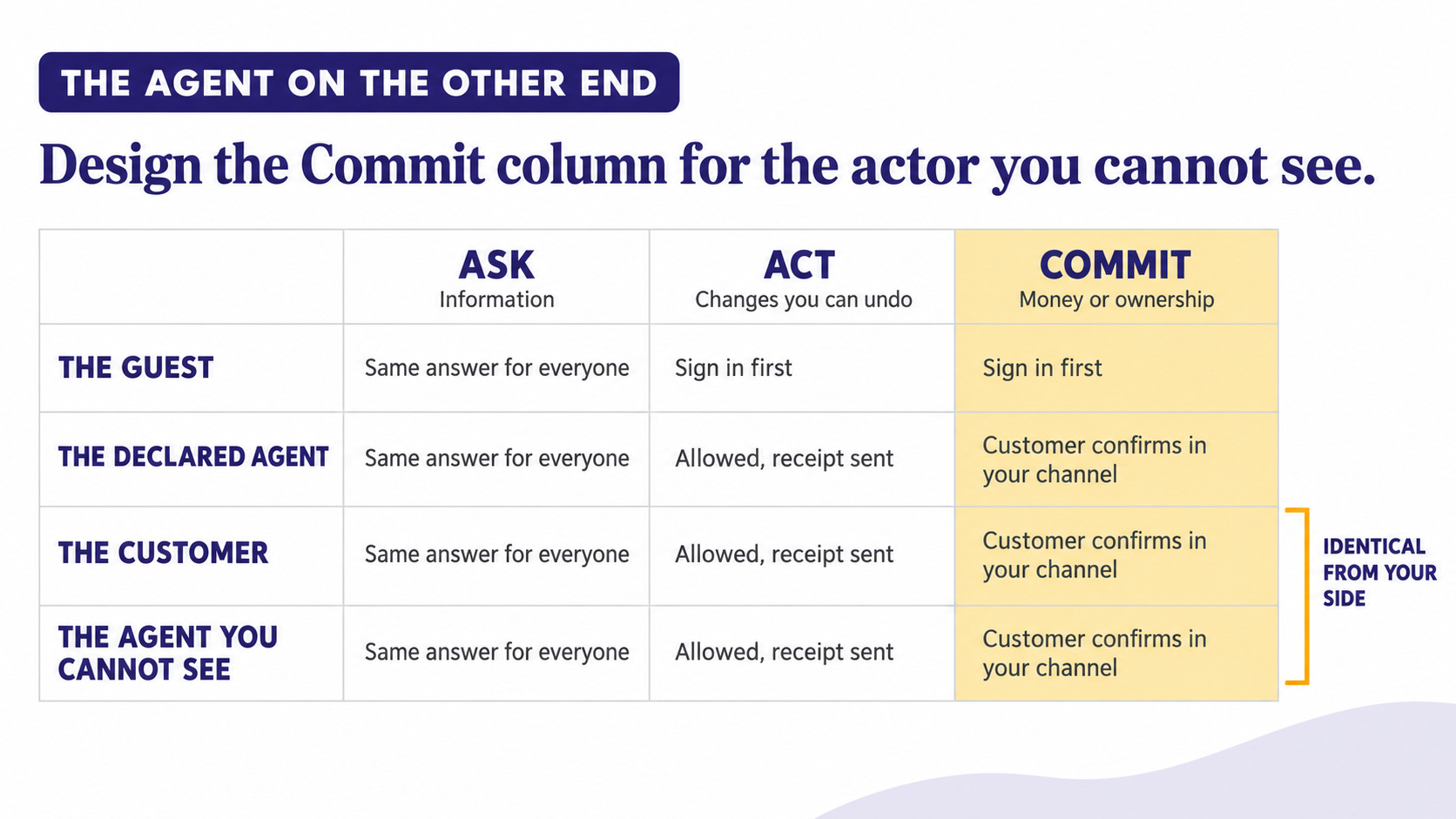
Now fill the cells. The Ask column is the easy one. Anyone gets the answer, agents included, and the answer has to be identical no matter who asks. An agent that gets a different answer from your chat than from your help center has found leverage, not a typo.
The Act column belongs to anyone in an authenticated session, declared or not. These actions are reversible by design, so the cost of the wrong actor is small. Send a receipt to the account’s contact channel every time. The receipt is how a customer learns their agent did something they did not expect.
The Commit column is where the grid earns its keep. Two rows in it look exactly alike from your side: the customer typing for themselves, and the agent you cannot see. You will not reliably tell them apart. So do not try. Design the Commit column for the actor you cannot see.
A rule that only works when you know who is typing is a rule that stopped working this year.
Every Standard Hands the Decision Back to You
Support teams are not being left to solve this alone. Two pieces of plumbing arrived this month, and both are worth knowing by name.
The first finds the door. Zendesk announced the Open Service Directory, a draft specification and public directory that helps a personal assistant reach a brand’s official support instead of a lookalike site or a scam helpline. A brand approves a listing, the listing is checked against the brand’s own domain, and the assistant connects to the brand’s support. OSD builds on Agentic Resource Discovery, an open discovery protocol whose working group includes Microsoft, Google, and Hugging Face. Zendesk has said it will share more at its AI Summit on November 12.
The second checks the badge. Decagon open-sourced PACT, a protocol that lets a business verify which agent is calling and what the customer has authorized it to do. Each business defines its own permissions, such as reading orders or cancelling one. The customer signs in directly with the business and approves the permissions there. The agent never handles the login. Decagon also joined the Personal Agent Protocol working group that the team behind Muse announced for the same problem.
Now read what each one says it does not do. The directory does not carry out support tasks. Once the assistant connects, it follows the brand’s own rules on authentication, data access, and escalation. PACT standardizes how permissions are discovered and granted, and leaves the capabilities and the policies to each business. Every standard hands the decision back to you.
That is why the grid comes first. When a protocol asks which permissions you offer, the grid is your answer: Ask permissions any agent may hold, Act permissions for a verified delegation, and Commit permissions that require the customer’s consent with you. A team without a grid will still publish permissions. They will be written by whoever builds the integration, under deadline, as defaults.
Discovery finds the door. Identity checks the badge. Neither one writes your policy.
Two cautions keep this honest. The first is adoption. In his analysis of the launch, Keith Kirkpatrick of Futurum reached the conclusion this series started from: “the directory is the easy part.” Zendesk lists the major assistants as compatible, but the launch partners are brands and platforms, not the companies that build assistants. Compatible is not the same as used. He also notes that the specification is still a draft and the identity and permission controls are still being built, so treat OSD as a direction, not something to deploy this quarter. His advice for CX leaders is the same as the grid’s: do not wait for a standard to settle, because you will have to decide how to authenticate an assistant and which actions to delegate whichever standard wins.
The second caution is that the standards only cover the agents that choose them. Muse’s own team announced a protocol working group, and Muse is also gaining the ability to sign in with saved passwords. Both paths will run at once. The declared path arrives with a verified identity and a scoped consent. The other path arrives with the customer’s password and nothing else. Your grid has to hold for both.
Their Confirmation Is Not Your Confirmation
Meta built a safeguard into Muse that matters here. Muse pauses and asks its owner to confirm before it sends a message or completes a purchase. That is a responsible design, and it protects the customer from their own agent.
It does not protect you. The confirmation happens inside the agent’s product, between the agent and its owner. You never see it, you cannot audit it, and your policy cannot rely on it. When the refund request reaches your queue, all you have is a valid session asking for a refund.
So the Commit column needs a confirmation that belongs to you. That means a step the customer completes in a channel you control and the agent does not: a link to the email address on file, a push to your own app, a code to the phone number you verified. The agent can request the commit. The person confirms it, with you. PACT builds this idea into the protocol, because the customer approves permissions with the business and not with the agent. For agents that arrive through a saved login, you build it yourself.
This is where the customer’s own confirmation has to stay. Not everywhere, because a confirmation on every action turns the grid into the friction Part 4 will price. Only on the actions where the wrong actor costs money, ownership, or trust.
This is not a detection problem. It is a policy design problem. You do not need to know who is typing if your highest-stakes actions require something only the account holder can supply, in a channel you own.
Teams that still want to sort agents from people will reach for four kinds of signal. They are not equal, and the order matters more than the list.
Declaration comes first. An agent that tells you it acts for a customer, through a route you published, has given you a fact you can route, log, and measure. It can lie, but a lie in a declared lane is a policy violation you can act on. Protocols like PACT go further and make declaration verifiable: a signed identity for the agent and a signed record of what the customer approved.
Authentication comes second. It tells you the account owner granted access to someone. It does not tell you who. Treat it as permission, not identity.
Behavior comes third. Typing speed, message timing, the shape of the argument. These are guesses, and they misfire on fast typists, people using dictation, and customers who rely on assistive tools. A behavior signal can start a question. It should never end one.
Watermarks come last. Part 1 showed why: the customer who pastes an assistant’s reply innocently leaves the mark intact, and the one working your refund policy strips it.
The ranking turns one direction around. Watermark your own agent’s replies instead, and disclose them. When a customer’s agent reads a conversation, it should be able to tell which side was your AI. Your honest label costs nothing and gives the other side a fact instead of a guess, which is the same thing you are asking of them.
Ambiguity Was Always a Cost. Agents Turn It Into a Queue.
Go back to the payment article. People read the vague version, filled the gaps, and called. The cost was a 30% rise in one question type and the hours to answer it, plus the cleanup to rewrite the source.
An agent reading the same article does something different. It does not fill the gap with a guess. It asks about the gap, cites the paragraph, and keeps asking until someone gives it a definitive answer in writing. Then it holds you to that answer the next time, for every customer it works for.
That changes what consistency means. It used to be a quality goal. Now it is a policy requirement, because an agent will find every place where your help center, your macros, your AI, your terms, and your reps disagree, and it will treat each disagreement as an opening.
People got confused by vague policy and called. Agents will get precise about it and argue.
Consistency needs an owner, and the owner needs a path for disputes. In the program I ran, policy wording came from an outside authority. A program manager owned the interpretation: he took the rules from the agency that set them and turned the legal language into what we told customers. When customers or vendors contested the wording, leadership worked with the agency’s counsel to settle what it meant. Then the settled meaning flowed back into our articles, macros, and AI.
That structure is what an agent-facing policy needs: one owner of the wording, one route for contested meaning, and one place the settled answer is published so every channel says the same thing. Without the owner, every rep becomes a policy interpreter. With an agent on the other end, every rep becomes a policy interpreter under pressure, at volume.
A Conversation With an Agent Needs a Defined End
Part 1 raised the human cost. A customer’s agent can be set to persist: try every argument, every escalation path, every rephrasing, until it gets what it was sent for. A person runs out of patience. An agent runs out of nothing. The cost lands on your rep’s time and energy, and on their morale.
Reps should not have to decide alone, mid-shift, when that conversation is over. The policy should decide it for them. A conversation with an agent ends when three things are true: the request has been answered by the policy owner’s published answer, the decision has been stated in writing, and the customer has been given the appeal route. After that, repeating the request does not reopen it. The rep says so, once, and closes.
The appeal route is not a brush-off. It is a structured form the customer or their agent can submit, reviewed by the policy owner on a known cycle. Persistence gets a channel, not a rep.
Decision rule: after the published answer, the written decision, and the appeal route, a repeated request does not reopen the conversation. The rep closes it, and the appeal goes to the policy owner, not back to the queue.
Reps also need words for the moment they suspect an agent. Do not train them to accuse. Train them to ask one neutral question: “Are you an AI assistant acting for the account holder?” If the answer is yes, route to the declared lane and its rules. If the answer is no, or no answer comes, keep serving the person in front of you under the grid. The question never changes what a customer is entitled to. It changes where the conversation goes.
Your own AI needs the mirror of that rule. If a customer, or a customer’s agent, asks your AI whether it is an AI, it says yes. Every time.
Who Owns This in the Leadership Room
For the executive reading this, the operator’s grid hides an ownership question. Agent-facing policy touches Support, Product, Security, Legal, and Finance, and in most companies it belongs to none of them. That gap has a cost, and it shows up in three places.
The first is leakage. When channels disagree, a persistent agent finds the most generous answer and holds you to it. Refunds and credits granted against policy rarely get labeled that way on a dashboard. They show up as a slightly higher concession rate that nobody can explain.
The second is rep hours. Every contested policy that has no owner and no appeal route lands in a live conversation, and a live conversation with something that does not tire is the most expensive minute in your queue.
The third is exposure. If a valid login alone can complete a commit-level action, then anyone holding that login, including an agent the customer connected months ago and forgot about, can complete it too.
Four decisions belong at the leadership level before the volume arrives. Name one owner for agent-facing policy across every channel. Decide which actions sit in the Commit column and require the customer’s own confirmation in your channel. Decide whether to list your support in a directory and accept a delegation protocol, and who maintains the permissions you publish. Fund the consistency work, because the help center, the macros, and the AI have to say the same thing before an agent starts reading all three.
Five Days to Your First Grid
This does not need a project plan. It needs a week and the right people in the room.
Monday: Ask a personal assistant to find your support and see where it sends you, including any lookalike sites. Then list the twenty actions your support team performs most often. Include everything a customer can do in chat, by email, on the phone, and in self-service.
Tuesday: Place each action in Ask, Act, or Commit. Argue about the borderline ones. The arguments are the point, because they show you where your team already disagrees.
Wednesday: Take the five highest-volume Commit actions and read the policy for each across your help center, your macros, your AI’s answers, and your terms. Mark every place they differ. Each difference is an opening an agent will find.
Thursday: For each Commit action, answer one question: can a valid login alone complete it today? Where the answer is yes, design the confirmation step in a channel you own. Write the rep’s neutral question and the closing script. The finished grid is also the permission list you will publish when a directory or protocol asks for one.
Friday: Hand the grid to the owner you named in Part 1’s first week, or name one now. Set the appeal route and the review cycle. Count the Commit actions that a login alone can complete. That count is your baseline.
The Wednesday audit is the step teams skip, and it is the one an agent will run for you if you do not. Every inconsistency you find this week is one you fix on your schedule instead of in a live conversation.
The Next Reader Will Quote It Back
The payment spike taught us that a vague paragraph is a cost even when the people reading it give up. We paid for it in contacts, in rep hours, and in the cleanup to rewrite the source. Then the questions dropped, because people accepted the clarified answer and moved on.
The next reader of that paragraph will not move on. It will have the customer’s password, the customer’s patience multiplied, and every version of your policy open side by side.
Write every policy as if the reader will quote it back to you, because the next one will.
Which of your Commit actions can be completed today with nothing more than a valid login?