


One week, voice containment fell from 30.4% to 7.0%. Callers had learned that if they said “human, human, human” the moment the AI picked up, they skipped it and reached a person. That was a large part of why the number fell, alongside a program close and a manual-review backlog that landed the same week. The fix was tuning the handoff. Instead of transferring on command, the AI asked what the caller needed, paraphrased it back, routed the call with a summary, and offered the answer first: “do you still need a transfer?” Containment recovered over the following weeks of tuning.
The weekly report that went to leadership flagged that week for urgent review and tuning, the way you flag an AI that has stopped working. A large part of the problem was not the AI. The people on the other end of the call had changed what they did, and the metric had no way to show that.
That is the problem this part is about. Every number on your AI support dashboard assumes a human on the other end. When that human changes how they behave, the number moves, and it moves in a way that looks like quality. The next change will not come from callers learning a trick. It will come from callers sending something else to make the call.
By the end of this article you will have a list of what each core metric assumes about the person on the other end, a tag spec that separates human contacts from agent contacts, the contract language to change before renewal, and a five-day plan to rebuild your dashboard on honest definitions.
The Number Fell Because the Caller Changed
Most AI reporting is built to answer one question: is the AI doing its job? Containment, resolution rate, satisfaction, and handle time all get read that way. When they rise, the AI improved. When they fall, the AI got worse, and someone opens a tuning ticket.
That reading works only as long as the other side of the conversation holds still. It rarely does. Customers learn. They find the shortcut, share it, and use it until the shortcut stops working. A large part of the dip above was not the AI getting worse. It was callers learning the same sentence.
Agents change the other side faster than any shortcut, and they are already making service requests. Brian X. Chen, the lead consumer technology writer at The New York Times, spent two weeks testing Meta’s Muse and OpenAI’s dots and published five tasks he handed them. One was a service request. He needed new tires, so he asked both agents to find the best price online and get a nearby tire store to match it. Both agents found a lower price, and both filled out the price-match form on the store’s website. By the time he got home, the store had sent two emails confirming the match.
An agent does not learn a trick over a few weeks the way callers did. It arrives with its behavior already set by whoever built it: how long it waits, how it phrases a request, when it asks for a person, when it gives up, and whether it gives up at all. When a meaningful share of your volume starts coming from agents, every metric on your dashboard will move at once, and none of the movement will be about your AI.
Analysts are already asking the measurement question. In his analysis of Zendesk’s Open Service Directory, Keith Kirkpatrick of Futurum points out that when a customer’s assistant works with a brand’s AI agent, the brand still needs to know whether the issue was resolved, how long it took, and whether the customer was satisfied, even though the customer never dealt with the brand directly. That is the right question. Most dashboards cannot answer it today.
A dashboard that cannot tell you who was on the other end cannot tell you what changed.
Every Metric Has a Person Built Into It
Open your weekly AI report and read each metric as a sentence about a person. The assumptions are easy to find once you look for them.
Containment assumes a person who either got what they needed or asked for help. An agent can accept an answer its owner never reads, or keep asking for a person it does not need.
Customer satisfaction assumes someone who experienced the conversation and will answer a survey about it. When an agent handled the conversation, the survey goes to a person who was not there, or to the agent, or to no one.
Contacts per customer assumes one person bringing one problem through one door. An agent can split a request into several contacts, retry on another channel, or send the same request twice because its first attempt timed out.
Handle time assumes human reading and typing speed on both sides. An agent replies in seconds and expects the same, so conversations can get shorter without anyone on your side getting faster.
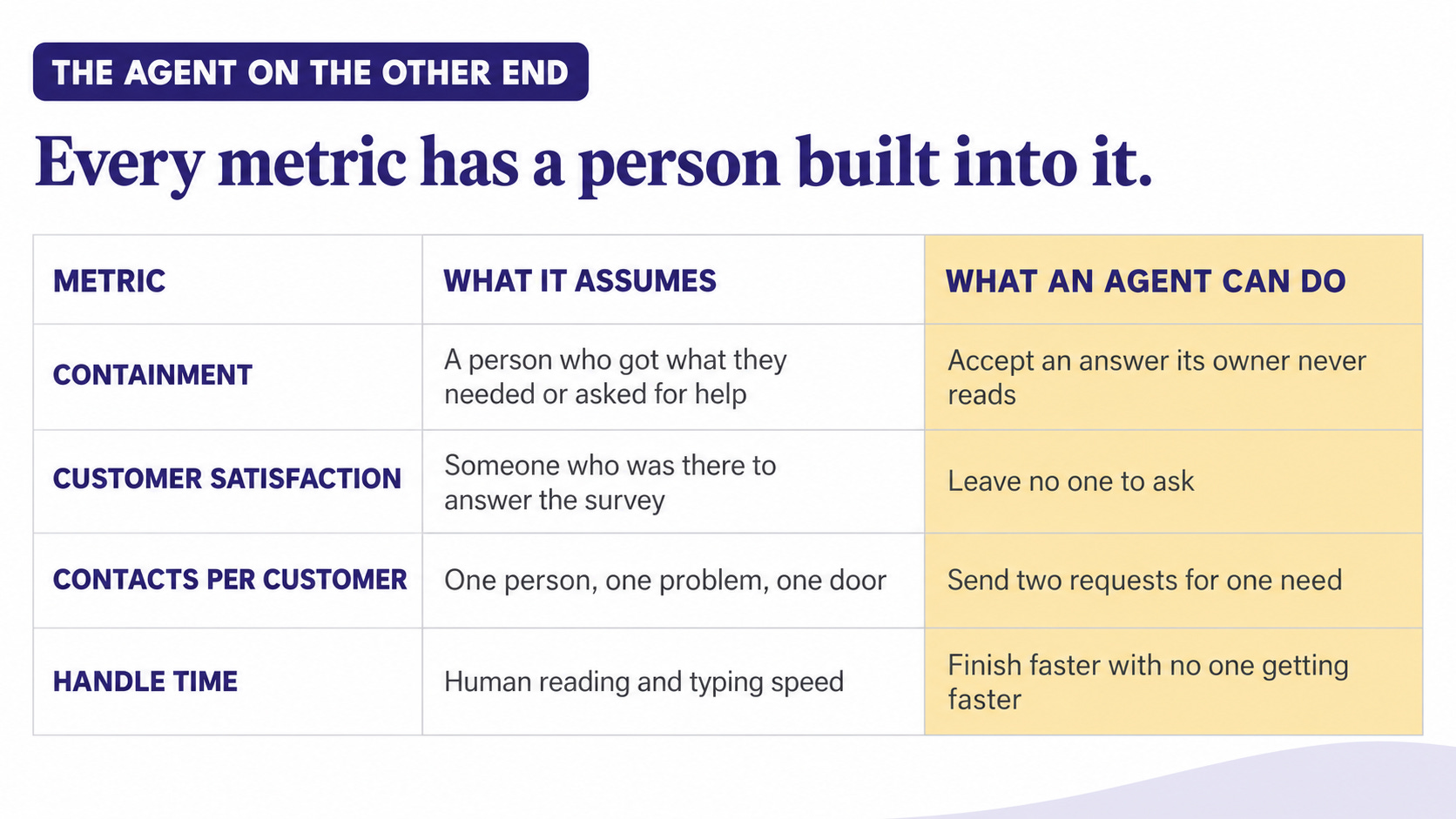
Now look at the tire store from its side of the counter. One customer wanted one thing, and the store received two form submissions, sent two confirmations, and resolved two requests. The column does not say whether the store knew agents had filled out the forms. If it measures contacts per customer or resolutions per week, both numbers went up that afternoon, and neither one means what it appears to mean.
None of these metrics are wrong. They were built for the caller you had. The question is whether you will notice when the caller is different.
Containment Can Rise While Nobody Is Helped
Containment is the metric most exposed, because it can move in both directions for reasons that have nothing to do with your AI.
It can rise with no one helped. A customer’s agent asks your AI a question, receives an answer, and ends the conversation. The ticket closes as solved. Nobody reopens it, because the customer never saw the answer, or saw a summary that left out the part that mattered. Your dashboard counts a contained contact. The customer’s problem is still sitting where it was.
It can fall with everyone helped. A persistent agent gets the right answer, then asks again in different words to confirm it, then asks for a person to confirm it again. Each step reads as dissatisfaction. Your AI answered correctly every time, and the metric still records a failure.
Both errors land in the same place: a tuning backlog full of work on an AI that was never the problem. Teams spend weeks retraining answers that were already right, because the number told them to.
Containment measures what happened between your AI and whoever showed up. It does not tell you who showed up.
Write the Definition Before the Volume Arrives
The defense starts with a definition you can read out loud. In the program I ran, an AI-solved ticket counted as contained only if the customer did not reopen it or open a new ticket, on any channel, within three days of the AI solving it. Anything escalated to a human did not count, no matter how the conversation ended. The rule covered voice as well as chat.
That definition did real work. It stopped the dashboard from counting a closed ticket as a solved problem, and it caught the customer who came back the next morning with the same question, on whatever channel they chose. It was written for people, and for people it held up.
That definition also explains a large part of the dip. Every caller who said “human, human, human” and reached a person was an escalation, and escalations never counted as contained. The bypass did not need to make the AI worse to cut the number. It only needed to route around it.
Now run an agent through it. An agent that retries inside the three days, on any channel, triggers the rule, and the definition correctly records a failure. An agent that waits until day four, or files under an email address that does not match the customer, escapes the window entirely. The definition was not wrong. It assumed the person who came back would be recognizable as the same person.
The escalation rule has the same blind spot in the other direction. Counting every escalation as not contained was the right call when a person asked for help, because a person asks for help when the AI did not give them what they needed. An agent can be set to ask for a person every time, whatever the answer was. Under that rule, every one of those conversations becomes a containment failure your AI did nothing to cause, and your rate falls for reasons that have nothing to do with the quality of its answers.
Every rate on your dashboard needs three things written down: what you count as success, what you count it against, and the window you count in. If any of the three is missing, two teams will read the same number two different ways, and an agent will find the gap between them.
Write those three things for each metric you report upward, and keep them where the people reading the number can see them. Then add a fourth line: what this definition assumes about the person on the other end. That line is the one most teams have never written, and it is the one agents will test first.
Tag the Actor on Every Contact
You cannot measure what you do not record. The single most useful change you can make before agent volume grows is a field on every contact that says who you believe was on the other end.
Keep it simple. Four values cover it:
Human. No signal that anyone other than the customer was involved.
Declared agent. The agent said it acts for the customer, through a published route, a protocol, or a statement in the conversation.
Suspected agent. No declaration, but signals worth recording: a pasted assistant reply, timing no person types at, or a structure that reads like a generated request.
Unknown. Not enough to say. This value matters, because forcing a guess pollutes the other three.
If your team already tags contacts sent by an AI assistant, keep that tag and split it into declared and suspected. The other two values cover every contact the tag leaves out.
Expect the declared value to start near empty. On October 27, I asked four AI assistants to help me reach support at three companies. Across 24 requests to contact a company or cancel something, they offered to act 14 times. Not one said it would tell the company it was an AI acting for me. That is one run per assistant on one date, not a benchmark, and I wrote up the method and full results in “I Asked Four AI Assistants How to Reach My Support. None Cited the File I Built for Them”. It still tells you where most agent contacts will land for now: suspected or unknown. A small declared count is an accurate reading, not a broken tag.
Add two companion fields. The first records how a declared agent identified itself, so you can see which routes agents use. The second records, for any action that moves money or ownership, whether the customer completed a confirmation in a channel you control.
One rule keeps the tag honest. The tag is for measurement, not for treatment. A suspected agent gets the same answers and the same entitlements as anyone else. The tag changes what you report, not how you serve. The moment a tag starts deciding who gets a refund, reps will stop setting it accurately, and your data will be worth nothing.
Then report every core metric split by the tag. Containment for humans and containment for agents are two different numbers that answer two different questions. Blended together, they answer neither.
Blend human and agent contacts into one number and you lose both of them.
The tag does one more job: it tells your quality reviewers which rubric to use. That change matters enough to get its own section.
Grade Agent Conversations on Four Questions
Quality reviewers grade conversations against a rubric built for a person: tone, empathy, clarity, whether the rep acknowledged frustration, whether the customer left feeling heard. Those are the right questions when a person is on the other end. Hand a reviewer a conversation between your AI and a customer’s agent, and half of that rubric has nothing left to measure. An empathy score on that conversation does not tell you the conversation went well. It tells you the reviewer graded the wrong thing.
Grade those conversations on what still matters when nobody on the other side has feelings to manage. Four questions cover it. Score each one pass or fail, not on a scale, because each one describes something that either happened or did not.
1. Was the answer accurate? Check it against your source of truth, not against what sounds reasonable. Accuracy always mattered, but the stakes change when an agent is listening. A person who gets a wrong answer often hesitates, asks again, or calls back. An agent acts on it. It books, cancels, files, or reports back to its owner as fact, and nobody on the customer’s side reads the answer closely enough to catch the mistake before it becomes an action.
2. Did it match the help center, the macros, and the terms word for word? This is a different question from accuracy, and it is the one most rubrics skip. An answer can be correct and still differ from what your help center says, because a rep paraphrased, a macro is out of date, or the AI summarized a policy in its own words. A person rarely notices the difference. An agent compares sources and keeps the version that favors its owner. Fail the conversation if the answer cannot be traced to a published source in the same terms, even when the substance was right.
3. Did a request that moves money or ownership trigger the customer’s own confirmation? Refunds, cancellations, plan changes, payment details, and contact email changes should not complete on the word of whoever holds the session. Pass the conversation only if the confirmation went to a channel you control and the customer completed it before the action happened. If the action completed first and the confirmation followed, that is a fail, however polite the exchange.
4. Did the conversation end the way your policy says it should? A conversation with an agent needs a defined end: the published answer, the decision in writing, and the route to appeal. After that, a repeated request does not reopen it. Fail the conversation if it looped, if the answer changed after the third or fourth ask, or if your side conceded something to end it. Persistence that wins concessions is the failure this question exists to catch.
Those four questions will tell you more about agent-facing quality than any empathy score. Accurate, consistent with your published sources, confirmed by the customer when money or ownership moves, and ended the way your policy says. A conversation that passes all four was handled well, whoever was on the other end.
Notice who these questions grade. They do not grade the customer’s agent. They grade your side: your AI, your reps, and your published sources. The customer’s agent is the stress test. Your conversation either holds up under it or it does not, and these four questions show you which.
Report the result the way you report everything else in this article: split by actor. The share of agent-tagged conversations that pass all four questions is a quality number your leadership has never seen, and it will tell them more about readiness than any containment rate.
One caution applies to these four questions as much as to any scorecard. A Birdie report on QA in financial services, free with registration, argues that most programs spend their effort making sure a scorecard is scored consistently, and almost none checking whether the criteria predict what happens to customers afterward. Birdie sells QA software, so read it as a vendor’s view. The point still holds here. Treat the four questions as a starting rubric, not a proven one. Check them against outcomes you already track, such as repeat contacts, reversed decisions, and complaints, and keep the questions that predict something.
Keep the human rubric for human conversations, and use these four questions for the rest. The actor tag tells the reviewer which one applies. When the tag says unknown, grade on both, because a conversation that passes the four questions and still left a person feeling unheard has a different problem, and you want to see that too.
What This Does to Your Vendor Contract
For the executive reading this, the measurement problem becomes a money problem at renewal.
More support software is sold on outcomes: a price per resolution, a price per contained conversation, a bonus tied to automation rate. Every one of those prices rests on a definition of success that was written for a person on the other end. Kirkpatrick makes the same point about outcome-based pricing: vendors and buyers will need agreed definitions of resolution when an outside assistant starts the request. Today most contracts do not have one.
Read your contract with three questions. Does a conversation that a customer’s agent started and ended count as a resolution you pay for? Does the reopen window in the contract match the one in your own dashboard? Does the vendor’s reporting separate agent-originated contacts from human ones, or will you find out about the shift from your invoice?
Then make three decisions before the next renewal. Require the vendor to report core metrics split by actor. Write your resolution definition into the contract, including the window and how agent-initiated contacts count. And when containment jumps or satisfaction drops, check the actor mix first, before anyone funds a tuning project.
Decision rule: when a core metric moves more than you expected, read the actor split before you read the AI. If the mix of humans and agents changed, the AI may not have.
The staffing model is next. Most AI business cases convert containment into hours not worked by people. If part of that containment is an agent accepting answers its owner never reads, the hours come back later as a second contact, and the staffing plan built on the first number is short. Ask whoever owns the forecast which containment number it uses, and whether that number has ever been split by actor.
Plan for volume to go up, not down. This is a planning assumption, not a measured result: agents lower the cost of asking. The customer who would never spend an afternoon disputing a small fee will let an agent do it for them, and the agent will not stop at one try. Budget for more contacts per customer, not fewer, until your own tagged data says otherwise.
Five Days to an Honest Dashboard
This does not need a data team or a new tool. It needs a week, a sample, and the people who read the numbers.
Monday: Pull one hundred recent contacts across chat, email, and voice. Read each one and set the actor tag by hand: human, declared agent, suspected agent, or unknown. Count each value. That is your first look at the mix.
Tuesday: Write the definition for each metric you report upward: what counts as success, what you count it against, and the window. Add the fourth line: what the definition assumes about the person on the other end.
Wednesday: Recalculate containment and satisfaction for the sample, split by tag. Note where the human and agent numbers differ, even with small counts. The difference tells you which definitions will break first. Then grade every conversation tagged declared or suspected agent on the four questions, pass or fail.
Thursday: Add the actor field and the two companion fields to your ticket form. Draft the request to your vendor for reporting split by actor, and mark the contract clauses that define resolution.
Friday: Set the baseline: the share of contacts tagged as declared agent and the share tagged as suspected agent, reported separately. Expect the declared share to start small. Record it anyway, because it is the number that should grow once you publish a route for agents to declare through.
The Monday hand count is the step teams skip, and it is the one that makes the rest believable. One hundred contacts read by a person will tell you more about who is on the other end than any detector.
The Next Caller Will Not Say Human
The dip taught us that a number can fall because the caller changed. Our callers told us what they were doing, in plain words. They said “human, human, human,” and we tuned the handoff to meet them.
The next caller will not say anything that obvious. It will be polite, fast, and patient. It will accept an answer its owner never reads, or ask the same question five ways until it gets the one it wants. Your dashboard will move either way, and unless you have tagged who called, it will look like your AI did it.
A metric that cannot tell you who was on the other end cannot tell you what changed.
If containment rose five points next month, how would you know whether a person or an agent was on the other end?
Keeping the tag for measurement and not for treatment is the rule I'd copy. It mirrors the agent side of this: if an agent logs in as the person who started it, the log can't tell you who acted either. Your near-empty declared bucket fits what I see, since most agents still arrive on a person's login.