


INTRO
Part 1 defined the role of AI.
Part 2 focused on picking the right use cases.
Part 3 trained agents on prompting without turning them into prompt engineers.
Part 4 covered measurement, so outcomes stay tied to customer reality.
Part 5 covers change management, so adoption sticks as scope expands.
Part 6 covers governance.
So quality stays stable once AI becomes normal work.
So ownership stays clear when something breaks.
So the system improves without burning out your leads.
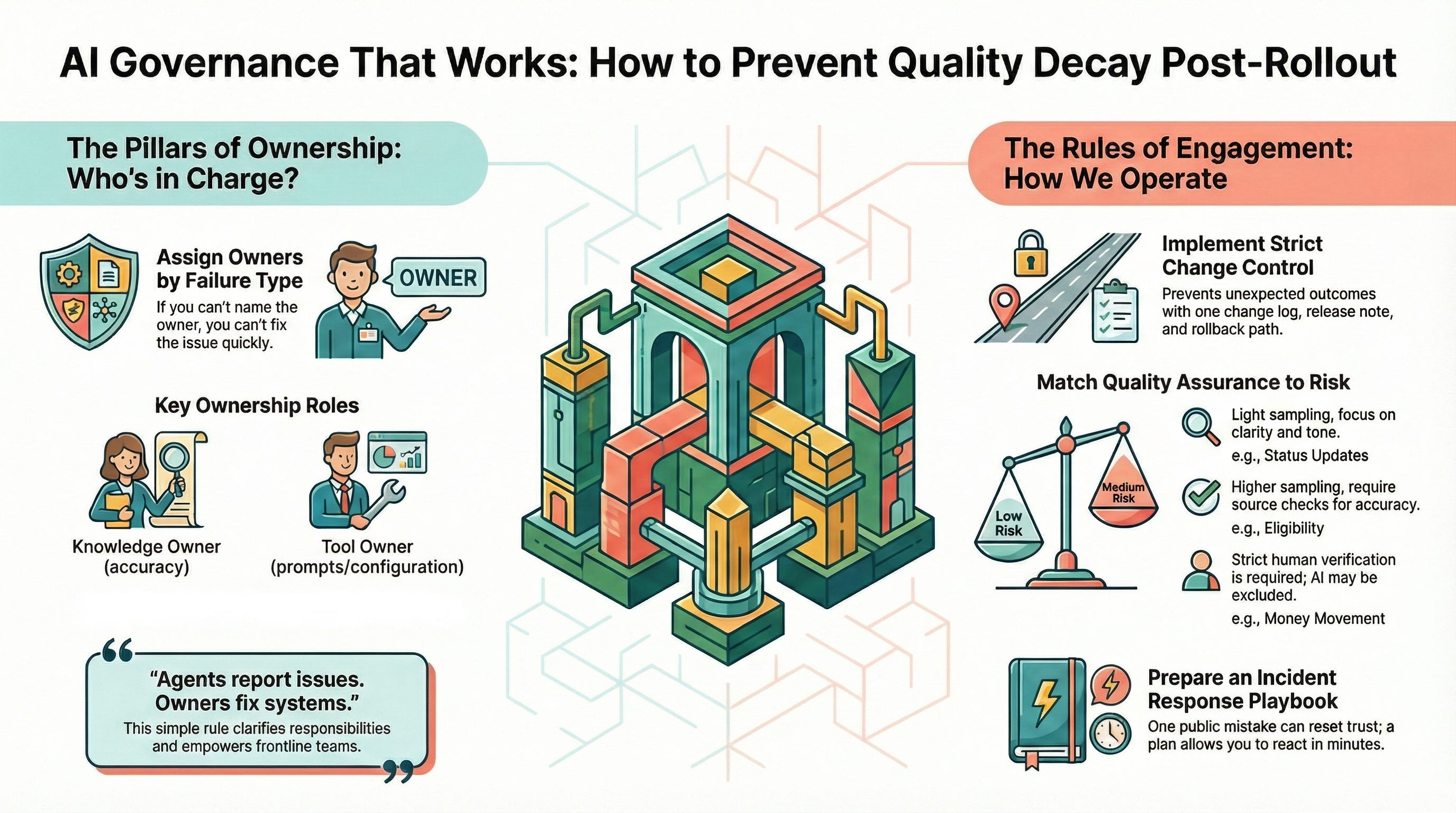
AI GOVERNANCE SNAPSHOT
The goal
Ensure quality stays stable, ownership remains clear when things break, and the system improves without burning out leads.
THE CORE OWNERSHIP MAP
Why this matters
If you cannot name the owner, you cannot fix the issue fast.
Slow fixes train people to avoid the system.
Quality drifts.
Policies age.
Workarounds spread.
Leads become cleanup crews.
Agents stop trusting output.
Governance prevents that decay.
What governance solves
Clear ownership.
Clear decision rights.
Clear change control.
Clear QA rules tied to risk.
Fast incident response.
ROLE AREA OF OWNERSHIP
The golden rule
Agents report issues. Owners fix systems.
Core roles
Support Ops Owner
Own workflows, routing, tags, reporting, and release notes.Knowledge Owner
Own accuracy, freshness, structure, and updates tied to policy.QA Owner
Own sampling, scoring, calibration, and coaching themes.Tool Owner
Own configuration, prompts, guardrails, and integrations.Engineering Partner
Own reliability, logging, permissions, and data pipelines.Support Leadership
Own risk acceptance, red zones, escalation paths, and resourcing.Frontline Leads
Own coaching and surfacing patterns from the floor.
DECISION RIGHTS AND CHANGE CONTROL
Why this matters
Teams stall when nobody knows who decides.
Change control prevents debugging ghosts.
Set decision rights in writing.
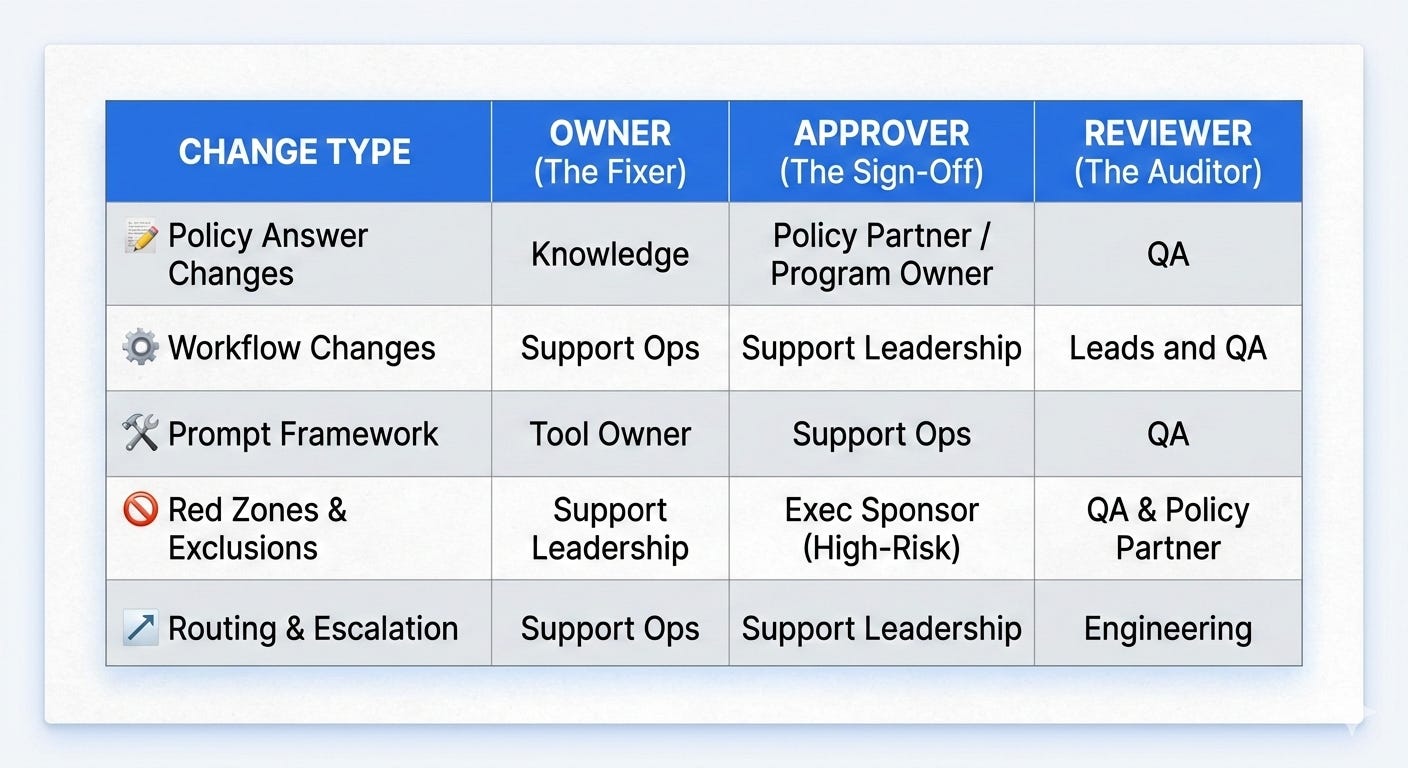
Decision rights examples
Policy answer changes
Owner: Knowledge
Approver: policy partner or program owner
Reviewer: QAWorkflow changes
Owner: Support Ops
Approver: Support leadership
Reviewer: Leads and QAPrompt framework changes
Owner: Tool Owner
Approver: Support Ops
Reviewer: QARed zones and exclusions
Owner: Support leadership
Approver: exec sponsor for high-risk changes
Reviewer: QA and policy partnerRouting and escalation logic
Owner: Support Ops
Approver: Support leadership
Reviewer: Engineering
CHANGE CONTROL
Why this matters
AI outcomes shift from small edits.
One macro update changes tone.
One article rewrite changes retrieval.
One routing tweak changes who gets what.
Without change control, you debug ghosts.
Change control rules
One change log.
One release note.
One rollback path.
Minimum change log fields
Date.
Change.
Owner.
Reason.
Risk tier.
Queues and audiences impacted.
Validation plan.
Rollback plan.
Release cadence
Weekly releases for normal work.
Same-day changes only for incidents.
QUALITY CONTROL BY RISK
Why this matters
More QA is not the answer.
Smarter QA is the answer.
Risk tiers
Low risk
Navigation help, status updates, simple clarifications.Medium risk
Eligibility explanations, documentation guidance, multi-step workflows.High risk
Money movement, appeals, identity changes, legal exposure.
QA actions by tier
Low risk
Light sampling, focus on clarity and tone.Medium risk
Higher sampling, require source checks.High risk
AI stays out, or strict human verification with escalation rules.
One habit to enforce
No unsourced certainty.
If policy language matters, cite the source or escalate.
KNOWLEDGE GOVERNANCE
Why this matters
AI quality tracks knowledge quality.
If the knowledge base drifts, AI drifts.
What breaks knowledge
Policy updates.
State-specific exceptions.
Seasonal deadlines.
New forms.
Internal workflow changes.
Operating rules
One owner per topic cluster.
Weekly review of top intents and gaps.
Freshness checks during peak weeks.
Retire outdated macros, do not leave landmines.
Minimum standards for AI-ready content
Clear titles.
One task per article.
Short sections.
Examples and edge cases.
Last updated date.
Source links for policy claims.
INCIDENT RESPONSE
Why this matters
One public mistake resets trust fast.
You need a playbook that moves in minutes and keeps damage small.
Incident triggers
Repeated wrong answers on one topic.
Tone failures with stressed audiences.
Escalations spiking tied to AI output.
QA flags a policy mismatch.
Incident playbook
Freeze the failing use case.
Post a stop-use message to the team.
Deploy a workaround macro.
Assign an owner and next update time.
Run a targeted QA sweep.
Ship the fix with a release note.
Reopen only after validation.
A rule worth repeating
Transparency beats optimism.
MEASUREMENT THAT SUPPORTS GOVERNANCE
Why this matters
Metrics need owners.
If nobody owns a metric, nothing improves.
Governance metrics
Rework rate on AI-assisted work.
Escalation rate tied to AI misses.
Top knowledge gaps by intent.
Time to close feedback issues.
QA fail themes by risk tier.
Agent confidence pulse trend.
Tie each metric to an owner.
If you cannot, delete the metric.
30, 60, 90 DAY GOVERNANCE PLAN
Why this matters
Governance fails when it becomes “extra work.”
A timeline makes it real.
30 DAYS, STOP THE DRIFT
Goal
Stop drift. Clarify ownership.
Deliverables
Ownership map published.
Decision rights documented.
Change log started.
Risk tiers defined.
Incident playbook published.
Weekly release notes started.
60 DAYS, NORMAL OPERATIONS
Goal
Make governance normal operations.
Deliverables
Monthly QA calibration running.
Knowledge gap loop running.
Metric owners assigned.
Top failure modes documented with fixes.
Rollback process tested once.
90 DAYS, SCALE QUALITY
Goal
Scale without losing quality.
Deliverables
Quarterly risk review cadence set.
Red zones reviewed and updated.
Expansion checklist finalized.
Governance work staffed and scheduled.
TAKEAWAY
Governance keeps quality stable after rollout.
Ownership prevents blame games.
Decision rights prevent debate.
Change control prevents drift.
Risk-based QA protects customers and agents.
Incident playbooks protect trust.
NEXT
Part 7 covers scaling.
How you expand across queues, audiences, and states without rebuilding the system every time.