


Most teams stop at rollout.
They track usage.
They celebrate volume.
Then quality drifts, trust drops, and the tool becomes background noise.
Ownership prevents drift.
Ownership means support sets the rules, runs the backlog, ships improvements on a cadence, and proves outcomes.
Why AI rollouts stall after launch
AI does not fail because the model is weak.
AI fails because teams treat output quality like a one-time setup.
Common failure patterns:
Feedback has no home.
Agents mention issues in Slack, then move on.No decision rights.
Nobody knows who can approve what.No cadence.
Fixes happen in bursts after incidents.No change log.
Agents do not see improvements, trust stays low.Success is measured by usage.
Usage hides drift, rework, and wrong escalations.
If you want stable AI, treat AI like an operational surface.
Backlog. Owners. Reviews. Releases.
What AI ownership means in support
AI ownership means your support org owns four things:
Quality.
Scope.
Change.
Proof.
Quality
Support defines what “good” looks like per use case.
Support owns the QA loop.
Scope
Support defines what AI should do and what AI should never do.
Support maintains red zones and exclusions.
Change
Support runs the backlog and ships improvements every week.
Support publishes changes.
Proof
Support ties AI work to outcomes.
Less rework. Better routing. Better containment. Better handle time.
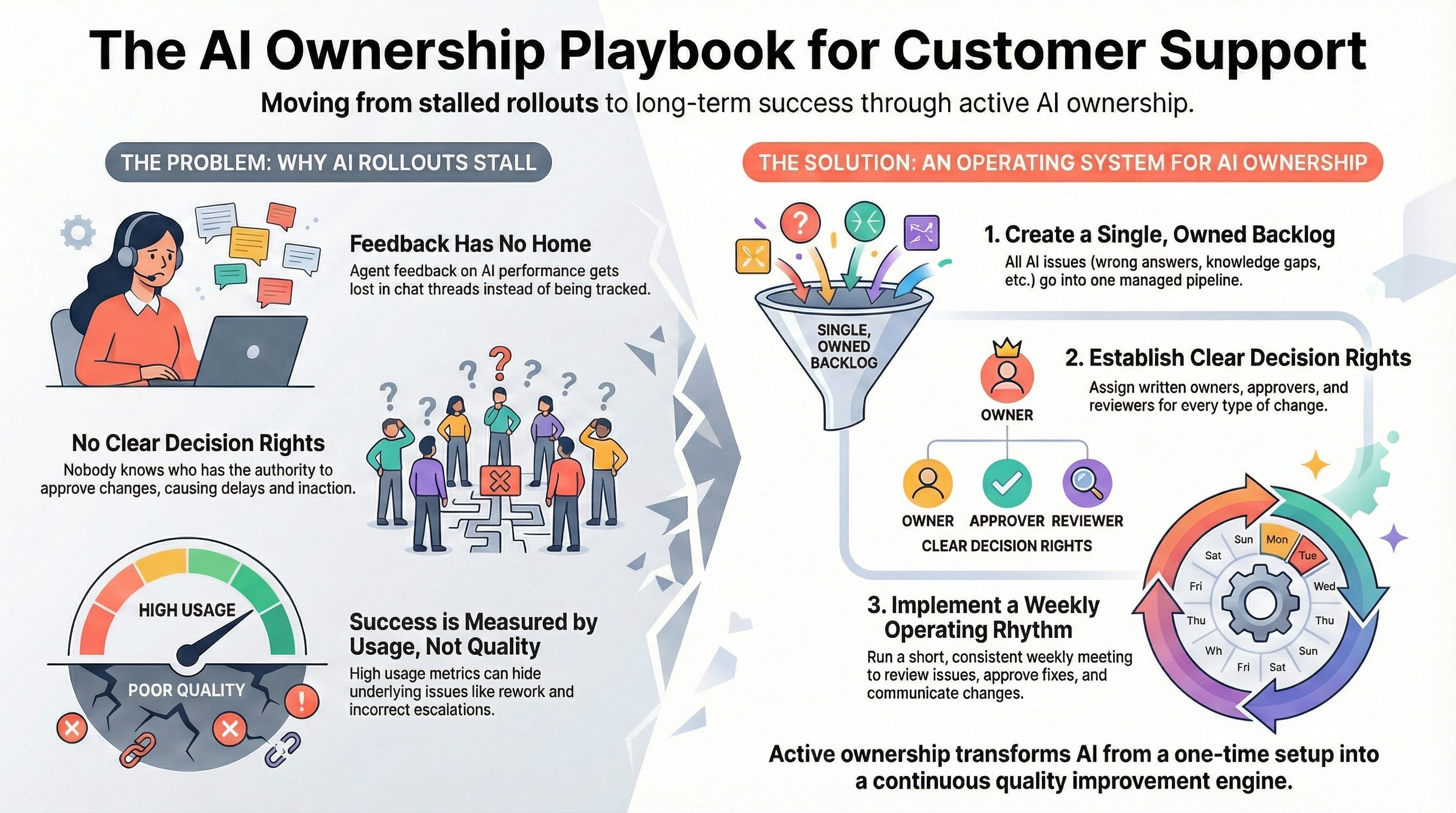
The operating system: what you must put in place
One backlog
One list. One owner.
Every issue goes into the same pipeline:
• Wrong answer
• Missing intent
• Bad escalation
• Bad summary
• Broken workflow step
• Knowledge gap
If feedback lives in chat threads, feedback dies in chat threads.
A fast intake path for frontline teams
Agents need a low-friction way to flag problems.
Use one tag or one form.
Recommended fields:
• Reference ID (ticket ID, conversation ID, call ID)
• Channel (chat, voice, email assist, knowledge search)
• What happened (one sentence)
• Risk level (green, yellow, red)
• Expected behavior (one sentence)
• Link to transcript, recording, or snippet
If you make agents write a paragraph, you lose signal.
Decision rights, written down
Speed without controls breaks trust.
Controls without speed stop improvement.
Assign decision rights by change type:
Knowledge answer changes
Owner: Knowledge
Approver: Policy partner or program owner
Reviewer: QA
Workflow changes
Owner: Support Ops
Approver: Support leadership
Reviewer: Leads and QA
Prompt framework changes
Owner: Tool owner
Approver: Support Ops
Reviewer: QA
Red zones and exclusions
Owner: Support leadership
Approver: Exec sponsor for high-risk topics
Reviewer: QA and policy partner
Routing and escalation
Owner: Support Ops
Approver: Support leadership
Reviewer: Engineering
This removes ambiguity.
This also removes politics, which is rare and beautiful.
A weekly operating rhythm
One meeting. Same agenda. 30 to 45 minutes.
Agenda:
• Top 10 issues by risk
• Repeat patterns, items seen 3+ times
• Approvals needed, unblock list
• Changes shipping this week
• One training note for agents
Boring on purpose.
Stable on purpose.
A 90-day ownership loop
Days 1–30: Stabilize
Goal: remove obvious failures.
Work:
• Stand up intake tag or form
• Define red zones and auto-escalation topics
• Fix the top recurring failures
• Publish a weekly change log
Outputs:
• Weekly release notes to the team
• A short QA checklist for high-risk topics
Days 31–60: Expand with control
Goal: grow coverage without raising risk.
Work:
• Add missing intents
• Tighten routing rules
• Close top knowledge gaps based on real conversations
• Add guardrails for sensitive topics and money movement
Outputs:
• Updated intent list
• Updated workflows and knowledge set
• One weekly training snippet tied to shipped changes
Days 61–90: Prove outcomes
Goal: tie work to outcomes, not usage.
Track:
• Reopen rate on AI-assisted resolutions
• Escalation accuracy, right team, right urgency
• Handle time movement on assisted workflows
• Knowledge deflection performance by article
Outputs:
• Weekly summary showing fewer repeats, fewer corrections, fewer touches
A real feedback loop example
Problem
Escalation happens too late on identity verification edge cases.
Signal
A spike in AI Fix submissions with the same pattern.
Fix package
• Add a new intent for the edge case
• Add an early escalation rule
• Update the knowledge article with the exact wording agents see
• Update the human handoff macro
Close the loop
• Post the change log entry
• Share one training note
• Monitor repeats for one week
Ownership turns incidents into improvements.
No heroics required.
Templates to copy
Template 1: AI Fix intake
Title: AI Fix
Fields:
• Reference ID
• Channel
• What went wrong
• Risk level
• Expected behavior
• Link to transcript or snippet
Template 2: Weekly AI review notes
Date:
Attendees:
Shipped this week:
Queued next:
Approvals needed:
Training note:
Metrics to watch:
Template 3: Change log entry
Change:
Reason:
Risk level:
Owner:
Approver:
QA check:
Ship date:
Agent impact:
Series wrap
This series focused on one outcome.
Adopt AI in support without losing trust, speed, or quality.
Part 1: Define the role
Set a charter. Define what AI owns and what humans own.
Part 2: Choose the right use case
Start where value and risk align. Avoid demo-first rollouts.
Part 3: Teaching agents
Teach prompting as a work skill. Build repeatable patterns.
Part 4: Measure AI like operations
Measure outcomes per use case. Track drift, escalation accuracy, and rework.
Part 5: Change management
Roll out in sequence. Train, coach, and protect trust through guardrails.
Part 6: Governance
Assign owners, approvers, reviewers. Keep quality stable as scope expands.
Part 7: Ownership
Turn AI into an operational surface with backlog, cadence, and release notes.
Call to action
Assign an owner this week.
One person owns the AI backlog and weekly review.Stand up the AI Fix intake.
One tag or one form. Make submission easy.Publish a weekly change log.
One paragraph per change. Tie each change to risk and outcome.
If this series helped, share Part 7 with one support leader who owns Support Ops, QA, or tooling.
Subscribe for future posts on escalation design, multilingual accuracy, and reporting structures for exec reviews.