


Quick takeaways
Keep rollups small, keep operational intents governed
Define scope with inclusions and exclusions
Tie every intent to an action
Log every taxonomy change, protect trend lines
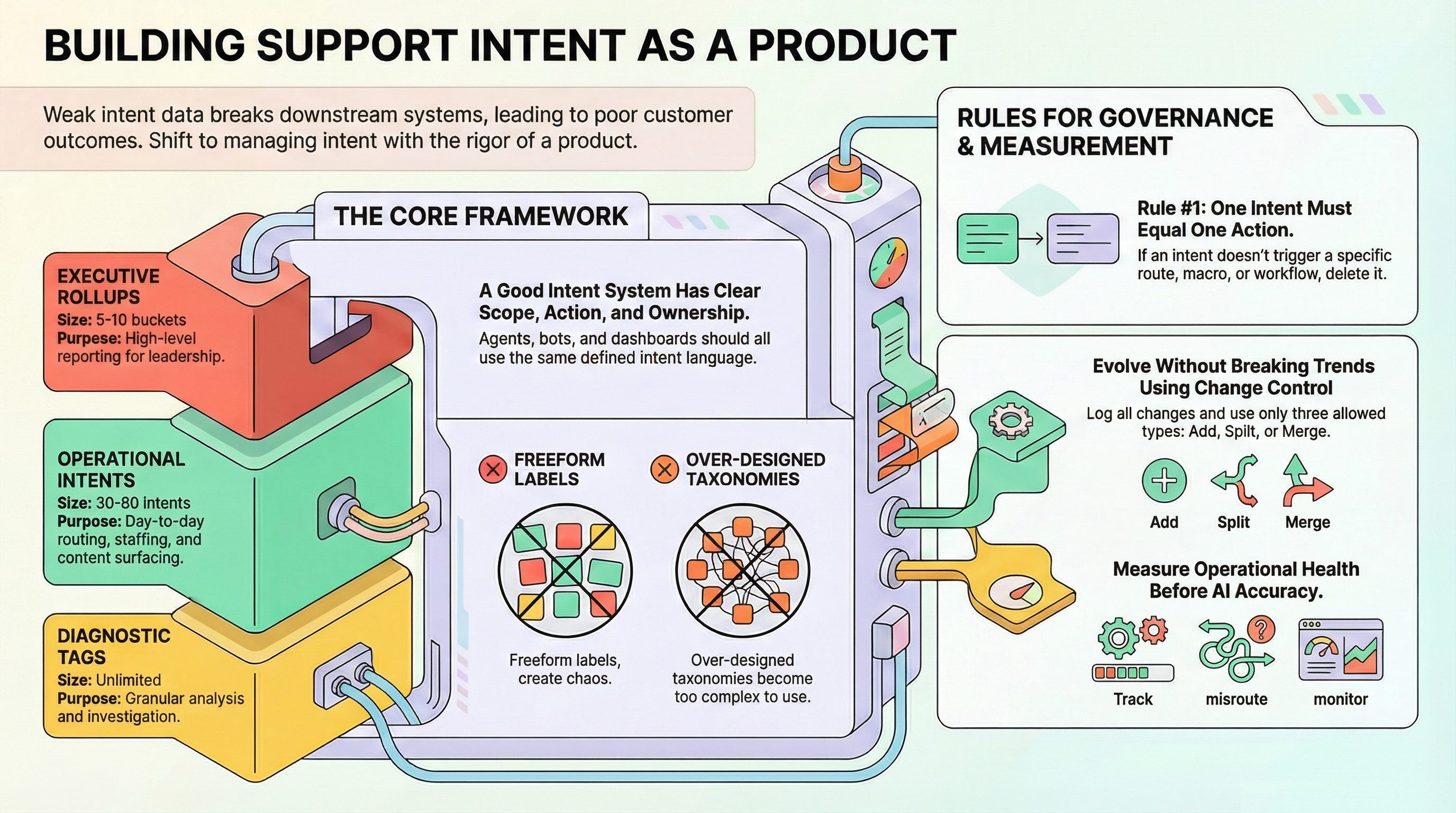
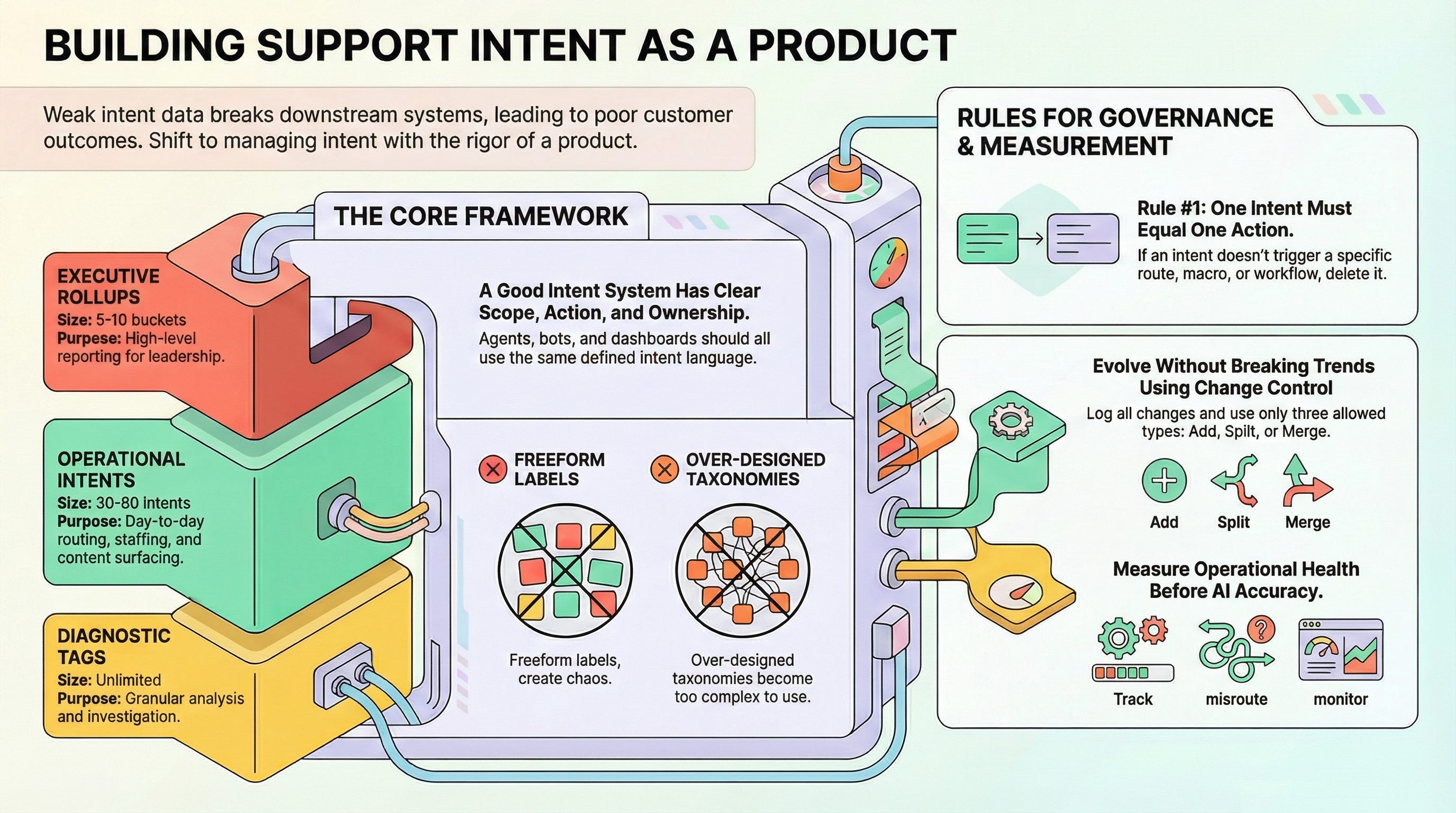
Building support intent as a product. Three layers, governance, measurement.
Why this matters
If your intent data is weak, everything downstream breaks.
Routing drifts.
QA wastes time.
Your knowledge backlog turns into noise.
Your AI metrics look good while customers get worse outcomes.
Most teams treat intent as a reporting label.
You need to treat intent as a product.
What “good” looks like
An agent, a bot, and a dashboard all use the same intent language.
Each intent has a definition.
Each intent has in-scope and out-of-scope examples.
Each intent has an owner and a review cadence.
You can change the taxonomy without breaking trend lines.
Your goal is not a perfect taxonomy.
Your goal is stable decision-making.
The two failure modes
Freeform labels
Agents type anything. AI guesses anything. Reporting becomes fiction.Over-designed trees
You build 200 intents. Nobody remembers them. “Other” wins every week.
You want a small, governed set.
Then you grow it with change control.
The operating model
Intent data has three layers.
Layer 1. Executive rollups
5–10 buckets.
This is for leaders.
Layer 2. Operational intents
30–80 intents.
This is for routing, staffing, and content.
Layer 3. Diagnostic tags
Unlimited.
This is for investigation, not routing.
If you mix these layers, you lose both clarity and control.
Start with the 30–50 that matter
Pull 6–12 weeks of tickets.
Rank by volume.
Add the top escalations.
Add the top drivers of repeat contacts.
Stop there.
If you cannot name the owner for an intent, you do not ship the intent.
Intent naming rules
Keep names short.
Use verbs for actions.
Use nouns for objects.
Avoid internal team names.
Bad
Billing Team Issue
Portal Bug
Needs Help
Good
Payment, Refund Request
Login, Password Reset
Application, Proof Of Identity
One intent must equal one action
Every intent should trigger at least one of these outcomes.
Route to the right queue.
Offer the right macro.
Surface the right article.
Prompt the right AI workflow.
Start the right follow-up task.
If an intent does not change an action, delete it.
Scope is the whole game
Define what the intent includes.
Define what it excludes.
Add three examples of each.
If you skip exclusions, your “accuracy” fails in silence.
Governance, who owns change
You need three roles.
Owner
Writes the definition. Owns outcomes.
Approver
Signs off on changes. Protects stability.
Reviewer
Audits quality and drift. Flags risk.
Keep governance boring.
Boring scales.
Change control, how to evolve without breaking trends
Taxonomies change. Your reporting still needs continuity.
Use versioning.
Keep a change log.
Do not rename without a mapping note.
Three allowed change types
Add
New intent, new definition, new examples.Split
One intent becomes two. Document the split date and mapping.Merge
Two intents become one. Document the merge date and mapping.
One forbidden change
Silent edits.
If you edit a definition without logging the change, your trend line becomes a lie.
Measurement that matters
Do not start with “AI accuracy.” Start with operational health.
Track these weekly
Unclassified rate
Misroute rate
Reopen rate by intent
Repeat contact rate by intent
Top intent drivers by channel
Then track these monthly
Intent drift, percent of tickets that move intents week to week
Intent sprawl, number of intents created vs retired
Coverage, percent of volume covered by the top 30 intents
If unclassified rises, your taxonomy is failing.
If misroute rises, your definitions are failing.
If repeats rise, your knowledge and workflows are failing.
A concrete example
Intent
Login
Password Reset
Definition
User cannot access account due to credential issues
In scope examples
Forgot password
Password reset link fails
Account locked after attempts
Out of scope examples
Cannot find application in account
Two accounts with two emails
Error after login during submission
Primary action
Route to Tier 1
Serve macro with reset steps
Show reset article
Escalate if locked out after verified steps
Owner
Support Ops
Approver
Support Leadership
Reviewer
QA
This is what “intent as a product” looks like.
Clear scope. Clear action. Clear ownership.
Template you can copy and use
INTENT TAXONOMY SPEC
Intent name
Definition
Primary action
Escalation rule
Owner
Approver
Reviewer
Last reviewed date
In scope examples
1.
2.
3.
Out of scope examples
1.
2.
3.
Required data fields
What fields must exist on the ticket for this intent to be useful.
Related knowledge
Articles that must stay accurate for this intent to succeed.
Monitoring signals
What metrics you watch for drift or failure.
CHANGE LOG
Date
Change type, Add, Split, Merge
Intent(s) impacted
Reason
Owner
Approver
Version
How to implement in 14 days
Day 1–2
Pull ticket sample. Rank top reasons.
Day 3–5
Draft 30–50 intents. Write definitions and exclusions.
Day 6
Assign owners. Set review cadence.
Day 7–10
Run in parallel with your current labels. Do not cut over yet.
Day 11–14
Review unclassified and misroutes. Fix definitions. Fix training data. Fix routing rules.
Then cut over.
Keep the change log from day one.
Call to action
If you lead support, build your intent system before you buy your next AI feature.
Next part covers Knowledge Ops, the loop that keeps AI answers stable as policies and workflows change.