


If you missed Part 8, read it here: AI Ops, Part 8: The AI Release Train.
If you are new to the series, start with Part 1: https://1fernandoduarte.substack.com/p/ai-ops-for-support-leaders-part-1
It was launch morning.
A little after 8:00 a.m., the queue was already moving faster than normal. Two programs had opened on the same day. New rules. New customer questions. New escalation paths. The kind of morning where every polished workflow looks solid for about fifteen minutes.
Then one of the answers came back wrong.
Not obviously wrong. Worse than that. Calm, polished, plausible. The kind of answer that makes a customer trust it and makes an agent hesitate for a second before challenging it.
A lead pasted the screenshot into chat.
Another agent said they had seen something similar in a different queue.
Someone from operations asked whether this was isolated or systemic.
Someone else asked whether the AI flow should stay live.
Engineering wanted examples.
Support wanted guidance.
Leadership wanted to know whether customers were already affected.
The wrong assumption was simple. We thought the hard part was launch.
The real hard part was deciding, in the middle of a live day, who owned the problem now, who owned the pattern behind it, and who owned the next change before it shipped.
That was the moment the job became clear.
What changed
Most teams still treat AI support failures like isolated defects.
They are not. They are operating failures. The issue is rarely one bad answer by itself. The issue is the missing system behind the answer. No containment path. No weekly learning loop. No release discipline. No clean handoff between them.
That is why good teams still look chaotic under pressure. They have pieces. They do not have an operating system.
By the end of this post, you will have a simple way to run AI support across three clocks: what needs containment now, what needs diagnosis this week, and what earns a controlled change in the next release.
The rule to steal early
Most AI issues get worse because teams mix three kinds of work into one messy conversation.
They try to contain the incident, diagnose the pattern, and debate the long-term fix all at once. That is how a live issue turns into theater.
The better move is simple.
Every AI failure must be assigned to one of three clocks: now, this week, or next release.
On that launch morning, the screenshot in chat did not need a philosophy debate. It needed a clock.
The immediate question was whether the current flow stayed live.
The weekly question was whether this was a one-off or part of a broader pattern.
The release question was what change would ship, under what test, with what rollback rule.
Once the team separated those clocks, the noise dropped. The incident desk handled containment. The quality loop handled diagnosis. The release train handled change.
Example version
Now:
Pause the live response for this intent. Route new cases to human review. Publish one internal guidance note for agents before the next customer reply goes out.
This week:
Review every similar case. Classify the failure type. Check source material, routing logic, and prompt behavior. Decide whether the root cause is knowledge, workflow, policy, or system behavior.
Next release:
Ship one fix with a named owner, test evidence, release date, and rollback trigger. Review results after launch.
Blank version
Now:
Name the issue. Set severity. Decide whether the AI stays live, moves to safe mode, or routes to human review. Publish one internal instruction for the frontline.
This week:
Collect similar examples. Classify the failure pattern. Identify the owner and the root cause category. Decide whether the issue belongs to knowledge, workflow, policy, or system behavior.
Next release:
Define the change. Set the risk tier. Confirm the test method. Assign the approver. Set a rollback trigger. Review the result after release.
This looks almost boring on paper. Good. Boring is what you want when the system is live and people are improvising.
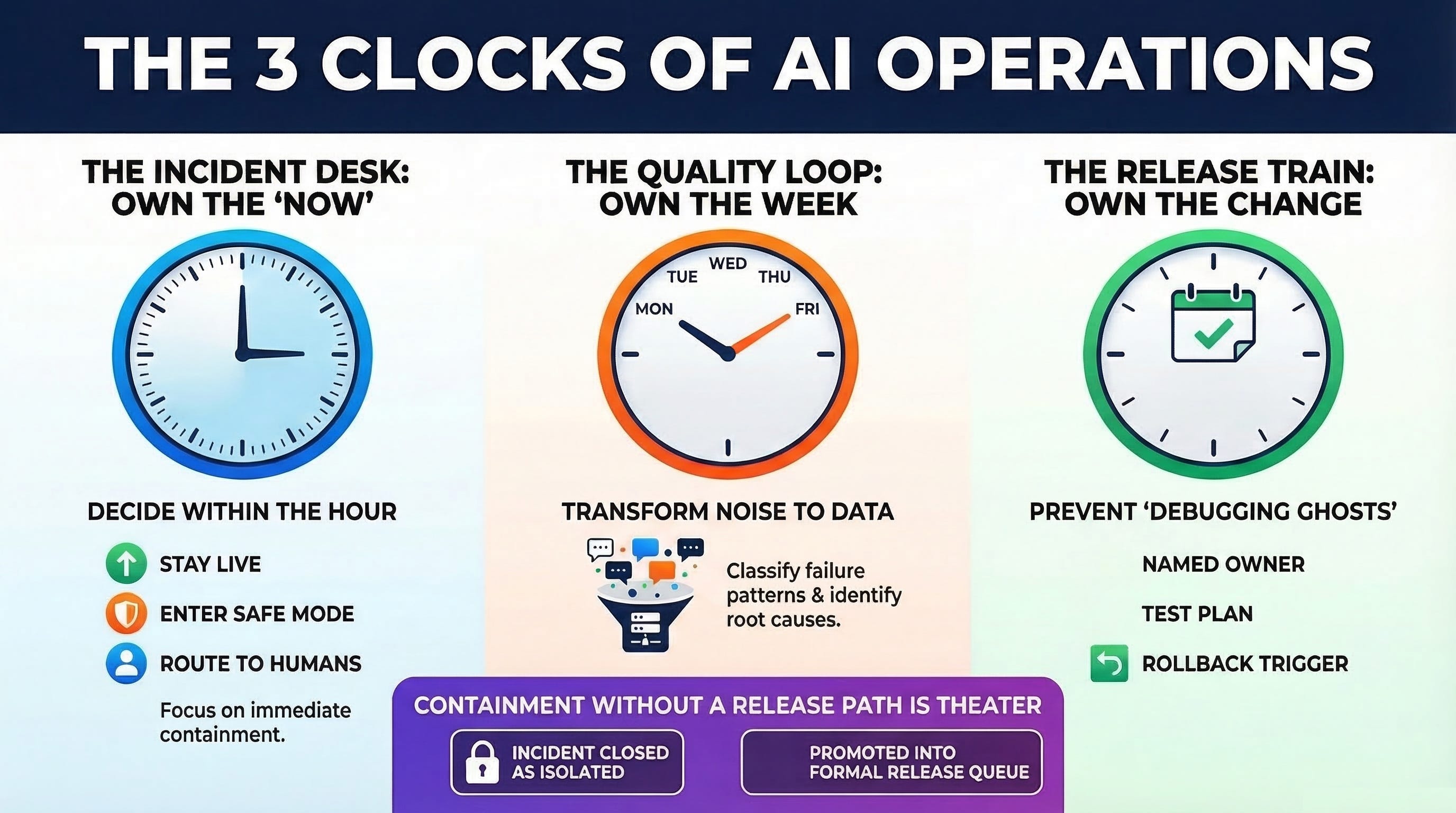
The operating model
Incident desk
The incident desk owns the present tense.
Its job is not deep analysis. Its job is containment. When something high-risk shows up, this team decides what happens in the next hour. Keep it live. Move to safe mode. Route to humans. Publish internal guidance. Start an evidence trail.
That matters because customers do not care whether your internal teams need more time to align. The system is already live. The response has to be real.
In practice, the incident desk works best when it follows a short verification pattern. Intent. Risk tier. Sources checked. Critical fields verified. Redaction check. That private note becomes the receipt for judgment, not a decorative ritual people ignore after week two.
Quality loop
The quality loop owns the week.
Its job is to turn repeat pain into structured improvement. One screenshot in chat is an interruption. Three similar failures are a pattern. That pattern needs intake, classification, ownership, and follow-through.
This is the part most teams skip because they confuse visibility with learning. A few angry Slack messages feel like awareness. They are not. If feedback lives in chat, feedback dies in chat.
The weekly loop is where support stops being a cleanup crew and starts acting like an operating function. Wrong answers, missing intents, bad handoffs, weak summaries, broken routing, stale content. One intake. One backlog. One owner per issue.
Release train
The release train owns change.
Its job is to keep teams from debugging ghosts. AI systems shift from small edits. One article rewrite changes retrieval. One macro change shifts tone. One routing tweak changes who gets what. One prompt update changes escalation behavior. Without release discipline, nobody knows which change moved the outcome.
This is why release train matters more than people admit. Teams love saying they are moving fast. Then they spend a week arguing over which update caused the problem.
A good release train forces basic adult behavior. Risk tier. Test plan. Approval path. Release window. Rollback trigger. Post-release check.
The opening scene only gets calmer when these three parts work together.
Back on launch morning, the system did not stabilize because someone had the best opinion in chat.
It stabilized because the work got separated.
The incident desk handled the live decision.
The quality loop prepared the weekly diagnosis.
The release train took ownership of the change path.
That is the hidden advantage of this model. It protects time.
Without it, your best people do all three jobs at once. They contain incidents in public. Diagnose root cause in fragments. Argue for fixes with no clean evidence. Then leadership wonders why the same names look exhausted every quarter.
The hard part people miss
Most teams think the failure is the bad answer.
It is not.
The failure is the broken handoff between containment, learning, and release.
Here is what that looks like in real life.
A lead catches a risky answer and flags it.
The issue gets contained for the day.
Everyone agrees it looked serious.
Then nobody turns it into a weekly pattern review.
No owner gets assigned.
No one decides whether the root cause was knowledge, routing, policy, or prompt logic.
A fix gets mentioned.
A different urgent issue shows up.
The fix never enters a real release queue.
Two weeks later, the same problem returns wearing a slightly different shirt.
That is not an AI quality issue. That is operational drift.
This is the contrarian truth most teams resist: containment without a release path is theater.
You feel busy.
You look responsive.
Nothing gets safer.
The fix is not more vigilance. Humans are already exhausted enough. The fix is one operating rule. Every contained incident must end in one of two places by the weekly review: closed as isolated, or promoted into the release queue with a named owner and a test path.
Monday morning plan
Name the three owners.
Assign one incident lead, one quality owner, and one release owner. If one person covers two roles for now, fine. Name it anyway.Create one intake path.
Every AI issue, from wrong answer to bad handoff to stale knowledge, enters the same pipeline. No side channels. No “I dropped it in chat.”Use the three-clock rule.
For every issue, decide what belongs to now, this week, and next release. Write it down in that order.Set one weekly review.
Pick the day. Keep it. Review new issues, repeat patterns, shipped fixes, and open risks. This is the quality loop.Set one release cadence.
Weekly or biweekly is fine. The point is not elegance. The point is that changes stop shipping as random acts of optimism.Track four measures.
Time to containment.
Repeat incident rate.
Change success rate.
One trust metric tied to customer reality, such as misroute rate or repeat contact rate.Define failure behavior.
When a high-risk issue appears, decide in advance what safe mode means. Human review. Routing change. Macro removal. Feature pause. Pick the actions before the next incident chooses for you.Review one month later.
Ask four questions. Which issues repeated. Which fixes stuck. Which owners were overloaded. Which workflow still creates avoidable risk.
What this changes for support leaders
This model changes the role of support.
Support stops being the place where broken experiences go to wait. It becomes the place where weak signals are caught early, risk is contained fast, patterns are translated into action, and change gets shipped without chaos.
That is also why the people side matters. As routine volume falls, the work that remains gets harder. The edges become the job. The customer emotions sharpen. The blast radius grows. Lower volume is not always a win. Sometimes it is a risk signal.
That is why Part 10 has to tie the system together.
The incident desk protects the hour.
The quality loop protects the week.
The release train protects the next change.
Together, they protect trust.
Close
I still think about that launch morning.
Not because the system failed. Every system fails somewhere. I think about it because the real question was never whether AI made one wrong call.
The real question was whether we had an operating system strong enough to catch it, learn from it, and change the next release before customers paid twice.
That is the job.
Which of these is weakest in your org today: incident containment, weekly quality review, or release discipline?
Series map
Read Part 8: The AI Release Train
Read Part 2, The AI Quality Loop
Read Part 4, Risk, Privacy, and Hallucinations
Read Part 6, Governance
Start with Part 1