


If you missed Part 1, start here: Part 1 covered intent data as a product, plus the three-layer model and change control.
Now comes the part most teams skip, keeping quality stable after launch.
Most AI failures happen after week 3. Not at launch. Not during the pilot. After the first bad answer spreads through Slack.
This article gives you a simple operating loop:
No ML team required
No new headcount required
A small set of habits
QUICK TAKEAWAYS
Set one intake for AI failures, then route by owner.
Classify issues with six failure types, spot patterns fast.
Run a 30-minute weekly review, ship small releases.
Track time to fix, escalation after AI, recontact, rubric pass rate.
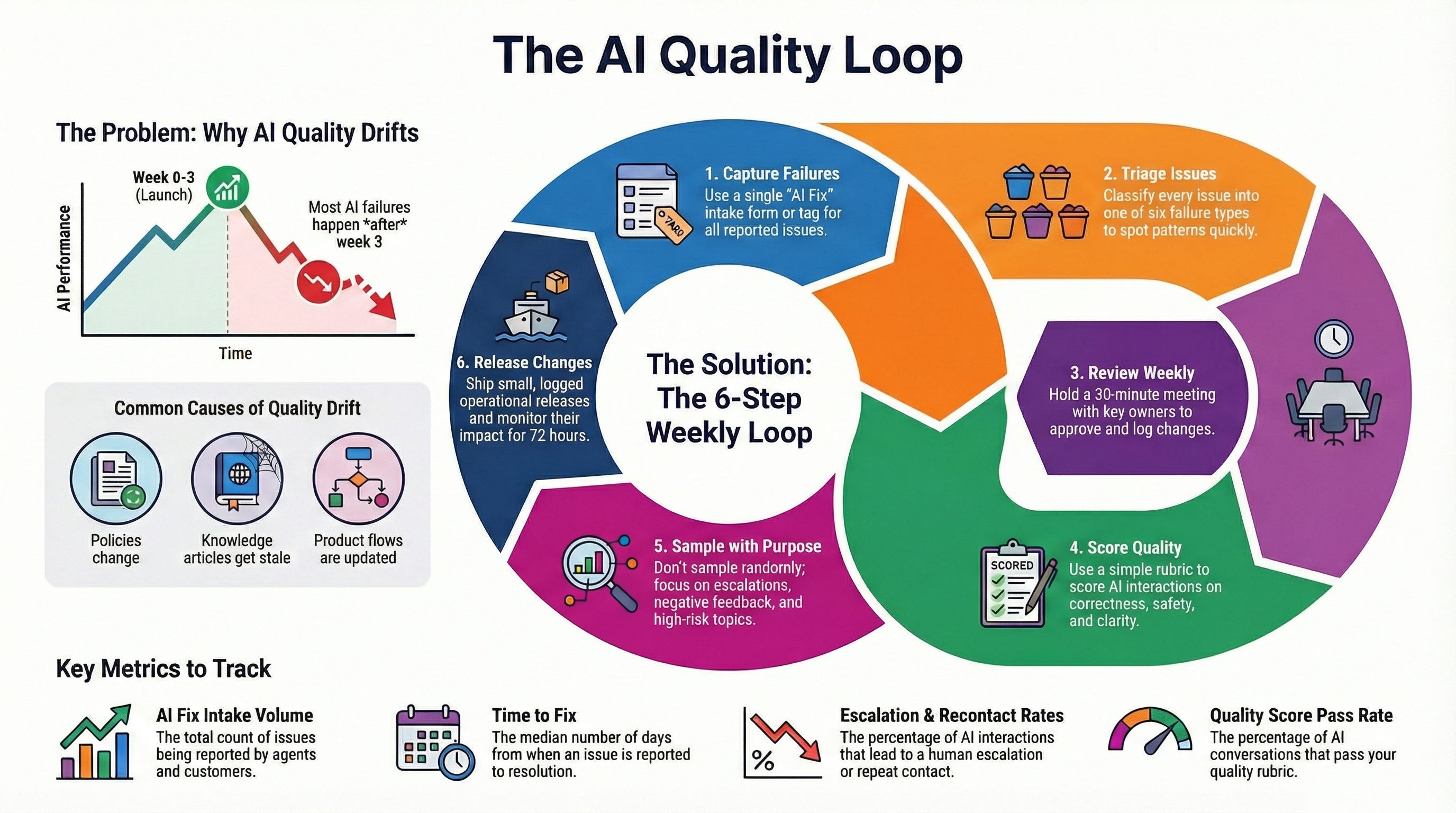
WHY QUALITY DRIFTS
Quality drifts for boring reasons.
Policies change. Old answers stay alive.
Knowledge articles get stale.
Product flows change.
New edge cases show up in peak season.
Routing rules change without updating prompts.
Agents stop trusting the system, then stop reporting issues.
A demo does not survive those forces.
Operations does.
THE AI QUALITY LOOP
Run one loop.
Every week.
Same agenda.
Same outputs.
Step 1. Capture AI failures with one intake
Create one intake called “AI Fix”.
One tag or one form.
No extra workflow.
AI Fix triggers
Agent flags a wrong answer
Customer says “this is wrong”
Escalation after AI response
Negative CSAT tied to an AI interaction
Any red-zone topic touched by AI
AI Fix fields
Channel (chat, voice, email)
Intent (from your governed list)
Failure type (picklist below)
Risk level (green, yellow, red)
Link to conversation or ticket
One sentence: what went wrong
One sentence: expected outcome
Step 2. Triage with six failure types
Keep failure types small.
Make patterns visible.
Failure type picklist
Knowledge gap
Missing article. Missing step. Missing example.Knowledge conflict
Two sources disagree. Old policy left behind.Scope mismatch
Wrong intent. Wrong audience. Wrong flow.Workflow gap
AI answered, but no action followed. No route. No macro. No handoff.Tool behavior
Prompt issue. Guardrail issue. Retrieval issue. Bad citation. Bad formatting.Risk breach
PII exposure. Money movement. Legal language. Medical language. Identity verification.
Step 3. Review with a fixed weekly cadence
Weekly meeting.
Thirty minutes.
Same roles.
Same output.
Attendees
Support Ops owner
Knowledge owner
QA owner
Tool owner
One lead from the floor
Agenda
5 minutes: new AI Fix count by failure type
10 minutes: top 5 red or yellow items
10 minutes: approve changes for next release
5 minutes: publish change log entry
Output every week
Updated backlog with owners and due dates
Change log entry
One coaching note for agents
Step 4. Score quality with a simple rubric
Use one rubric across channels.
Avoid debate.
Score each sampled conversation 0, 1, 2 per line.
Rubric
Correct outcome
0 wrong. 1 partial. 2 correct.Evidence support
0 no source. 1 weak source. 2 matches source.Next step clarity
0 unclear. 1 some steps. 2 clear steps and owner.Safety and compliance
0 risky. 1 borderline. 2 safe.Tone and promise control
0 overpromised. 1 minor issue. 2 clean.
Passing bar
8 out of 10 for green topics
9 out of 10 for yellow topics
Red topics require block or forced handoff
Step 5. Sample on purpose
Random sampling misses the failures that hurt trust.
Sample where risk lives.
Weekly sample rule
1% of AI conversations per channel, minimum 25
100% of AI Fix items
100% of escalations after AI
100% of negative CSAT tied to AI
100% of red-zone touches
Segment the sample
By channel
By intent
By audience, if multiple audiences exist
Step 6. Release changes like operations
Small releases.
Logged releases.
Measured releases.
Release checklist
Change type labeled
(knowledge, workflow, prompt, routing, guardrail)Owner assigned
Approver assigned
Test set reviewed
Change log written
Metric to watch listed
Post-release checks, 72 hours
AI Fix volume on changed intents
Escalation rate on changed intents
Negative CSAT rate on changed intents
Recontact within 7 days for changed intents
THE MINIMUM METRICS SET
Skip vanity metrics.
Track work outcomes.
Weekly metrics
AI Fix intake volume
Count of issues reported.Time to fix
Median days from AI Fix to release.Escalation after AI
Escalations divided by AI interactions, by intent.Recontact after AI
Recontacts within 7 days divided by AI interactions, by intent.Quality score pass rate
Percent passing rubric, by intent.Drift signal
Percent of volume in “Other” or “Needs clarification”, by channel.
THE CHANGE LOG FORMAT
One paragraph per change.
Short.
Specific.
Change log entry format
Date
Change type
What changed
Why changed
Risk level
Metric to watch
Owner
EXAMPLE WEEK
This is what “week 1 of AI Ops” looks like.
Monday
Pull AI Fix list from last week
Assign owners and due dates
Wednesday
QA sample scoring
Flag red-zone touches
Friday
30-minute review
Approve changes
Publish change log
Post one coaching note
WHAT TO DO THIS WEEK
Create the AI Fix intake. One tag or one form.
Add the six failure types as a picklist.
Start the weekly review with a 30-minute meeting.
Publish the first change log entry, even if only one change exists.
If you implement this loop, reply and tell me what broke first. I’ll share fixes and templates in the next post.