


Intro
Part 1 defined intent data as a product.
Part 2 introduced the AI Quality Loop.
Part 3 showed a repeatable prompting pattern for agents.
Part 4 set risk tiers and verification loops.
Part 5 built the testing sandbox.
Part 6 builds a defect taxonomy so every failure becomes a label, an owner, and a fix path.
Humans ship bots. Bots fail. Humans argue in Slack. Nothing changes.
A defect taxonomy stops the arguing.
Every failure becomes:
A label.
An owner.
A standard fix path.
A test to prove the fix worked.
This part builds the taxonomy and the workflow around the taxonomy.
Part 5 tested changes. Part 6 labels failures so fixes land fast.
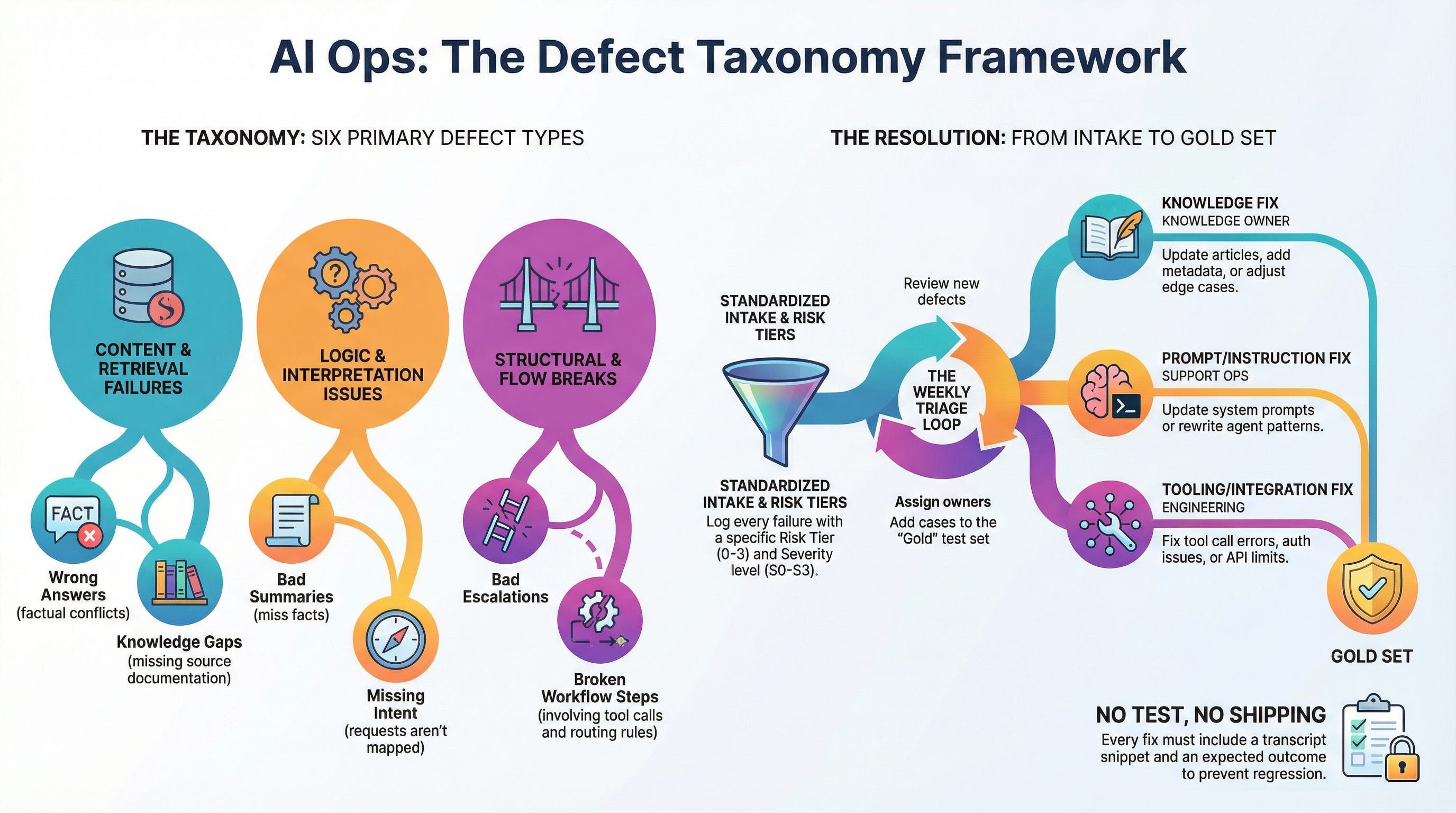
The graphic groups defects into three buckets, but labeling stays on the six primary defect types.
Quick takeaways
Label every failure using one primary defect type.
Tie every defect to a risk tier and a severity tier.
Route defects by owner group, not by whoever shouted first.
Map every defect to one fix path.
Add one new gold set case for every S0 and S1 defect.
Track repeats by subtype, treat repeat defects as regressions.
Why a defect taxonomy exists
A support AI failure without a label becomes a debate.
Debate creates heat. It does not ship fixes.
A taxonomy turns failure into operational work.
Every label maps to an owner group and a fix path, so the work lands in the right queue.
Every shipped fix needs proof.
A taxonomy makes testing easier because each defect becomes a reusable test case in the gold set.
Rules for a working taxonomy
Rule 1. One failure, one primary label.
Rule 2. Labels describe outcomes, not opinions.
Rule 3. Every label maps to an owner group.
Rule 4. Every label maps to a fix path.
Rule 5. Every label has a severity tier.
Rule 6. Every taxonomy change gets logged, or trend lines rot.
Rule 7. Every label maps to a test case in the gold set.
The three fields for actionable defects
Field 1. Impact tier
Use the same risk tiers used for verification and escalation.
Tier 0. Link and move.
Tier 1. Verify the record.
Tier 2. Two-source verify.
Tier 3. Stop and escalate.
Field 2. Defect type
Start with six types. Keep the top level stable.
Part 2 introduced a cadence to capture failures and classify them into six failure types.
Field 3. Fix path
A defect without a fix path becomes an orphan.
A fix path tells the team where work lands.
The six defect types
WRONG ANSWER
AI gave an answer which conflicts with a source of truth.KNOWLEDGE GAP
The right answer exists, but retrieval failed or the article is missing.BAD SUMMARY
A summary or internal note missed key facts, swapped facts, or leaked sensitive data.BAD ESCALATION
The flow escalated late, escalated early, or escalated to the wrong place.BROKEN WORKFLOW STEP
Automation, tool calls, forms, or routing rules broke the journey.MISSING INTENT
A conversation did not map to the taxonomy, or mapped wrong.
These map cleanly to the “one list, one owner” pipeline:
Wrong answer.
Knowledge gap.
Bad escalation.
Bad summary.
Broken workflow step.
Missing intent.
Subtypes to save hours
Use the same naming pattern:
DEFECT TYPE :: SUBTYPE
WRONG ANSWER :: Policy conflict
WRONG ANSWER :: Stale content
WRONG ANSWER :: Hallucinated rule
WRONG ANSWER :: Math or eligibility error
WRONG ANSWER :: Unsupported promise
KNOWLEDGE GAP :: Missing article
KNOWLEDGE GAP :: Outdated article
KNOWLEDGE GAP :: Bad metadata
KNOWLEDGE GAP :: Retrieval miss
KNOWLEDGE GAP :: Answer exists in product, not in docs
BAD SUMMARY :: Missed next step
BAD SUMMARY :: Wrong intent
BAD SUMMARY :: Wrong names or IDs
BAD SUMMARY :: Missing verification note fields
BAD SUMMARY :: Sensitive data included
BAD ESCALATION :: Escalation threshold wrong
BAD ESCALATION :: No context in handoff
BAD ESCALATION :: Wrong queue
BAD ESCALATION :: Looping without progress
BROKEN WORKFLOW STEP :: Tool failure
BROKEN WORKFLOW STEP :: Routing rule failure
BROKEN WORKFLOW STEP :: Form missing required field
BROKEN WORKFLOW STEP :: Automation fired wrong macro
BROKEN WORKFLOW STEP :: Channel handoff broke
MISSING INTENT :: New topic
MISSING INTENT :: Multi intent
MISSING INTENT :: Ambiguous request
MISSING INTENT :: Taxonomy too granular
MISSING INTENT :: Taxonomy too broad
Owners and fix paths
Assign ownership by fix path, not by blame. Ownership follows fix path, not the team that found the defect.
Fix path A. Knowledge fix
Owner: Knowledge owner
Work: Add or update article, add examples, add edge cases, adjust titles, add metadata.
Fix path B. Prompt or instruction fix
Owner: Support Ops
Work: Update system prompt, rewrite agent prompt pattern, add constraints, add formatting rules.
Fix path C. Policy and guardrail fix
Owner: Support leadership plus policy partner
Work: Add exclusions, tighten escalation thresholds, add verification requirements, block unsafe actions.
Fix path D. Routing or workflow fix
Owner: Support Ops plus Engineering
Work: Update routing logic, triggers, forms, tags, queue rules.
Fix path E. Tooling or integration fix
Owner: Engineering or vendor
Work: Fix tool call errors, auth issues, missing fields, API limits.
Fix path F. Coaching fix
Owner: Team lead or QA
Work: Train agents on capture, escalation, verification notes, and defect reporting.
A governance grid avoids debates during changes.
The defect intake form
One form. One place. No DMs.
Required fields:
Conversation link or ticket ID
Channel
Intent (current label)
Risk tier (0 to 3)
Defect type and subtype
Customer impact
Evidence
Repro steps
Suggested fix path
Owner group (auto filled from fix path)
Severity
Severity guide:
S0. Tier 3 risk or legal, security, money movement.
S1. Tier 2 risk or large customer impact.
S2. Tier 0 to 1 risk with repeat volume.
S3. Cosmetic, rare, or low impact.
The triage loop
Run triage once per week, same slot, same people.
Agenda:
Review new defects by severity.
Merge duplicates.
Assign owner group and due date.
Choose fix type.
Add test cases to the gold set.
Close the loop with the reporter.
Minimum staffing:
Support Ops
QA
Knowledge owner
Engineering rep
Policy partner for Tier 2 and Tier 3
A weekly cadence keeps drift visible.
Testing, prove the fix
Every fix needs a test.
No test, no shipping. Humans already ship enough guesses.
For each defect, add:
A short transcript snippet
Expected outcome
Risk tier
Pass or fail rule
Track regression:
If the same subtype returns within 14 days, reopen and escalate priority.
Metrics for operations
Track the work, not the hype.
Core metrics:
Defects per 1,000 AI conversations
Defects per 1,000 AI assisted tickets
Repeat rate by subtype
Time to triage
Time to fix
Recontact rate after “resolved”
Loop rate for automated flows
Escalation acceptance rate
Defect mix by risk tier
Measurement needs operational truth, not demo truth.
Examples
Example 1. Wrong answer, policy conflict
Scenario: Bot says “refunds post in 24 hours” while policy states 5 business days.
Label: WRONG ANSWER :: Policy conflict
Risk tier: Tier 2
Fix path: Policy and guardrail fix plus Knowledge fix
Test: Ask the refund question in three phrasings, expect the 5 day answer plus escalation criteria.
Example 2. Bad escalation, looping
Scenario: Bot asks for screenshots three times, user asks for a person, bot repeats troubleshooting.
Label: BAD ESCALATION :: Looping without progress
Risk tier: Tier 1
Fix path: Routing or workflow fix
Test: Detect “talk to an agent” plus “already tried” phrases, then escalate with context.
Example 3. Knowledge gap, missing article
Scenario: New feature launched, no doc exists, bot fills space with guesses.
Label: KNOWLEDGE GAP :: Missing article
Risk tier: Tier 0
Fix path: Knowledge fix
Test: Retrieval returns the new article, answer includes link and next steps.
The template: AI defect record
Title:
[Defect type :: subtype] in [channel] for [intent]

Fields:
Date found
Risk tier
Severity
Reporter
Conversation link
Current answer or behavior
Expected answer or behavior
Sources of truth checked
Customer impact
Root cause guess (optional)
Fix path
Owner group
Due date
Test cases added (yes or no)
Release note sent to frontline (yes or no)
If the team already uses an internal verification note, attach the note for Tier 1 to Tier 3 defects.
First 30 days: stand up the system
Week 1
Pick the six top level defect types.
Create the intake form.
Define owner groups and SLAs.
Week 2
Train the team on reporting.
Start triage weekly.
Ship one small fix per week.
Week 3
Build the gold test set from real failures.
Add regression tracking.
Week 4
Publish a monthly defect report:
Top subtypes
Fixes shipped
Open Tier 2 and Tier 3 items
Repeat offenders
Drift signals
Defects will keep coming.
A taxonomy decides whether defects become noise or progress.
Next up.
AI Ops, Part 7. From AI Use to AI Ownership.
Turn frontline feedback into governed changes.