


Intro
AI does not fail in a demo. AI fails mid-shift, when a real customer asks the one question your system never tested.
Frontline teams feel those failures first. They patch the gaps with workarounds. They warn each other in chat. They lose time. Trust erodes.
Part 5 tested changes. Part 6 labels failures so fixes land fast.
Part 7 is the next move. Turn frontline feedback into owned changes, with a record, approvals, tests, and rollback. No more “someone should fix this” drifting into the void.
AI Ops, Part 1 (link to Part 1)
AI Ops, Part 2 (link to Part 2)
AI Ops, Part 3 (link to Part 3)
AI Ops, Part 4 (link to Part 4)
AI Ops, Part 5 (link to Part 5)
AI Ops, Part 6 (link to Part 6)
Quick takeaways
AI systems ship fast. Governance ships slow. The gap shows up in support first.
A customer asks a standard question.
The AI answers fast.
One policy detail is off.
The case escalates.
An agent fixes the issue manually and moves on.
The next customer asks the same question.
The AI misses the same detail.
An agent applies the same manual fix.
The team loses the same time again.
A lead posts screenshots in Slack.
A manager asks for “a quick tweak.”
Someone edits a prompt, a routing rule, or an article.
A week later, a different failure appears.
Teams call this AI adoption.
Frontline experiences unowned change.
Why AI ownership exists
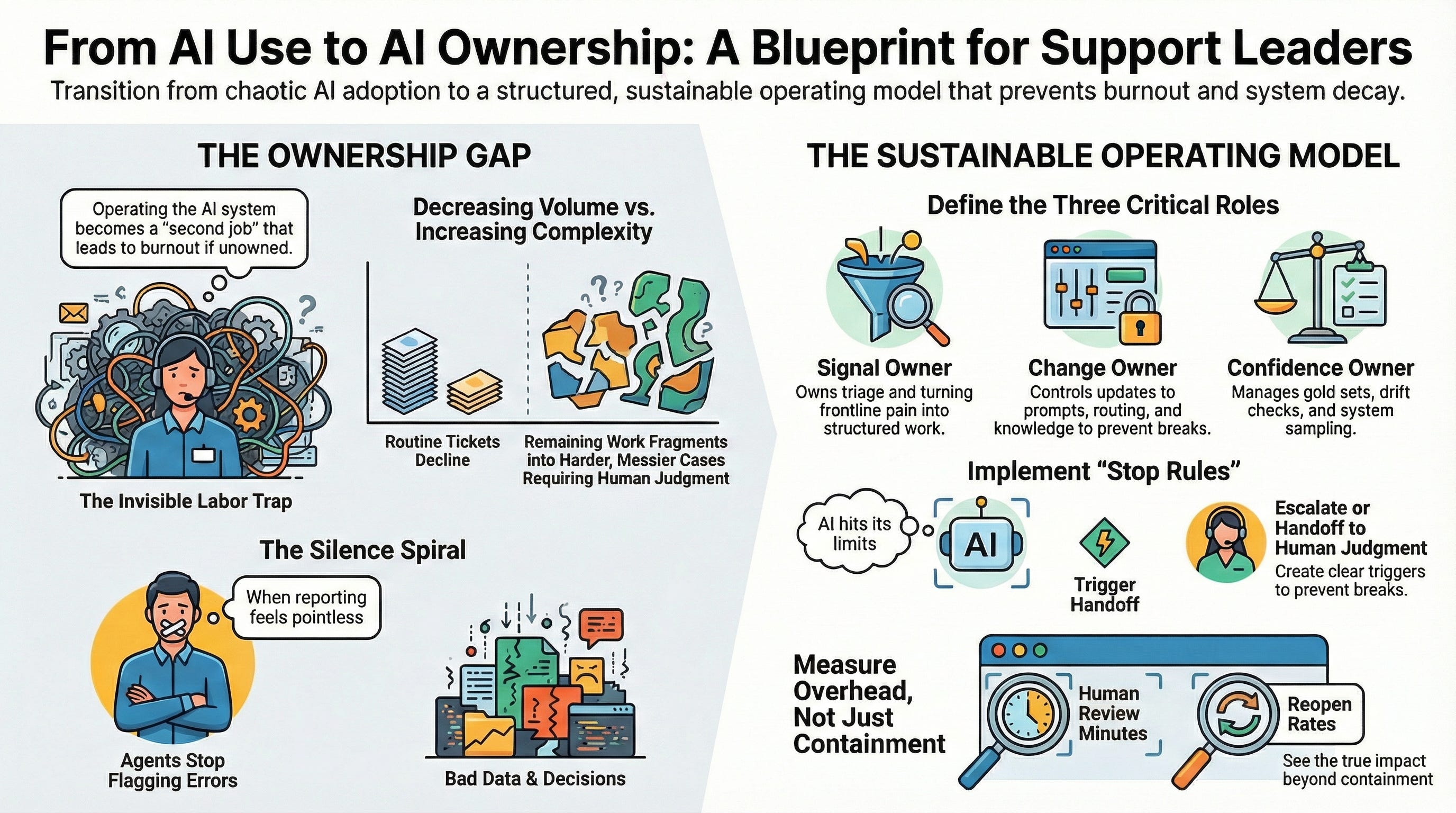
The ownership gap
AI reduces routine support tickets. Work does not drop. Work shifts.
When routine volume falls, the remaining work gets harder.
Edge cases become the job.
Customer emotion rises.
The blast radius grows when something breaks.
At the same time, a second job appears inside support.
Operate the system that resolves customer issues.
If you do not define ownership for that second job, it becomes invisible labor.
Invisible labor becomes burnout.
Burnout becomes silence.
Silence becomes bad data.
Bad data becomes bad decisions.
Where the work breaks
The first failures do not look dramatic.
They look like small friction.
A misroute.
A confident wrong answer.
A summary that hides the real risk.
An escalation that triggers too early, or too late.
A knowledge article that stays stale for a week.
Then the pattern forms.
Agents stop flagging AI issues because reporting feels pointless.
QA rewrites answers to protect CSAT.
New intents show up in comments, not in the taxonomy.
Routing changes ship with no before and after review.
Containment rises while reopen rates rise.
Those are not AI problems.
Those are ownership problems.
Two jobs, one team
Support now has two jobs.
Job one: resolve customer issues and protect trust.
Job two: operate the system resolving customer issues.
AI ownership starts when you stop treating job two as a side quest.
What changes inside support
This creates a predictable shift.
Productivity rises.
Capacity falls.
Routine volume declines while remaining work fragments into harder, messier cases.
Review and rework increase because AI output still needs judgment.
Breaks disappear because the work leaks into small tasks between meetings and at the edges of the day.
A fast tweak becomes routine.
A fast tweak becomes a backlog.
Rules for governed change
A sustainable operating model starts with three moves.
Assign ownership.
Define stop rules.
Measure overhead.
Part 7 adds the missing step.
Turn frontline feedback into governed change.
Assign ownership
Name one owner per AI workflow in production.
Not one owner for “AI.”
One owner for each workflow.
Examples of workflows:
Chat answer and deflection.
Voice intake and routing.
Agent assist summaries.
Escalation recommendation.
Intent classification.
Then name three roles across the system.
Signal owner
Owns intake, triage, and defect classification.
Turns frontline pain into structured work.
Change owner
Owns release control for prompts, routing, and knowledge updates tied to AI behavior.
Prevents random edits from breaking trend lines.
Confidence owner
Owns evaluation.
Gold set coverage.
Drift checks.
Sampling.
Ownership removes debate.
Ownership creates throughput.
Define stop rules
Write clear “done” states for AI-assisted work.
Stop rules prevent endless polishing loops, repeated retries, and slow drift.
Stop rule examples:
If the AI answer lacks a source, escalate or respond with the verified policy text.
If the customer asks for eligibility decisions, route to the policy path, not self-serve.
If the customer repeats the same question twice, treat it as a handoff signal.
Stop rules do one thing well.
They protect trust when the system is under pressure.
Measure overhead
Track the work AI creates, not only the work AI resolves.
Pick simple measures tied to real cost:
Human review minutes per AI resolution.
Reopen rate after AI-assisted resolution.
Repeat contact within 72 hours.
Escalation acceptance rate.
Misroute rate.
These numbers reveal the real curve.
Containment without overhead is a demo metric.
The change intake form
Feedback dies in chat threads.
It needs a home with dates, owners, and status.
Pick one intake path.
A form.
A macro.
A ticket type.
A project board.
One rule.
No intake record, no fix.
Keep intake short.
Require evidence.
Avoid opinion battles.
Required fields
Channel.
Defect type.
Customer goal, one sentence.
AI action, one sentence.
Expected outcome, one sentence.
Evidence link, ticket ID or conversation ID.
Optional fields
Suggested intent.
Suggested article.
Suggested escalation path.
Screenshot.
The ownership loop
Then run triage weekly.
Same day.
Same time.
Thirty minutes.
Decisions only.
Agenda
Defect type.
Owner group.
Risk tier.
Fix path.
Test case added after ship.
Change record created before ship.
Owners and fix paths
Route by owner group, not by whoever shouted first
Owner groups keep work moving.
Knowledge owner group
Missing article.
Stale policy text.
Conflicting guidance.
Ops owner group
Intent mapping.
Routing rules.
Forms.
Macros.
Handoff steps.
QA owner group
Gold set updates.
Sampling plan.
Scoring rubric.
Engineering owner group
Integrations.
Workflow steps.
System bugs.
Policy owner group
Eligibility language.
Compliance rules.
Regulated topics.
Product owner group
UI confusion.
Broken flows.
Missing in-product guidance.
One item gets one owner group.
One owner group produces one next action.
Ship changes with a record
Small edits change outcomes.
Treat them like releases.
The template: AI change record
Change type.
Owner group.
Risk tier.
Reason.
Expected impact.
Test plan.
Rollback plan.
Ship date.
Evidence after ship.
No record, no ship.
Testing, prove the change
A single good answer proves nothing.
Operations needs stable outcomes over time.
Use two checks.
Gold set
A small set of cases that represent your real work.
Add one new gold set case for each shipped fix.
Weekly sample
A set of recent conversations.
Use it to detect drift.
Gold set prevents regression.
Sampling catches slow decay.
Close the loop with frontline
Frontline trust grows from receipts.
Publish a weekly “AI changes shipped” note.
Keep it short.
Ship three items per week.
For each item:
What went wrong.
What changed.
What to watch.
Credit the submitter.
Close the loop publicly.
Remove blame.
Remove hero culture.
This is how reporting turns into trust.
This week
Five step checklist.
List top 5 AI workflows in production.
Assign one owner per workflow.
Write 2 stop rules per workflow.
Add 1 overhead metric per workflow.
Standardize escalation handoffs with a short packet: customer goal, steps tried, system signals, relevant logs.
Close
AI use looks busy.
AI ownership looks boring.
Boring means repeatable.
Repeatable means governed.
Governed means trusted.
Trusted systems scale.
Unowned systems break, quietly, in chat threads.
Next up: AI Ops, Part 8: The AI Release Train.
How to ship changes on purpose, not by accident.