


If you missed Part 7, start here: AI Ops, Part 7: From AI Use to AI Ownership.
AI Ops, Part 1
AI Ops, Part 2
AI Ops, Part 3
AI Ops, Part 4
AI Ops, Part 5
AI Ops, Part 6
AI Ops, Part 7
When the train jumps the track
A weekly exec review starts with a familiar chart. CSAT dips. Escalations rise. Recontact climbs. Someone asks a simple question: “Why did the assistant give a different answer on Tuesday?” Nobody wants drama. Everyone wants a traceable answer.
Quick tweaks feel helpful. Quick tweaks also create surprises.
The fix was not another prompt tweak. The fix was an AI release train, a weekly shipping cadence for every customer-facing change.
The team searches for a single root cause and finds a pile of tiny edits. A prompt tweak to sound warmer. A knowledge article edit to reduce repeats. A routing adjustment to cut escalations. A safety rule change to reduce risk. Each change felt small. The combined outcome shifted customer promises and agent workload, then blurred the trend line.
Why AI changes drift without a schedule
Support organizations already understand release risk in software. AI adds a twist. Words act like product behavior. Retrieval acts like a data pipeline. Routing acts like org design. A small change in any one layer can reshape outcomes across channels.
When changes land through untracked edits, drift follows. Drift then turns into work. Agents stop trusting outputs. Leaders stop trusting metrics. Customers notice inconsistency. The organization pays trust debt through escalations, coaching time, and incident time.
The release train operating model
The fix does not require heroics. The fix requires a release train.
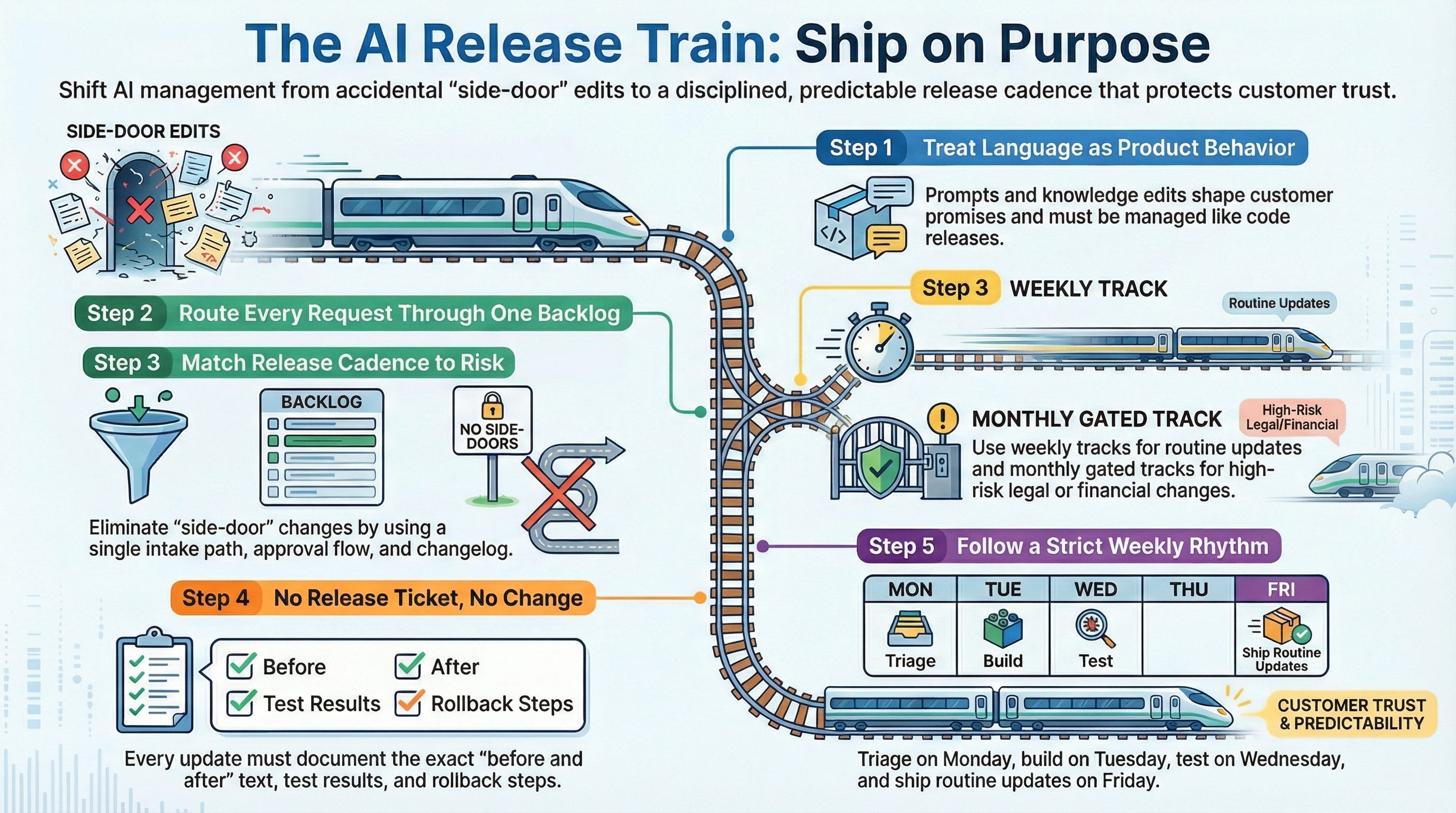
A release train means a fixed cadence for customer-facing AI changes, with one intake path, one backlog, one approval flow, one changelog, and one rollback plan. The goal stays simple: ship changes on purpose, not by accident, then prove what shipped.
Fewer surprises. Cleaner metrics. Lower risk.
What the release train covers
Start with scope. Then pick a track. Then ship on schedule.
Start by treating every customer-facing change as a release, then route each release through the same train.
A release happens whenever customer-facing output changes. Treat the following work as a release, even when the change feels minor.
Customer-facing change types
Prompts and templates
Knowledge edits tied to assistant answers
Retrieval sources and ranking rules
Intent taxonomy and routing logic
Escalation triggers
Model settings and tool behavior
Safety filters and redaction rules
Agent assist macros tied to assistant output
Three tracks, tied to risk
One train for every customer-facing change. Tests, notes, rollback.” A release train works when risk drives cadence. Run three tracks. Keep the rules plain.
Track A, Routine
Use for Tier 0 and Tier 1 changes. Ship weekly. One operational approver. Light test coverage plus spot checks.
Track B, Controlled
Use for Tier 2 changes. Ship every two weeks. Approval from a support leader plus a policy partner. Deeper testing for impacted intents plus a shadow run.
Track C, Gated
Use for Tier 3 changes. Ship monthly, plus an emergency path. Exec sponsor approval. Scenario testing. Rollback rehearsal.
Risk rule for Track C
Treat identity, money movement, eligibility, deadlines, legal language, and compliance as Track C by default.
Trust stays stable when every customer-facing change ships through one release train, with tests, notes, and rollback.
One intake, one backlog, clear ownership
Feedback trapped in chat threads turns into repeated mistakes. Route every change request into the same backlog. Assign one owner per change request. Route triage by owner group, not by volume of noise.
Owner groups
Support Ops: workflows, routing, macros, escalation rules
Knowledge owners: articles, translations, policy content
Engineering: integrations, tooling failures, data sync
Policy and compliance: eligibility rules, regulated flows
The release ticket
No release ticket, no change. A release ticket forces clarity and keeps rollback real.
Release ticket fields
Problem, one sentence
Scope, impacted intents, channels, states, products
Change, exact before and after text
Risk tier and track
Source of truth, named owner
Test plan, pass criteria, fail criteria
Rollback steps, owner, time target
Release notes audience
Three post-ship metrics to watch
The weekly rhythm
Predictable shipping builds trust across teams. A weekly rhythm keeps effort steady.
Weekly release train schedule
Monday: triage intake, reject vague requests, assign owners, set track
Tuesday: build changes, update test coverage
Wednesday: run tests, review promise language and policy risk
Thursday: write release notes, prepare rollback steps, set monitoring
Friday: ship Track A, hold Track B and Track C for planned windows
Testing that protects trust
Testing should feel boring. Boring testing scales.
Practical testing rules
Add one new gold set case per shipped change, so coverage grows with real issues.
Test promise language: deadlines, eligibility, money movement, guarantees.
Test real customer phrasing: incomplete context, emotional messages, rushed requests.
Test fallback paths: retrieval failures, conflicting sources, missing context.
Test across channels: chat, email, voice summaries.
Go or no-go gate
A short gate prevents “ship and hope.”
Go or no-go checklist
Release ticket complete
Source of truth verified
Gold set passed
Rollback steps written
Monitoring ready
Release notes drafted
Approvals logged
When any line fails, move the change to the next train.
Emergency path with a receipt
Emergency fixes will happen. The release train still needs a paper trail.
Emergency rules
Ship the fix.
Log the change within 24 hours.
Add gold set coverage within 48 hours.
Share a short postmortem in the next weekly review.
Post-release monitoring
Watch a small set of signals tied to the shipped change.
Monitoring windows
First 24 hours: escalation rate for impacted intents
First 48 hours: recontact rate for impacted intents
First week: CSAT comments for new language patterns tied to the change
When signals spike, run rollback. Rollback should feel routine.
Skeptical questions, answered
Question 1
“Does a release train slow teams down and block fast fixes?”
Answer
Untracked fixes create hidden work later. The release train reduces rework by making changes traceable and reversible. Track change failure rate, time to detect regressions, and time to restore service quality. A stable train lowers all three because diagnosis becomes faster and rollback becomes simpler.
Measure change failure rate and time-to-restore after releases, both should drop within a few cycles.
Question 2
“Why treat prompt edits and knowledge edits like software releases?”
Answer
Prompts and knowledge shape customer promises. A one-line wording change can shift a deadline, eligibility guidance, or refund expectations. Treating language as a release aligns governance with impact. Track policy-dispute escalations, seven-day recontact, and QA accuracy defects tied to the edited intent set. Controlled shipping reduces spikes tied to silent edits.
Measure policy-dispute escalations tied to edited intents, spikes flag unsafe shipping.
Question 3
“How does leadership know the assistant improves, not merely changes?”
Answer
Tie each shipped change to a measurable target and a defined watch window, then log outcomes in the changelog. Example targets: lower recontact for one intent, lower escalations for one channel, higher containment without higher complaint rates. Over time, the organization gains a portfolio view of which change types produce gains and which change types create regressions.
Use a pre/post watch window per release ticket, then log outcomes in the changelog.
One sentence to remember
Trust stays stable when every customer-facing change ships through one release train, with tests, notes, and rollback.
Closing thought
Predictable change keeps trust stable. The AI release train turns scattered edits into deliberate shipping, with tests, notes, monitoring, and rollback. Ship changes on purpose, not by accident. Run one train.
Next up: AI Ops, Part 9: The AI Incident Desk. How to handle failures mid-shift without chaos.