


A support leader sits in a staffing meeting with a dashboard on one screen and a budget model on the other.
The dashboard says AI handled 38% of incoming conversations.
The finance model says headcount should fall by 38%.
The support leader looks at the queue and sees something else.
The easy questions are gone first. Password resets. Basic how-to requests. “Where do I upload this?” “How do I check my status?” “Where is the form?” AI handles those well enough when the knowledge base is clean and the workflow is stable.
But the queue did not get easier.
The remaining tickets now carry more weight. A customer already tried self-service and got stuck. A policy answer depends on three fields in two systems. A reimbursement question needs verification. An escalation touches legal, finance, product, and support. A customer is upset because the AI answer sounded confident, but missed the edge case.
The dashboard says volume dropped.
The floor says complexity rose.
The staffing model has not caught up.
The dashboard says volume dropped. The floor says complexity rose.
The CFO asks, “So how many seats do we cut?”
That question is where a lot of AI support ROI models go off the rails.
Because AI does change capacity planning. It reduces some manual work. It shortens some replies. It improves some first contact resolution. It helps agents move faster when the workflow is clear.
But AI does not erase coverage, complexity, escalation load, QA, knowledge work, coaching, or manager span.
If you treat AI containment as a headcount reduction formula, you will build a team sized for the work AI removed, not for the work AI left behind.
And the work AI leaves behind is where customer trust usually breaks.
What changed
Traditional support staffing was built around volume.
You forecast tickets, contacts, calls, chats, handle time, occupancy, shrinkage, and coverage. Then you translate demand into people. The model was never perfect, because humans keep having issues at inconvenient times. A design flaw, frankly.
But the core logic was clear.
More volume usually meant more agents.
AI changes the shape of demand.
It does not remove support work evenly. It removes the easiest layers first. That means the average ticket left for humans often becomes harder, slower, riskier, and more cross-functional.
A team might handle fewer tickets and still need the same number of people. In some periods, it might need more senior coverage, stronger QA, tighter escalation management, and better knowledge ownership.
AI reduces some transaction cost, while increasing the importance of judgment cost.
That is the economic problem. Leaders often measure the first part and ignore the second.
A chatbot might answer 40% of conversations, but the remaining 60% often includes most of the risk, revenue exposure, churn risk, compliance exposure, emotional labor, and executive escalation cost.
That is why the staffing model has to change.
The economic problem
The wrong model says:
AI handled 40% of tickets.
So we need 40% fewer agents.
That math feels clean. It is also how spreadsheets lie with excellent posture.
A better model asks four questions:
What work disappeared?
What work shifted?
What work became more expensive?
What new work did AI create?
Those four questions matter because AI creates operating costs many teams fail to budget for.
Someone has to review AI answers.
Someone has to monitor recontacts after containment.
Someone has to maintain the knowledge base.
Someone has to update macros and workflows.
Someone has to investigate AI failures.
Someone has to coach agents on verification.
Someone has to manage escalations when a confident wrong answer reaches the customer.
If none of those responsibilities are named, they do not disappear. They land on your strongest agents, leads, QA analysts, and support ops people.
Then leadership celebrates “efficiency” while the best people quietly absorb unpaid system maintenance.
That is not ROI. That is deferred cost.
The operating mistake leaders make
The most common mistake is treating AI like a labor replacement layer before treating it like an operating system.
A labor replacement layer gets judged by automation rate.
An operating system gets judged by total cost, quality, risk, and retained customer trust.
Those are different conversations.
If the goal is automation rate, you will push AI into more work, even when the work is risky.
If the goal is support economics, you will ask where AI lowers cost without increasing downstream rework, escalations, or trust damage.
The difference shows up fast.
A vendor dashboard might say a conversation was contained. But did the customer return two days later? Did they open a new channel? Did an agent have to unwind the answer? Did a support ops person have to patch a broken workflow? Did QA find the answer was technically correct but operationally incomplete?
Containment only matters when the issue stays resolved.
Agent assist only matters when it improves speed without lowering accuracy.
Summaries only matter when they reduce cognitive load without hiding important details.
AI does not get credit for moving work out of sight. It gets credit when the total system performs better.
The better staffing model
The better model starts with a different assumption.
Do not staff the AI-enabled support team by deflected volume. Staff it by remaining work, coverage requirements, risk, and system ownership.
This is the model I would take into a staffing conversation with Finance.
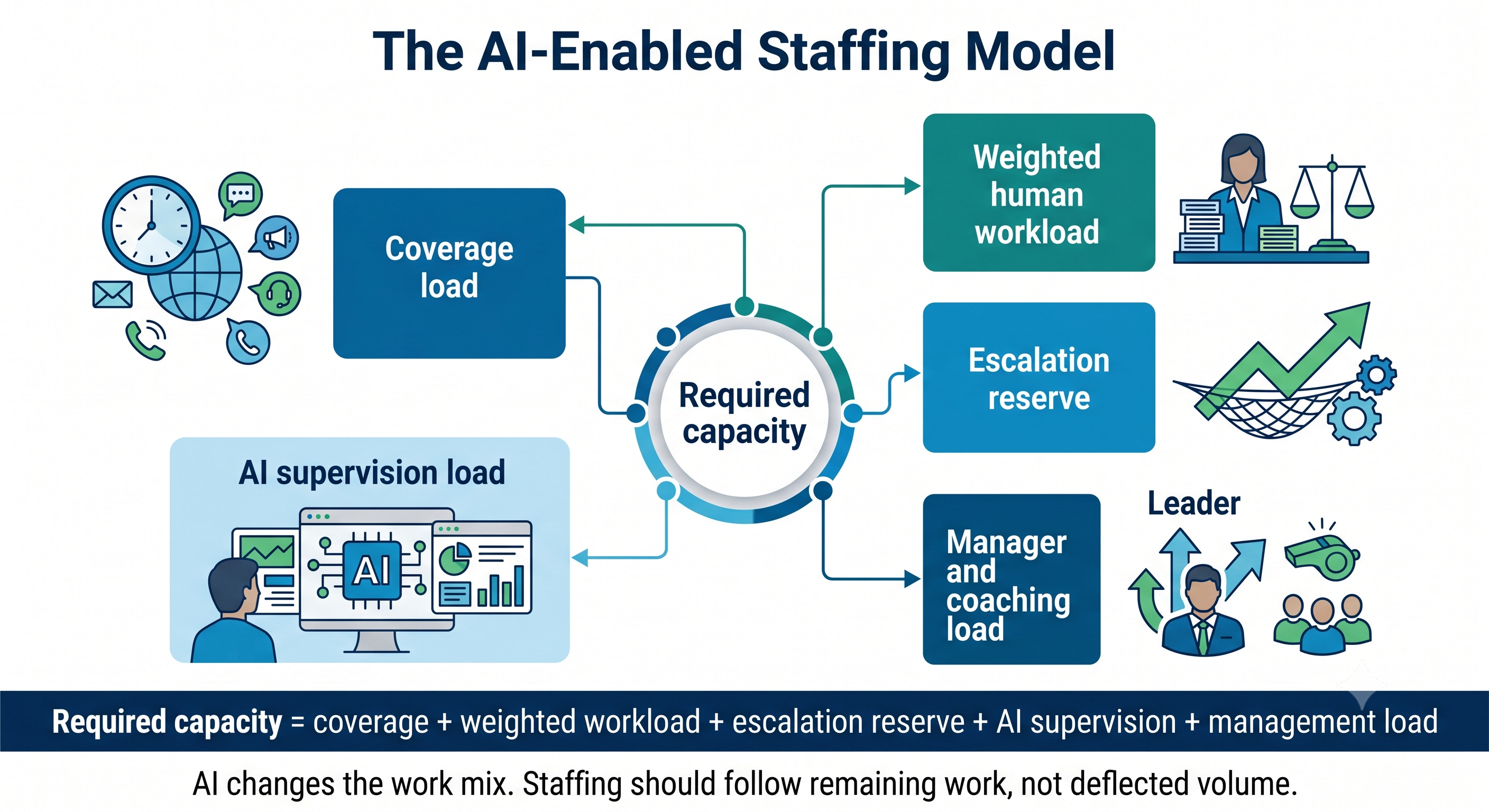
It has five parts:
Coverage load
Complexity load
Escalation load
AI supervision load
Management and coaching load
Those five parts create a practical staffing model leaders can defend to executives without pretending AI changed physics, time zones, or customer anger.
1. Coverage load
Coverage is the work AI does not erase.
If your support team offers live chat, phone, email, social, community, or premium support, you still need people available when customers need humans. AI might reduce demand in some channels, but it does not remove the need for coverage.
A team with lower ticket volume might still need the same schedule footprint.
Customers arrive unevenly. High-risk issues cluster around launches, billing dates, product changes, deadlines, outages, and policy shifts.
AI might handle routine questions at 2 p.m. It will not staff your escalation bridge, own a VIP customer, calm a frustrated customer, or explain a policy edge case with accountability.
Coverage planning needs to separate volume from availability.
A team needs enough people to cover hours, channels, languages, queues, and service commitments. Cutting too deep creates gaps. Then the remaining agents bounce between channels, handle more context switching, and lose the speed AI was supposed to create.
The question is not “How many tickets did AI remove?”
The question is “What human coverage still has to exist after AI performs well?”
2. Complexity load
Complexity is the cost hiding under reduced volume.
When AI handles repetitive work, the remaining work becomes denser. Agents spend less time answering simple questions and more time resolving problems with multiple variables.
A simple ticket might take four minutes.
A complex ticket might take twenty minutes, require two systems, need a policy check, and demand careful language because the customer is angry or the outcome affects money, access, eligibility, or trust.
If you use average handle time across all tickets, AI will distort the metric.
Before AI, the queue mix includes easy, medium, and hard work.
After AI, easy work gets filtered out.
So the human queue looks smaller, but the average human interaction gets heavier.
This is why leaders need a complexity-adjusted capacity model.
Do not count every ticket equally. Weight the work.
A practical version looks like this:
Simple work, weight 1.0
Basic how-to, status lookup, routine account question.
Moderate work, weight 1.5
Requires system check, light policy interpretation, workflow correction.
Complex work, weight 2.5
Multi-step issue, edge case, financial impact, high emotion.
Escalated work, weight 4.0
Executive, legal, compliance, severe trust risk, cross-functional issue.
Then model workload like this:
Weighted workload = simple tickets x 1.0 + moderate tickets x 1.5 + complex tickets x 2.5 + escalated tickets x 4.0
This is not perfect.
It is useful.
A smaller queue with higher weighted workload needs more expertise than the old model suggests.
This is where many teams get trapped. Leadership sees lower volume and cuts staff. Then the team slows down, QA drops, escalations increase, and everyone acts surprised. Humanity’s spreadsheet worship claims another victim.
3. Escalation load
Escalation load grows when AI removes easy work.
This happens for two reasons.
First, the remaining customers are often further along in frustration. They tried the bot. They searched the help center. They still need a person.
Second, AI creates a new type of escalation: the “AI said something wrong or incomplete” case.
Those cases are expensive.
The customer does not arrive neutral. They arrive with a belief shaped by the system. The agent now has to solve the original issue and repair trust.
That takes time.
It also requires stronger language, better policy judgment, and cleaner internal handoffs.
A good staffing model creates explicit escalation capacity. That means named owners, dedicated coverage windows, and clear thresholds for when work moves out of the general queue.
If escalation ownership stays vague, senior agents become the unofficial landing zone for everything hard. They still carry queue goals, answer Slack pings, review AI failures, and rescue cases. Then leaders wonder why the strongest people look tired.
Escalation load needs a budget.
Not a hope.
A budget.
4. AI supervision load
AI creates supervision work.
This is the part most ROI decks leave in a ditch.
An AI support system needs ongoing care. Knowledge changes. Product behavior changes. Policies change. Customer language changes. Bad answers appear. Good answers drift. Routing logic breaks. Macros conflict. The model retrieves the wrong article because the source material is messy.
Someone has to watch this.
AI supervision includes:
Reviewing sampled AI conversations
Tracking recontact after containment
Investigating bad handoffs
Updating knowledge sources
Testing high-risk intents
Maintaining AI red zones and exclusions
Coaching agents on verification
Routing failures back to support ops, product, policy, or engineering
This work is not optional.
If you do not fund it, you pay for it later.
You pay through customer confusion, repeat contacts, support debt, and internal mistrust.
In an AI-enabled support team, AI supervision should sit in capacity planning the same way QA, workforce management, and training do.
A practical starting point:
For every 1,000 AI-handled conversations, allocate review capacity for quality sampling, failure investigation, and knowledge updates.
For every major policy, product, billing, or workflow change, allocate pre-release testing time for AI responses and handoffs.
For every high-risk intent, assign an owner who reviews performance weekly.
That sounds operational because it is. Sorry to disappoint the demo theater crowd.
5. Management and coaching load
Manager span changes when the work changes.
A manager who leads 12 agents handling routine tickets is doing one kind of job.
A manager who leads 12 agents handling policy exceptions, escalations, AI verification, QA feedback, emotional customers, and cross-functional dependencies is doing another job.
The second role carries more coaching load.
Managers need time to review cases, coach judgment, identify patterns, support escalation decisions, maintain morale, and translate executive expectations into something the team can act on.
AI does not reduce management need by default.
In many support teams, it increases the need for better management.
The mistake is assuming fewer tickets means fewer managers or wider spans.
As complexity and risk rise, manager span should tighten or manager enablement should improve.
That might mean fewer direct reports per manager, stronger team leads, better QA support, clearer escalation protocols, or dedicated support ops capacity.
The right answer depends on your team.
The wrong answer is pretending a co-pilot eliminates coaching.
The AI-enabled staffing template
Here is the practical model I would use with executives.
Start with the baseline work.
Human coverage requirement
Minimum people needed by channel, language, hour, region, and service level.Weighted human workload
Ticket volume adjusted by complexity, not raw ticket count.Escalation reserve
Dedicated capacity for high-risk cases, executive issues, compliance, revenue risk, and customer trust repair.AI supervision capacity
Time for AI QA, knowledge maintenance, failure review, prompt or workflow tuning, and test sets.Manager and lead capacity
Span based on complexity, coaching needs, QA volume, and escalation support.
The staffing formula:
Required capacity = coverage load + weighted human workload + escalation reserve + AI supervision load + management and coaching load
The executive decision rule:
AI headcount savings should only be considered after service levels, weighted workload, escalation health, QA, recontact, and AI supervision are stable.
That sentence matters.
AI might create savings. It often does.
But savings should come from measured operating improvement, not from multiplying automation rate by headcount.
How this works in a real support org
Let’s use a simple example.
A support org receives 50,000 monthly contacts before AI.
The team launches AI containment and agent assist. After a few months, AI handles 15,000 routine conversations per month. Human-handled contacts drop to 35,000.
A surface-level model says:
AI handled 30%.
Cut 30% of the team.
That sounds clean. It is also the kind of clean math that causes operational damage later.
Now look at the actual mix.
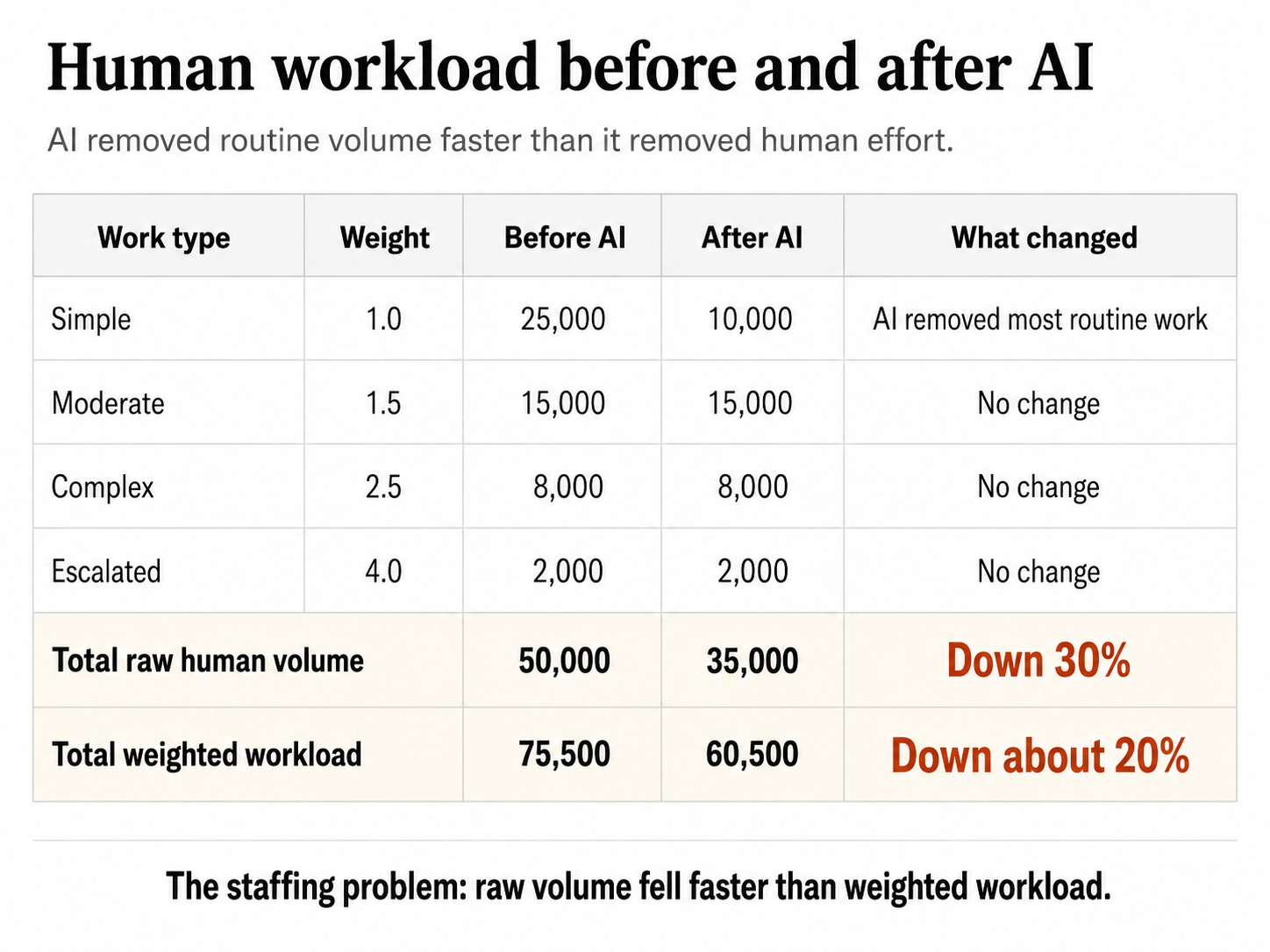
The raw human volume dropped by 30%.
But the hardest work did not drop. AI created real leverage by reducing simple tickets from 25,000 to 10,000. But moderate, complex, and escalated work stayed flat.
Once you weight the remaining work by complexity, the staffing story changes.
Human contact volume dropped 30%. Weighted workload dropped about 20%.
That already changes the savings story.
Now add AI supervision.
The team needs capacity to sample AI conversations, review containment failures, update knowledge, monitor recontact, and test high-risk intents. Suppose this equals 3 FTE of operational work.
Now add escalation reserve.
The team used to rely on senior agents to absorb escalations. That worked badly before AI. After AI, it becomes worse because escalations contain more trust repair and more context. Suppose the team needs 2 FTE reserved for escalation coverage.
Now add manager load.
If the remaining work is more complex, manager span cannot widen just because total contacts fell. The team needs coaching on source verification, escalation judgment, and AI-assisted replies.
Suddenly the staffing conclusion changes.
AI still created economic value. It removed routine volume. It improved speed. It reduced repetitive work. It might have lowered the need for some entry-level capacity.
But it did not justify a 30% headcount cut.
It justified redesigning the team.
A smarter plan might be:
Reduce hiring growth for routine volume
Keep coverage stable
Shift some agents into domain ownership
Add AI QA and knowledge ownership
Protect escalation capacity
Tighten manager coaching around complex work
Reforecast after recontact and QA stabilize
That is the difference between using AI to improve support economics and using AI to create a future outage with better slide design.
What executives should measure
Executives do not need a 40-metric AI dashboard. They need a small set of measures tied to operating reality.
Here are the ones I would use.
AI containment with recontact:
Shows whether AI resolution stayed resolved.
Human weighted workload:
Shows complexity-adjusted demand.
Escalation rate:
Shows whether risk is concentrating.
AI-to-human handoff success:
Shows whether customers repeat themselves or get routed poorly.
QA pass rate on AI-assisted replies:
Shows whether speed is harming accuracy.
Knowledge gap rate:
Shows where documentation and AI retrieval fail.
Manager span by complexity:
Shows whether leaders have enough coaching capacity.
The most important pairing is containment plus recontact.
A conversation should not count as resolved only because the AI session ended.
It should count as resolved when the customer does not come back for the same issue across a reasonable window.
That window depends on your business. It might be 48 hours, 7 days, or 30 days.
Pick a window. Be consistent.
If containment rises while recontact rises, AI is deflecting work, not resolving it.
If containment rises while recontact stays flat or falls, QA holds, and escalation health improves, then you have a real ROI signal.
What support leaders should do next Monday
Here is the Monday morning version.
Do not start with headcount. Start with the work mix.
Pull the last 90 days of human-handled tickets and split them into simple, moderate, complex, and escalated work.
Weight each category. Start simple: 1.0, 1.5, 2.5, and 4.0.
Compare raw ticket volume to weighted workload before and after AI.
Review recontact after AI containment. Pick one window and apply it consistently.
Identify the top five intents where AI reduces volume but humans still handle the hardest cases.
Assign owners for AI supervision work: knowledge, QA sampling, failure review, and escalation feedback.
Recalculate manager span based on complexity, not team size alone.
Bring executives one page with five numbers: volume change, weighted workload change, escalation trend, AI supervision requirement, and staffing recommendation.
That one page is the difference between “AI handled 30%, cut 30%” and “AI changed the work, here is the staffing model.”
It also gives finance a better answer.
Support leaders should not avoid the economic conversation. They should improve it.
AI should lower cost where it truly removes work. It should improve speed where accuracy holds. It should reduce repetitive load where the system is safe. It should help agents handle complex issues with better context.
But the staffing model needs to count the full system:
Coverage.
Complexity.
Escalations.
AI supervision.
Management.
Leave one of those out and the savings number becomes fiction.
Back to the staffing meeting
Back to the staffing meeting.
The dashboard says AI handled 38% of conversations.
The finance model says headcount should fall by 38%.
The support leader should not reject the question. The question is fair. Support is expensive. AI should create leverage. Executives deserve a real operating answer.
But the answer cannot be automation rate dressed up as math.
The answer should be:
AI reduced routine workload. The remaining workload is more complex. Here is the weighted demand. Here is the escalation trend. Here is the AI supervision load.
Here is the coverage requirement. Here is the staffing model we need to protect cost, quality, risk, and customer trust.
That is the conversation support leaders need to lead.
AI support ROI is not automation rate. It is the relationship between cost, quality, risk, and retained customer trust.
One sharp question for leaders:
When AI removes your easiest tickets, what staffing model protects the harder work left behind?