


Six weeks after an AI voice bot went live across two states on the same day, I sat in a leadership review with one slide up. Containment 53 percent on launch day, holding near 40 percent since. Average handle time down 43 percent. Onboarding cut from two weeks to three days. Heads nodded around the table until a leadership team member leaned forward and asked the question I had not fully prepared to answer.
What happens to the calls the bot could not contain.
Not what happens to the number. What happens to the caller.
I had an answer about escalation paths. I did not have the answer he wanted, which was proof that the calls we automated were the safe ones, and that the calls we routed to a person stayed staffed with someone who knew what they were doing. The slide answered a savings question. He asked a risk question. Those are two different conversations, and until that moment I had been running the second one only in my head. It had never made it onto a slide.
What changed
Boards used to accept a savings number on faith, because the alternative, a full audit of support operations, was not worth a board’s time. AI changed that math. Once a board hears “AI is handling most of our support,” they know enough about AI to ask what it gets wrong, and how often, and to whom. The savings pitch now arrives with a built-in follow-up question. If you cannot answer it in the same meeting, you look like you are hiding something, even when you are not.
The cost of being unprepared is not embarrassment. It is credibility. A board that catches one soft number stops trusting every number after it, including the ones that were solid.
Here is what I walked away with. Put savings and risk in front of the board at the same time, and the savings number gets stronger, not weaker.
You earn the right to talk about savings by first showing you can see the risk.
The four-pillar scorecard
The fix is not a bigger deck. It is a scorecard that forces four questions onto one page, so nobody in the room has to ask the fifth one you were hoping to skip.
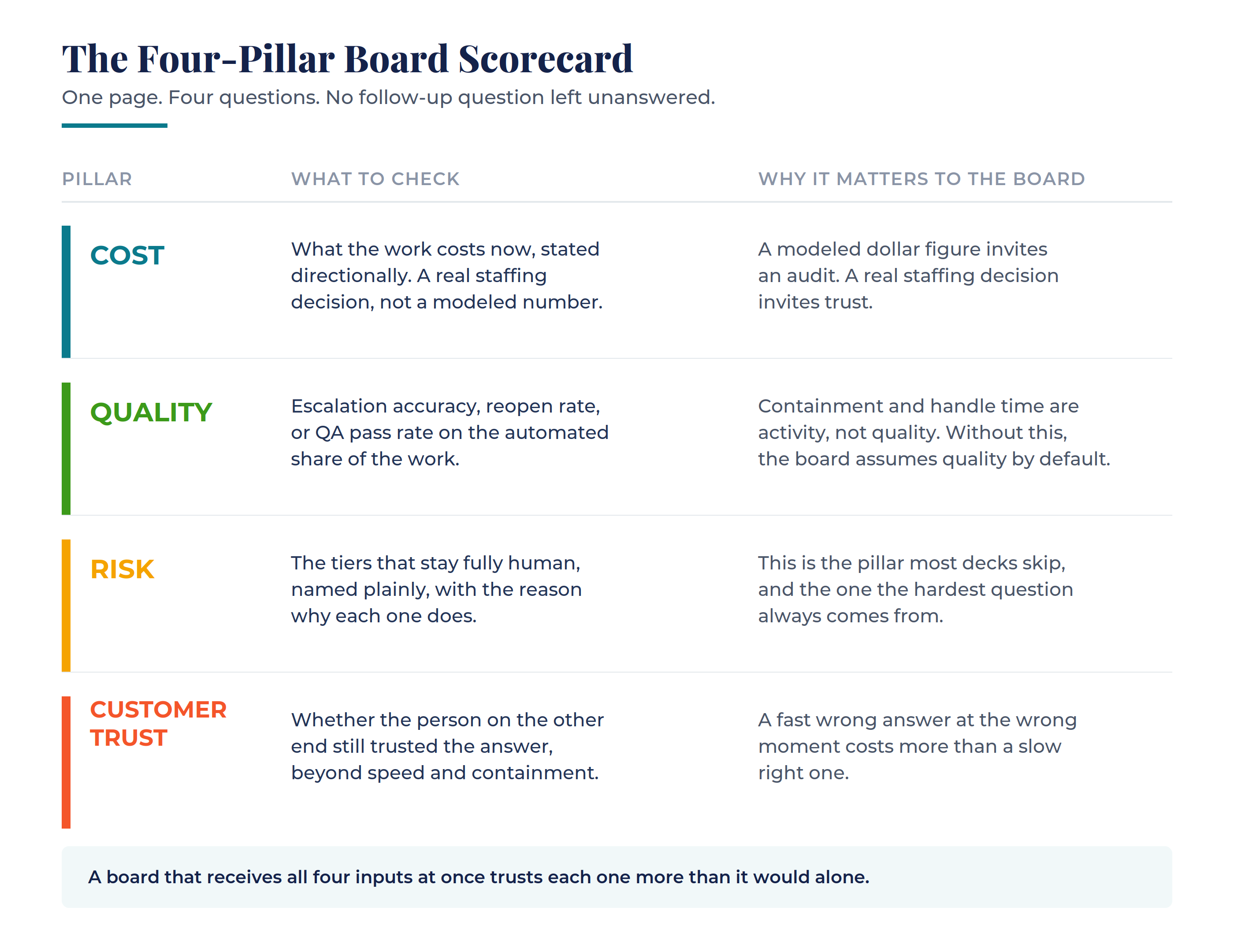
COST. What did the work cost before, and what does it cost now, in directional terms your finance partner will accept. You do not need an audited dollar figure to make this credible. When we forecast hiring ten new agents for a volume surge and only needed five, that gap told the board more than a savings estimate would have, because it was a real staffing decision, not a model.
QUALITY. Did the work get done right, or only fast. Containment and handle time are activity metrics. A board that only sees those two will assume quality held steady by default. It has not, until you show them the number that says so, whatever that number is inside your own operation: escalation accuracy, reopen rate, QA pass rate on the automated share of the work.
RISK. What is the automated system not equipped to catch, and what is standing behind it when it fails. This is the pillar most decks skip, and it is the one that question came from. Name your risk tiers. Say plainly which categories of work stay fully human, and why.
CUSTOMER TRUST. Did the people on the other end of the interaction still trust the answer they got. Speed and containment are not proxies for this. A fast wrong answer at the wrong moment costs more than a slow right one, and a board that has watched a customer-facing incident anywhere in its portfolio knows that instinctively, even if nobody says it out loud.
Fill in the blank version for your own review before you fill in the real one:
COST: [what changed, stated directionally]
QUALITY: [the metric that proves the work still gets done right]
RISK: [the tier that stays human, and why]
CUSTOMER TRUST: [the signal you watch beyond speed and containment]
Here is the filled version from that review, once I stopped hiding behind the one slide:
COST: staffing plan avoided a hiring round we had already forecasted
QUALITY: escalation accuracy held inside target range across both states
RISK: high-stakes eligibility and payment questions routed to a person by design, not by exception
CUSTOMER TRUST: parents facing a funding deadline got a verified answer instead of a fast one
A board that has never received the four inputs at once will trust the one input it did receive far less than it should.
Why the old version fails
The old version fails because it optimizes for the meeting instead of the decision. A single savings slide is built to survive fifteen minutes of attention. It is not built to survive a follow-up question six weeks later, when the board remembers the number and asks what happened since. By then you need a second data point, and if you were not tracking risk and quality from day one, you are building that answer from memory instead of from a system.
It also fails because it teaches your own team the wrong lesson. If cost is the only number leadership asks about, cost is the only number your team optimizes. Containment climbs. Escalation quality quietly slips, because nobody upstream is asking about it. You find out when a customer complaint reaches the board before your scorecard does, and now you are explaining a miss instead of presenting a result.
The board is not wrong to ask the hard question. The scorecard is what lets you answer it before they ask twice.
The hard part people miss
The hard part is that risk and quality data often look worse before they look better, and the instinct is to wait until the numbers are clean before you show them. That instinct is exactly backwards. A board that sees you tracking a rough number and improving it trusts you more than a board that sees a clean number appear from nowhere. The rough number with a trend line is proof of a system working. The clean number with no history is a claim.
The other hard part is emotional, not technical. Naming your own risk out loud in front of the people who approve your budget feels like handing them a reason to say no. In practice it is the opposite. A board that has to guess at your risk exposure will assume the worst case, because that is what boards are trained to do. A board that gets told the risk directly, with a plan attached, treats it as a solved problem instead of an open one.
A weak number with a plan reads as competence. A weak number with silence reads as a gap.
That is the standard for the whole scorecard, not the risk line alone.
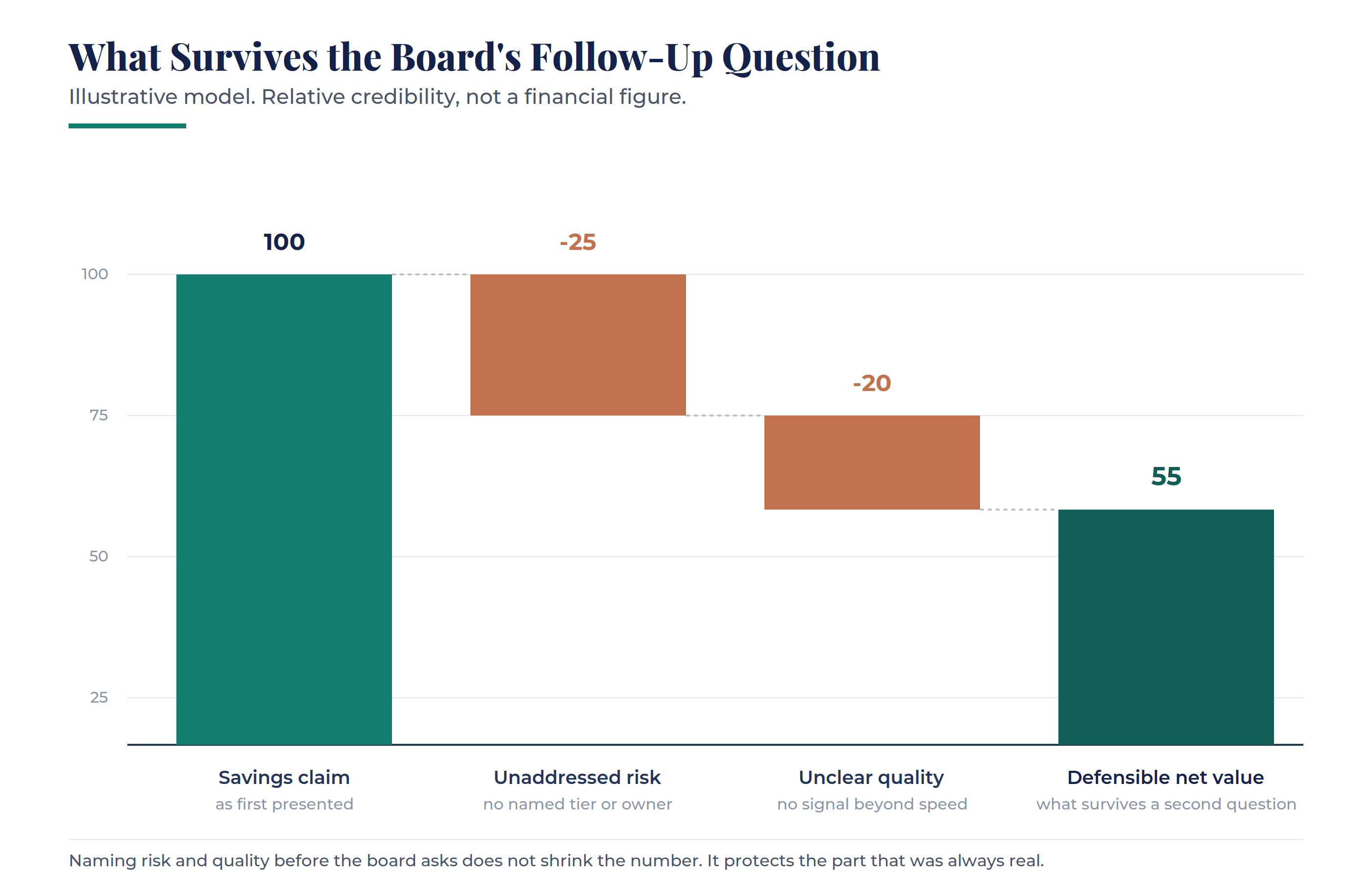
Naming the risk before the board finds it is what makes the savings number defensible.
Building this before your next review
Do this before your next leadership or board cycle, not during it.
Pick one owner for each of the four pillars. Cost usually sits with finance or ops. Quality and risk usually sit with you. Customer trust needs an owner even if it is new.
Define the one metric per pillar you can defend today, even if it is directional. Do not wait for a perfect number.
Set the update cadence. Monthly is enough for most orgs. Weekly if you are mid-rollout.
Write one sentence per pillar for what you say when the number is weak. Silence reads as a gap. A plan reads as competence.
Put all four pillars on one page, not four separate decks. The board should see the tradeoffs in one glance, not hunt for them across appendices.
Rehearse the follow-up question out loud before the meeting. If you cannot answer it in one sentence, the scorecard is not done yet.
The question worth asking your own team
This closes out three weeks built on one idea. Customer lifetime value asked what happens to trust after the first fast answer. Career ladders asked what happens to your people once the easy tickets are gone. This one asks what happens when someone outside the room has to trust your number without doing your job. Three questions, one balance sheet. Cost, people, and risk were never separate arguments. They were the same argument, told from three seats at the table.
Come back to the room. The leadership team member who asked about the uncontained calls was not trying to catch me. He was doing his job, which is to find the gap in the story before the story becomes the plan. Once I built the scorecard, that question stopped being the one I dreaded and became the one I opened with.
What is the one number on your current AI dashboard you could not fully defend if someone asked about it twice?
I am pressure testing our Chat AI rollout with your framework to see if we can answer any of the metrics well. It feels like a good way to guide conversations before roll out as well on how we are defining good beyond "the customer went away"