


In Part 1, I argued that AI support ROI is not automation rate. It is the relationship between cost, quality, risk, and retained customer trust.
Part 2 builds on that idea: when AI removes simple contacts first, the remaining human work becomes harder, riskier, and more dependent on expertise.
The dashboard looked better than the queue felt.
Ticket volume was down. Routine questions were getting handled before they reached the team. The queue looked cleaner. The simple contacts were fading out of the day: password resets, basic how-to questions, status checks, policy links, and repeated questions the team had answered hundreds of times.
Leadership saw relief.
The team felt something else.
The next case in the queue was not simple. The customer had already tried the chatbot. They had already searched the help center. They had already received either a partial answer, a confusing answer, or an answer that sounded confident but did not solve the real problem.
By the time the case reached a person, the customer was no longer asking a clean question. They were asking why the answer changed. Why the system said one thing and the policy said another. Why their money, access, approval, eligibility, timeline, or account status was still unresolved.
The volume was lower, but the work was harder. That is the part most AI support ROI conversations skip.
AI does not remove support work evenly. It removes the easiest work first. What remains is more complex, more emotional, and more expensive to get wrong.
What changed
Before AI, ticket volume was a usable staffing signal.
Imperfect, yes. Still useful.
If volume went up, you needed more capacity. If volume went down, you had more room. You modeled staffing from contact volume, handle time, shrinkage, occupancy, and service level.
AI changes that math.
The first contacts AI absorbs are usually the most repeatable ones. Clean questions. Low-risk workflows. Stable answers. Well-documented issues.
That is good.
It is also dangerous when leaders stop there.
When AI handles the simple layer, the human queue no longer represents the full customer base. It represents the filtered remainder. That remainder has edge cases, exceptions, failed automation, unclear policy, frustrated customers, and workflows touching more than one system.
The executive question should not be:
“How many fewer tickets reached support?”
The better question is:
“What kind of expertise does the remaining work now require?”
Those questions lead to different decisions.
One leads to cuts.
The other leads to an operating model.
The economic problem
The old support equation looked simple:
Ticket volume × average handle time = workload
That worked when tickets were spread across a wide range of complexity.
AI breaks the average.
After AI, the work left for humans often has a higher concentration of risk. Average handle time might rise. Escalation rate might rise. Recontact might rise. QA failures might become more expensive.
One bad answer might create:
• A complaint
• A refund request
• A churn risk
• A compliance issue
• An executive escalation
• A manual cleanup project for three other teams
That is why the better equation is:
Ticket volume × complexity × risk × trust impact = human workload
Trust impact matters.
A five-minute answer to a basic question is not equal to a five-minute answer about eligibility, payment timing, compliance, account access, or a policy exception.
Treating those contacts as equal is how companies underfund the exact work that protects them.
The CFO sees fewer contacts and expects savings. The support leader sees the hidden mix shift and knows the savings are not clean.
Both are looking at real data.
The problem is the data is incomplete.
The operating mistake leaders make
The mistake is using ticket volume as the main staffing signal after AI.
That mistake usually shows up in this order:
Automation rate improves.
Leadership asks how many roles the company should remove.
The team loses experienced people.
The remaining cases get harder.
Response quality slips.
Escalations rise.
Other teams absorb the mess.
Support gets blamed for “not adapting.”
A tidy little corporate ritual. Everyone brought a dashboard. Nobody brought judgment. Humanity’s finest recurring meeting.
Ticket volume tells you how many contacts reached the team.
It does not tell you how much judgment those contacts require. It does not tell you how much risk sits inside each case. It does not tell you whether AI prevented work, deferred work, or created downstream cleanup.
That is why support leaders need a different staffing argument for executives.
Not a defensive one.
A financial one.
Lower volume might mean fewer routine contacts. It does not automatically mean lower workload, lower risk, or lower expertise requirements.
The better model
After AI, staffing should be based on work type, not ticket count alone.
A useful model separates support work into four layers.
1. Routine resolution
This is where AI performs best.
It handles repeatable questions, basic guidance, simple triage, summaries, and suggested replies. This includes questions about document upload steps, password resets, form locations, status definitions, and support hours.
This work matters. AI creates real value here when the answer is stable, the risk is low, and the source material is clean.
2. Assisted resolution
This is where agents use AI to move faster without handing over judgment.
AI helps summarize, draft, translate, classify, or retrieve guidance. The human still verifies and owns the answer. This includes summarizing a long call for the ticket log, drafting plain-language replies from approved policy, finding the right knowledge base article, translating a response while preserving meaning, and turning messy customer language into clean internal notes.
This is where AI makes good agents faster.
It does not replace judgment. It reduces friction around the judgment.
3. Expert judgment
This is where AI exposes the need for stronger humans.
These are the cases involving exceptions, appeals, payment issues, account changes, identity questions, policy interpretation, high emotion, and conflicting system data.
This is the customer saying the system shows one thing, the policy says another, and last week they received a different answer. It is the payment that changed status without a clear explanation. It is the portal issue that looks like user error until someone checks the record history. It is the case where a confident answer would be faster, but a verified answer is safer.
These cases require context, verification, judgment, and careful language.
They also carry higher risk.
4. System improvement
This is the layer most leaders forget.
Someone has to identify failed intents, update knowledge, tune routing, improve macros, clarify escalation paths, and report patterns to product and operations. This includes reviewing AI failures, fixing stale articles, updating macros after policy changes, improving routing rules, building decision trees, creating escalation templates, flagging repeat issues to product or engineering, and measuring whether changes worked.
If system improvement has no owner, it becomes invisible labor.
Invisible labor lands on your best people.
Then your best people burn out.
Then someone says, “They were not a fit.”
Sure. Very convincing. The system ate them, but let’s blame personality.
The Volume-to-Risk Shift Scorecard
Before making any staffing decision after an AI rollout, do not ask only whether tickets dropped.
Ask what changed inside the remaining work.
Use this scorecard.
The scorecard is not meant to prove AI failed. It is meant to separate real savings from hidden risk.
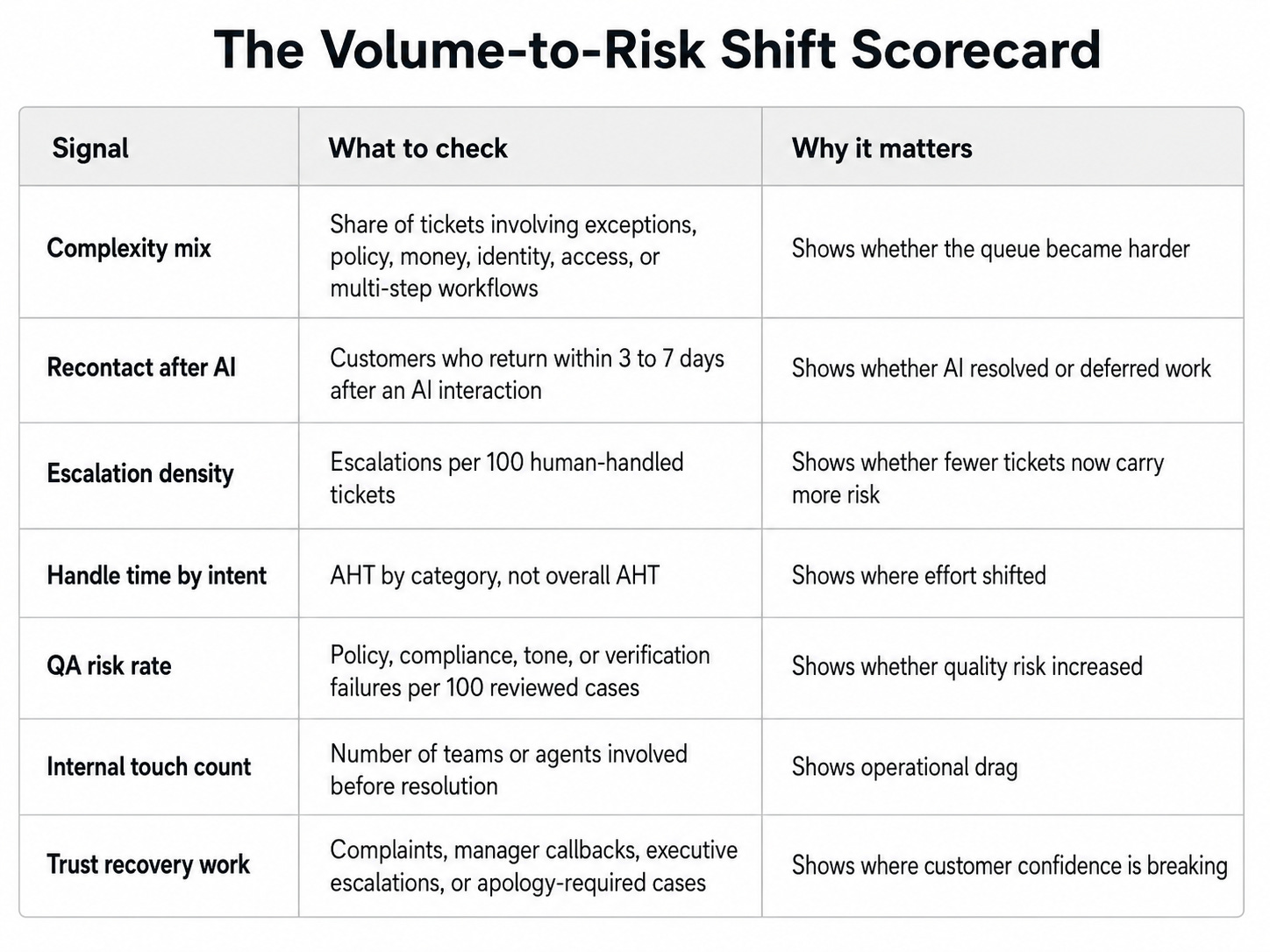
The decision rule:
If volume drops but complexity, recontact, escalation density, or QA risk rises, do not treat the drop as clean savings. Treat it as a workload mix shift.
That sentence saves support leaders from bad math.
It also gives executives a better way to evaluate AI.
The goal is not to protect headcount for sentimental reasons. Support is not a museum for old operating models.
The goal is to avoid cutting the expertise required to handle the work AI leaves behind.
How this works in a real support org
Picture a support organization serving multiple customer types across different programs, policies, and workflows.
Before AI, the queue includes a large number of routine contacts. Customers ask where to apply, how to upload a document, what a status means, where to find a form, or how to complete a familiar step.
Many of these questions appear across phone, chat, and email because customers are persistent and channel strategy is where optimism goes to get mugged.
Then AI goes live.
The chatbot starts resolving basic questions. Agent assist reduces time spent writing summaries. Voice AI collects context before escalation. Knowledge suggestions help agents move faster.
The top-line story looks good.
Common gains include:
• Lower routine contact volume
• Better AHT in simple categories
• Faster first response for common questions
• Higher availability outside business hours
• Cleaner routing for basic issues
• More consistent answers on low-risk workflows
Those gains are real.
They matter.
But now look at what remains.
The human queue starts filling with customers whose cases do not fit neatly into the happy path.
The remaining queue starts filling with cases that do not fit neatly into the happy path. A customer has an approval status that conflicts with an email they received. A payment shows as pending in one system and complete in another. A portal issue looks like user error until an agent checks the record history. A customer asks for an exception because the workflow does not reflect their situation.
Those contacts take longer.
They need:
• Context
• Source verification
• Judgment
• Careful language
• Cross-team coordination
• Clear ownership
• Follow-through
If leadership only sees lower volume, they miss the whole point.
The job moved up the stack.
The support team is no longer only answering. It is interpreting, verifying, escalating, translating, and improving the system.
That requires a different staffing model.
What executives should measure
Executives need a clean view of AI economics, not a victory lap over automation rate.
The executive scorecard should separate three categories.
1. Work AI actually resolved
AI resolved the issue when the customer got the right answer, did not return for the same issue, and did not need hidden manual cleanup.
Measure:
• AI containment rate
• No-recontact rate after AI
• Customer satisfaction on AI-resolved intents
• Ticket avoidance without later escalation
2. Work AI only deferred
AI deferred work when the customer left the interaction but came back through another channel, escalated, or needed correction.
Measure:
• Recontact within 3 to 7 days
• Channel switching after AI
• Tickets created after failed AI interaction
• Manual correction rate
• Repeat contacts tied to the same intent
3. Work AI concentrated for humans
AI concentrated work when it removed the easy layer and pushed a higher-risk mix to the human team.
Measure:
• Human queue complexity mix
• Escalation density
• AHT by high-risk intent
• QA failure rate on policy or verification
• Internal touch count per case
• Manager review rate
The final staffing signal should not be total volume. It should be expert capacity by domain.
That means leaders should know which high-risk workflows need named owners, protected improvement time, and deeper coaching.
If the team has no protected time to improve the system, AI quality decays. Knowledge gets stale. Routing drifts. Policy changes do not land cleanly. Agents build private workarounds. Customers get inconsistent answers.
Then leaders blame the tool.
The tool might deserve some blame. But many AI failures come from operating neglect wearing a vendor hoodie.
What support leaders should do next Monday
Start small.
Do not build a giant reporting temple where common sense goes to die.
Pick one week of AI-assisted and AI-contained support activity. Pull the data. Add judgment.
Use this plan:
Pick five high-volume AI-contained intents.
Pick five high-volume human-handled intents.
Calculate recontact within 3 to 7 days for each intent.
Compare AHT before and after AI for the human-handled version of each intent.
Review 25 to 50 cases from the remaining human queue and tag complexity using these categories:
• Routine
• Policy
• Payment or money
• Identity or account access
• System issue
• Exception or escalation
• High emotionIdentify the top three categories where human effort increased despite lower volume.
Report the findings to executives in one page:
• Volume changed
• Complexity changed
• Risk changed
• Expert capacity needed
• System improvements shipped
If the same high-risk category appears for two weeks in a row, assign an owner. If it appears for four weeks, it needs a workflow fix, not more heroic effort from the queue.
That changes the conversation.
You are no longer saying, “Please do not cut my team.”
You are saying, “Here is where work disappeared, here is where risk concentrated, and here is the expert capacity required to protect customers and savings.”
That is a stronger argument.
It is also harder to hand-wave away, which is rude but useful.
The staffing model has to change
The old model was built around coverage.
Enough people in the right queues at the right times to meet service levels.
That still matters. Customers do not care about your operating model when they are waiting.
But after AI, coverage alone is not enough.
You need expert capacity.
That means people who own domains, not just queues.
A domain owner understands the rules, edge cases, failure patterns, and system gaps. They help write the playbook, review AI failures, feed operations and product the right signal, coach agents, shape escalation language, and improve workflows.
That role pays for itself when it reduces rework, escalations, bad answers, and internal drag.
A strong domain owner reduces:
• Repeat contacts
• Manager escalations
• Policy corrections
• Refund mistakes
• Manual cleanup
• Engineering interruptions
• Customer churn risk
• Executive noise
Executives understand cost. They also understand risk when support leaders explain it clearly.
The trick is not asking them to value expertise in the abstract. Show what happens when expertise is missing. Show the cost of the repeat contact, the escalation, the avoidable complaint, and the three teams cleaning up one bad answer.
Then show the system improvement that prevents the next 50.
At minimum, the post-AI support model needs three named owners:
• Knowledge owner: Owns source quality, stale articles, macros, and decision trees.
• Workflow owner: Owns routing, queue design, handoffs, and skill alignment.
• Escalation owner: Owns high-risk cases, customer narrative, and cross-team follow-through.
The hard part people miss
The hard part is psychological.
Lower volume feels like permission to relax. It feels like the machine is working. It feels like the team should need less leadership attention.
That is often when support gets more fragile.
The easy work used to absorb training gaps. A newer agent could build confidence on simple questions. A generalist could contribute without owning deep judgment. A team lead could spot patterns by watching the whole queue.
AI removes much of that practice layer.
Now newer agents see harder work sooner. Experienced agents get pulled into more exceptions. Leads spend more time cleaning up edge cases and less time coaching. Managers lose the easy visual cue of volume and must inspect quality, risk, and system drift.
This is where organizations make bad cuts.
They remove the people who understand the messy cases because the ticket graph looks friendlier. Then the system loses memory.
Support quality does not collapse all at once. It thins out.
You see it in small ways:
• Answers get less precise.
• Escalations get sloppier.
• Knowledge updates lag.
• Agents depend on tribal knowledge.
• Customers repeat themselves.
• Other teams lose trust in support signal.
• Managers spend more time cleaning up than coaching.
By the time the dashboard shows the problem, the damage is already in the customer relationship.
The better executive story
Support leaders should stop presenting AI only as a deflection story.
Present it as a portfolio shift.
The portfolio has four parts:
• Some work was automated.
• Some work was assisted.
• Some work became more expert-led.
• Some work became system maintenance.
That is the honest model.
The executive story should sound like this:
“AI reduced routine contacts in these categories. That created real savings and faster service for customers. At the same time, the remaining human queue now has a higher concentration of policy, payment, account access, and exception work. To protect quality and trust, we need to preserve expert capacity in those domains and measure recontact, escalation density, QA risk, and internal touch count. The savings are real, but they depend on not cutting the people who keep the system safe.”
That is not anti-AI.
That is pro-economics.
If AI savings depend on customers getting accurate answers, then support expertise is part of the ROI model.
Cutting expertise to prove AI saved money is how companies turn automation into risk transfer.
The close
Back to the dashboard.
Tickets are down. That might be a win. It might also be the first sign that the easy work has left the building and the hard work is now concentrated in fewer hands.
The question is not whether AI reduced volume. The question is whether your operating model knows what replaced it.
Lower volume is not the finish line. It is the start of a different staffing conversation.
What is the highest-risk work still sitting with your human team, and who owns improving it every week?