


The staffing meeting gets harder after AI works
The dashboard looked good. Routine tickets were down. Average handle time had improved. Agents were using AI summaries. Some customers were getting answers before a human ever touched the case.
The AI vendor slide would have looked impressive, because apparently we still let screenshots make staffing decisions now.
Then the queue told the truth.
The remaining tickets were not simple. A customer had already tried self-service. The AI had already answered once. The help center had already failed to clear the confusion. By the time the customer reached an agent, the issue was no longer one clean question.
It was policy plus account history. Product behavior plus billing. A frustrated customer asking why they had received two different answers.
It was an escalation waiting to happen.
This is the moment where support leaders get pressure from both sides.
Finance sees lower volume and asks why the team still needs the same staffing level.
Executives hear “AI handled 40 percent” and assume labor should drop by 40 percent.
Agents feel the work getting harder and wonder why leadership thinks the job got easier.
All three groups are reacting to the same change, but only one group is living inside the queue.
The mistake is treating AI-handled volume as removed work. It is not.
AI changes the shape of support work. It changes who does what. It changes where time goes. It changes the mix of work humans see. It does not erase coverage, complexity, escalation load, QA, AI supervision, or management capacity.
That is the staffing model leaders need now.
What changed
Before AI, support capacity planning was often built around:
• Ticket volume
• Agent availability
• Handle time
• Backlog
• Response speed
That model was never perfect, but it worked well enough when the work was more evenly mixed. A team handling 10,000 tickets had a rough planning path. Volume, handle time, shrinkage, service level, coverage, and queue mix gave leaders a staffing estimate.
AI breaks that simplicity.
The easiest contacts leave the human queue first. Basic status questions. Password resets. Simple navigation. Repetitive policy questions. Clean how-to requests.
That looks like relief.
It is relief, but only for one part of the system.
What remains is heavier work. The human queue becomes more concentrated with exceptions, confused customers, broken handoffs, higher-risk decisions, edge cases, appeals, account-specific context, and issues where the customer already tried the cheaper path.
So the average ticket count drops, but the average judgment required per ticket rises.
This is the operating shift:
AI reduces routine load first. Human work becomes more complex, more supervised, and more connected to risk.
That is why a flat headcount cut based on automation rate is such a bad decision. It mistakes contact reduction for capacity release.
The economic problem
Executives need a staffing model because they are trying to answer a real question.
If AI is handling work, where should savings show up?
That is a fair question.
The answer is not “nowhere.” AI should improve support economics. It should reduce repetitive work. It should improve speed. It should reduce avoidable contacts. It should help agents resolve cases faster. It should improve knowledge reuse. It should help the company scale without hiring at the same linear rate.
But savings only count when the work truly disappears or gets completed safely with less total effort.
There are several places where AI creates partial savings rather than full savings.
AI might shorten the human interaction, but the agent still needs to verify the answer.
AI might contain the first contact, but a customer returns two days later because the answer was incomplete.
AI might summarize the case, but a senior agent still needs to interpret the policy.
AI might route the ticket, but Support Ops still needs to monitor routing quality and fix misclassification.
AI might draft a reply, but QA still needs to track whether AI-assisted responses create reopens or escalations.
AI might reduce the visible queue, but managers now spend more time coaching judgment, handling exceptions, reviewing AI failures, and translating customer signal back to Product, Engineering, Legal, Finance, or Operations.
This is where the financial logic matters.
A support org does not save one full agent hour every time AI touches one hour of prior work. Some work disappears. Some work moves. Some work becomes supervision. Some work turns into quality control. Some work shifts to leads, managers, support ops, and policy owners.
The goal is not to deny savings.
The goal is to measure where the savings are real.
The operating mistake leaders make
The most common mistake is this:
AI handled 35 percent of volume, so headcount should drop by 35 percent.
That logic is clean, simple, and wrong. A tiny miracle of spreadsheet violence.
Here is what it ignores.
First, coverage does not shrink in a straight line. If customers contact you across long business hours, weekends, regions, languages, or channels, you still need coverage. A queue with fewer contacts still needs people available at the right times.
Second, complexity does not average out evenly. A smaller volume of harder cases needs higher skill density, not only fewer seats.
Third, escalation load often rises after AI starts handling simple work. Not always because AI fails, but because the human queue now contains more cases where the stakes are higher.
Fourth, AI supervision becomes real work. Someone needs to review failures, monitor containment quality, audit handoffs, tune knowledge, update macros, review transcripts, and decide what AI should stop doing.
Fifth, manager load changes. Managers spend less time coaching routine workflow and more time coaching judgment, reviewing quality, handling escalations, supporting stressed agents, and explaining operational reality to executives.
If you only model ticket deflection, you miss the system.
A staffing plan built on deflection alone rewards the wrong behavior. It encourages leaders to over-cut, overload the remaining team, and then act surprised when CSAT, reopens, escalations, and agent retention get worse.
The old model asks, “How many tickets did humans no longer touch?”
The better model asks, “What human capacity still needs to exist for coverage, risk, quality, escalation, and system ownership?”
The better model
I would not start with headcount.
I would start with work categories.
An AI-enabled support team has at least six types of work:
Customer-facing resolution work
Coverage work
Complex case work
Escalation work
AI supervision work
Management and coaching work
The mistake is treating all six as one bucket called “tickets.”
They are not the same.
A simple chatbot answer and a policy exception do not require the same person, same time, same QA process, or same risk tolerance.
So the staffing model needs to separate the work before it assigns capacity.
This is the rule I would use before changing staffing plans:
Do not convert AI containment into headcount reduction until you have separated removed work from shifted work, supervised work, and higher-complexity work.
That one rule prevents a lot of bad planning.
The model has five planning layers.
Layer 1: Coverage floor
This is the minimum staffing needed to cover business hours, channels, languages, regions, and service levels.
Coverage does not disappear because AI works. A phone queue still needs people available. A chat queue still needs live backup. Email still needs review. Escalations still need ownership. If your support operation has launches, seasonal spikes, incidents, or high-emotion customer types, coverage needs to reflect that reality.
Ask:
What is the minimum human coverage required by channel, hour, region, language, and escalation path?
Layer 2: Complexity load
This is the human workload left after AI removes simpler contacts.
You need to score complexity, not only count volume.
A case involving one known answer is different from a case involving policy, account history, payment status, product behavior, and a frustrated customer. If those both count as “one ticket,” your model is lying with confidence, which is the preferred language of bad dashboards.
Ask:
What percentage of remaining work requires judgment, policy interpretation, cross-system investigation, or senior review?
Layer 3: Escalation capacity
Escalations do not follow averages. They arrive in clusters. They hit during launches. They hit when policy changes. They hit when systems fail. They hit when customers have already been bounced between channels.
A team without explicit escalation capacity turns senior agents into a panic button. That works until those people burn out or leave.
Ask:
How many people need protected time for escalations, incidents, executive complaints, and high-risk cases?
Layer 4: AI supervision
AI creates an operating system, not a set-and-forget tool.
Someone needs to monitor answer quality, review containment, check recontact, audit handoffs, maintain knowledge, review misroutes, and feed improvements back into the system. If you do not assign this work, it lands on your strongest agents as unpaid invisible labor.
Ask:
Who owns AI quality, failure review, knowledge fixes, intent tuning, and safe rollback decisions?
Layer 5: Manager span
Manager capacity changes when AI changes the work mix.
A manager with eight agents handling routine work has a different job than a manager with eight agents handling complex exceptions, AI-assisted replies, escalations, and high-risk customer situations. The second team needs more coaching, more QA review, more calibration, and more emotional support.
Ask:
What is the real span of control when work gets harder and AI adds review load?
A practical staffing framework
Use this as a first-pass model.
Not perfect. Useful.
Because perfect staffing models tend to arrive three quarters after the damage, wearing a nice deck and an apology.
AI-enabled staffing capacity model
Here is the staffing model I would put in front of Finance before discussing reductions.
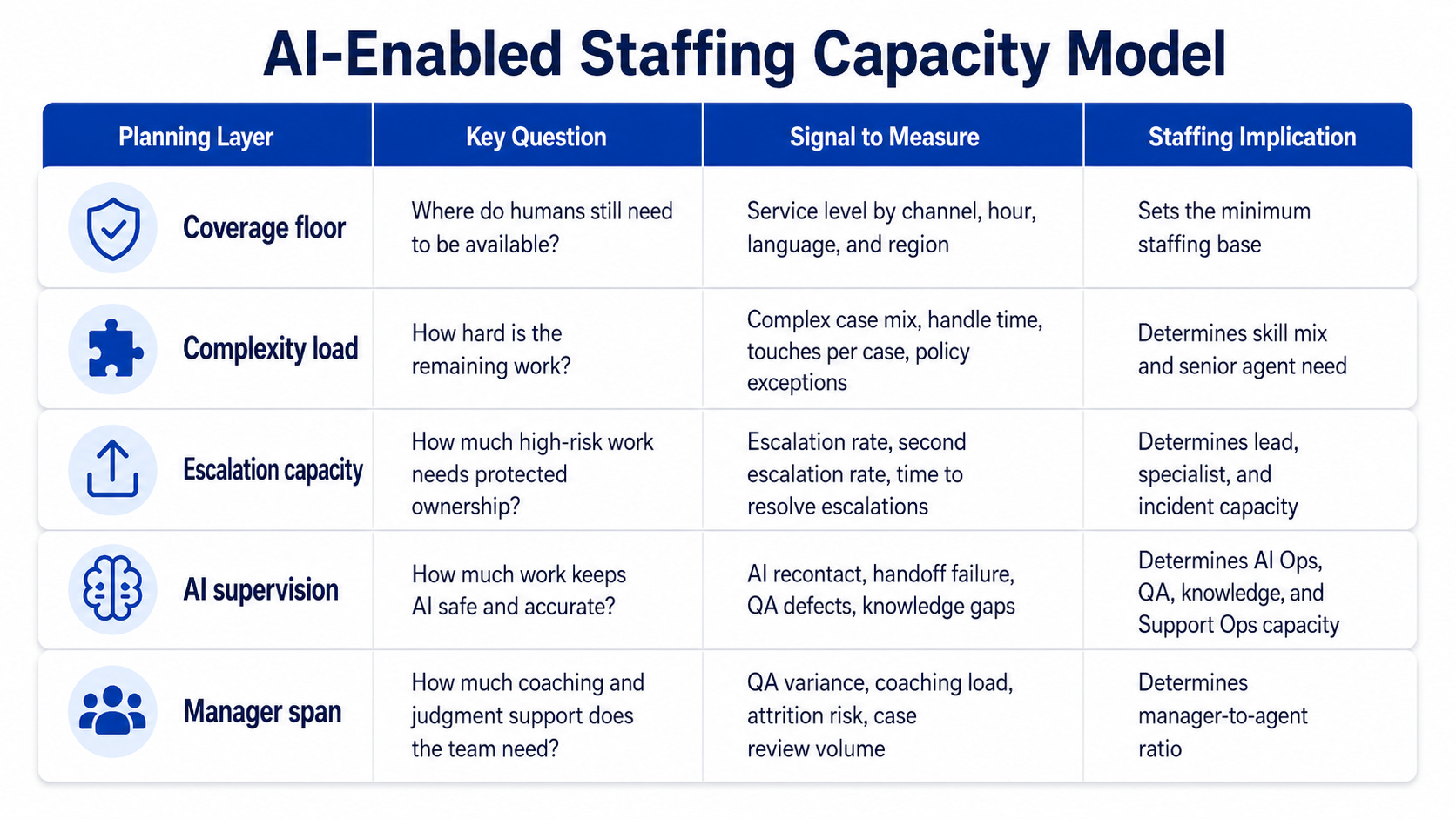
This model does not begin with “AI handled X percent.”
It begins with “What work still requires humans, and what kind of humans?”
That is the real staffing question.
Example: how this works in a real support org
Take a support team with 100,000 monthly contacts.
Before AI, the team has a broad mix of work:
Basic how-to questions.
Account access issues.
Status checks.
Policy questions.
Billing issues.
Escalations.
Technical problems.
Customer complaints.
After AI launches, it handles 35,000 contacts.
Leadership gets excited. Understandable. Humans love cutting things before understanding them. It has been a whole business model for decades.
The bad staffing answer is:
AI handled 35 percent, so reduce the team by 35 percent.
The better answer is to classify the 35,000 contacts and the 65,000 remaining contacts.
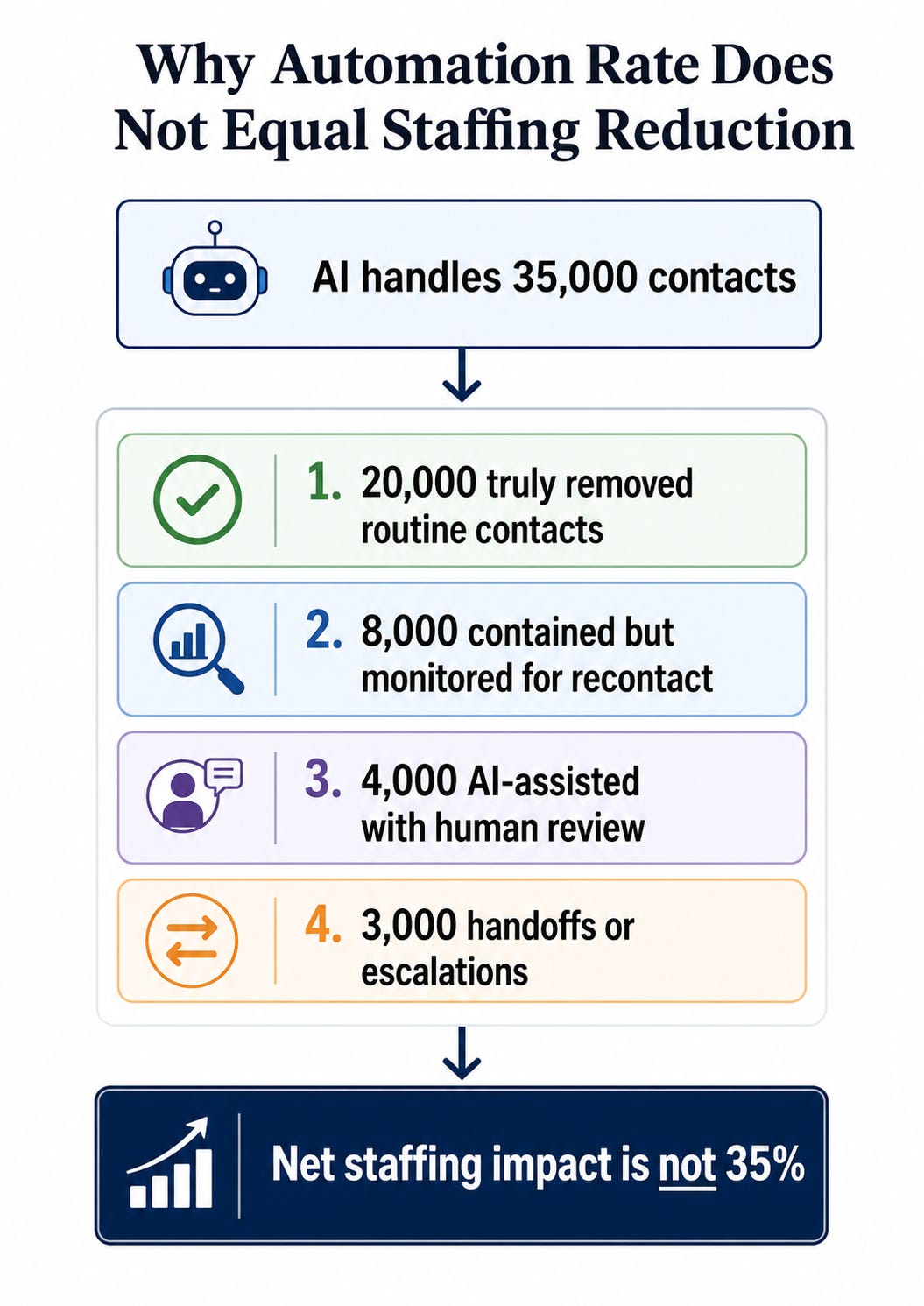
Let’s say the AI-handled contacts break down this way:
20,000 are truly removed routine contacts.
8,000 are AI-contained but need recontact monitoring.
4,000 are AI-assisted contacts where a human still reviews or approves.
3,000 become handoffs or escalations due to low confidence, missing data, or policy risk.
Now look at the human queue.
The remaining 65,000 contacts are not the same as the old 65,000 easiest contacts. They are the harder portion of the old work.
AHT does not fall evenly. It might fall for some assisted cases but rise for complex cases.
First contact resolution might improve in AI-supported workflows but fall in policy-heavy workflows if the knowledge is weak.
QA defects might move from tone and completeness to accuracy, source verification, and handoff quality.
Escalation work might concentrate among leads and senior agents.
Support Ops might spend more time on routing, tags, knowledge gaps, and AI failure patterns.
Managers might spend more time coaching judgment and less time reviewing basic macros.
Now the staffing conclusion changes.
You may still reduce hiring need. You may avoid backfills. You may slow future growth. You may shift headcount from general queue handling into QA, knowledge, support ops, escalation ownership, or senior agent roles.
But you do not cut blindly.
You reallocate based on the work left behind.
Here is the practical version:
If AI removes 20 percent of total labor demand but increases complexity load by 10 percent, creates 5 percent AI supervision work, and requires better escalation coverage, your net staffing opportunity is not 20 percent.
It might be 5 percent.
It might be future hiring avoidance.
It might be a skill mix change.
It might be a manager span change.
It might be “hold headcount flat while volume grows.”
That last one is still a real financial win.
A company that grows 30 percent without growing support headcount 30 percent has improved support economics. It did not need a dramatic layoff slide to prove it.
What executives should measure
Executives need metrics that separate savings from risk.
Start with these.
Cost per resolved contact: Measure the total cost to resolve customer issues, not only the cost per ticket touched by a human. Include AI cost, platform cost, human labor, QA, rework, escalations, and support ops time when possible.
Recontact after AI containment: If a customer comes back within a defined window for the same issue, the original interaction was not fully resolved. Track this by intent. This is where many automation claims start to wobble.
Complexity mix of human-handled work: Track the percentage of human cases requiring policy interpretation, multi-system investigation, escalation review, exception handling, or specialist involvement.
Escalation rate and second escalation rate: A second escalation usually means the first escalation did not resolve the issue, lacked ownership, or failed to align internal teams.
AI-to-human handoff success: Measure whether the agent receives enough context to continue without forcing the customer to repeat the story. Bad handoffs create friction and destroy trust.
QA defect type: Do not only track whether the answer sounded good. Track wrong policy, missing source, incorrect promise, incomplete resolution, poor handoff, and risky wording.
Manager span health: Track coaching volume, QA review load, escalation participation, agent tenure risk, and team complexity. Manager span is not a vanity ratio. It is a control system.
The executive scorecard should answer one question:
Are we reducing total cost while protecting resolution quality, risk control, and customer trust?
If the answer is yes, AI is improving support economics.
If the answer is “containment is up,” keep digging.
What support leaders should do next Monday
Here is the Monday plan.
Pull the last 30 days of support volume.
Separate human-only, AI-assisted, AI-contained, and AI-to-human handoff contacts.Classify the remaining human work by complexity.
Use low, medium, and high. Low means known answer and low risk. High means risk, escalation, money, legal language, exception handling, or emotional intensity.Build a coverage floor.
Map coverage by channel, hour, region, language, and escalation path. This becomes your minimum viable staffing base.Estimate AI supervision work.
List the recurring work needed to keep AI safe: transcript review, knowledge fixes, QA sampling, handoff audits, recontact review, routing tuning, and failure triage.
Assign hours and owners.
Review escalation load
Look at escalation volume, time to resolve, second escalations, and who absorbs the work. If your senior agents are carrying it informally, you have a staffing risk hiding under heroics.Recalculate manager span.
Do not use one generic manager ratio. Adjust for complexity, QA load, coaching needs, escalation load, and change velocity.Create three staffing scenarios.
• Scenario A: Keep headcount flat, shift roles
• Scenario B: Reduce future hiring, maintain current team
• Scenario C: Reduce headcount only after risk metrics stay stable for a defined period.Put guardrails around any reduction decision.
Do not reduce staffing if AI recontact is rising, escalation rate is rising, QA defects are shifting toward accuracy, or manager load is already unhealthy.
That is not caution.
That is operations.
The role mix matters more now
The future support team is not only a smaller version of the old team.
It has a different shape.
• Frontline agents: Handle the work customers feel most.
• Senior agents and specialists: Own judgment-heavy domains.
• Escalation leads: Protect the customer and the company when cases get risky.
• QA: Move beyond tone and track accuracy, sourcing, completeness, and safety.
• Knowledge ownership: Keep the help center usable for humans and AI.
• Support Ops: Own routing, reporting, workflows, and AI failure patterns.
• Managers: Coach the team through harder work with enough room to lead.
This is the headcount conversation leaders should bring to Finance.
Not “please let us keep everyone because change is hard.”
That will not work.
Bring the model. Show the coverage floor, the complexity shift, the escalation load, and the AI supervision work. Show the cost of poor handoffs, recontacts, and second escalations. Then show where AI created true savings and where it created capacity you are reinvesting into quality, risk control, and scale.
Finance does not need a sentimental defense of support. It needs operating logic.
Give them that.
The hard part people miss
The hardest part is admitting that AI success makes some human work harder.
That sounds backwards to executives who mostly see charts.
But inside the support org, the pattern is obvious. When AI removes the easy work, agents see fewer easy wins. Their day becomes a heavier mix of ambiguity, frustration, and judgment.
That affects performance, morale, retention, coaching, QA, and hiring.
A team might handle fewer tickets and still need more expertise.
A manager might manage fewer people and still carry a heavier load.
A support org might reduce cost per contact and still need dedicated AI supervision.
The failure mode is pretending those tradeoffs do not exist.
The fix is to make the hidden work visible before headcount decisions happen.
Do not wait for burnout, backlog, reopens, escalations, and customer complaints to prove the point for you. That is a slow and expensive way to become correct.
The callback
Back to the dashboard.
Routine tickets were down. AHT had improved. AI was helping. The story was real.
But the queue was also telling a second story.
The work left behind required more judgment, better handoffs, stronger escalation ownership, cleaner knowledge, tighter QA, and managers with enough capacity to coach the team through the shift.
That is the staffing conversation support leaders need to lead.
Not against AI.
Because of AI.
The right question is not, “How many tickets did AI handle?”
The right question is:
After AI changes the work, what human capacity still protects quality, risk, and customer trust?
That is the staffing model worth building.
One question for readers:
When AI removes your easiest contacts, what part of your support operation becomes the new bottleneck first: coverage, complexity, escalations, QA, or management capacity?