The Hidden Costs Nobody Books in AI Support
The meeting where the savings started getting expensive

The dashboard looked great. Ticket volume was down, chatbot containment was up, average handle time had improved, and first contact resolution looked healthier than expected.
The vendor slide had the kind of clean math executives like: fewer tickets, lower cost, higher efficiency.
Then the support ops manager opened the backlog.
There were stale articles waiting for review. A queue of AI answers needed QA. Three policy exceptions showed signs of old guidance. Two escalations involved customers who had already been “resolved” once by AI, then came back angrier because the answer was incomplete.
The CFO asked a fair question:
“If AI is reducing the workload, why are we adding more operational work?”
That is the question most AI support business cases are not ready to answer, because the work did not disappear. It changed shape.
The simple contacts left the queue first: password resets, basic how-to questions, order status checks, and copy-paste answers with one clear decision point. What stayed behind was harder to price: knowledge maintenance, drift review, test sets, QA calibration, escalation review, governance, vendor management, and trust repair when AI gives a clean answer to a messy problem.
Vendor decks rarely book those costs. Support teams pay them anyway.
What changed
Before AI, support cost was easier to explain. Volume drove staffing. Handle time drove capacity. Backlog drove urgency. CSAT and quality told you whether the team was keeping up.
That model was never perfect, but the work was visible. A customer wrote in. An agent answered. Time was tracked. QA sampled the response. Reporting showed the queue.
AI moved part of the work outside the ticket.
Now a customer might interact with AI before a human sees the issue. A summary might land in the ticket. A suggested reply might shape the answer. A workflow might route the case before an agent reads it. A knowledge article might feed both the bot and the human response.
The real support operation now has two layers. The visible layer is the customer conversation. The hidden layer is the system producing, shaping, routing, and supervising that conversation.
“AI did not remove support operations. It added a second operation inside support.”
The economic problem is simple. Most companies measure the visible savings and ignore the hidden labor. Then they wonder why the ROI feels weaker than the demo.
The economic problem
The first version of AI ROI usually looks clean. AI handled 40 percent of contacts. Those contacts used to cost a certain amount each. Therefore, savings equal 40 percent of volume times cost per contact.
That math is easy to present, but it is incomplete.
Support leaders know the missing pieces because they show up on Monday morning. An AI answer was “contained,” but the customer recontacted support two days later. A workflow routed a customer to the wrong team because the intent model missed a policy nuance. A macro rewrite changed tone in a way QA did not catch until customers complained. A product change went live, but the knowledge article feeding AI was updated 36 hours later.
None of those failures looks dramatic in isolation. Together, they become a tax.
Here is the financial logic leaders need to use instead:
Net AI support value = avoided manual work + improved resolution quality + retained trust, minus AI operating costs + rework + risk controls + trust repair.
The hard part is not writing the formula. The hard part is being honest about every cost in the second half.
A containment rate tells you how much work AI touched. It does not tell you how much work AI removed. That difference matters because a customer who gets the wrong answer from AI might cost more than a customer who waited for a human.
The second customer is delayed. The first customer is misled. Delay is frustrating. Misleading guidance breaks trust.
The operating mistake leaders make
The common mistake is treating AI maintenance as background work.
The support leader hears the same assumptions: the knowledge team already owns documentation, QA already samples tickets, Support Ops already manages workflows, managers already review escalations, the vendor owns the model, and Engineering will help if something breaks.
Each sentence sounds reasonable on its own. Together, they create an operating model based on spare capacity.
That is where things break.
Knowledge teams do not have spare capacity after every product launch. QA teams do not magically gain time to review AI output. Support Ops does not get free hours to tune routing, monitor handoff failures, and manage vendor settings. Managers do not have unused time for escalation review after AI removes the easy tickets and leaves them the hard ones.
The work gets absorbed by the most responsible people. That should make every executive nervous, because “absorbed by responsible people” is not a staffing model. It is a burnout model with better manners.
I have seen this happen in real support operations. A team launches AI assist. At first, the gains feel real. Summaries save time. Suggested replies help new agents. Triage improves. Then the exceptions appear. A policy changes. A source article conflicts with a runbook. An AI summary leaves out a critical detail. A customer returns after a contained conversation. A manager has to unwind the case.
Nobody planned for those hours because the hours were not in the business case.
The dashboard says the operation got lighter. The team feels the operation got heavier. Both things can be true when the company measures only the visible side of AI.
What a better AI support cost model looks like
The better model is not anti-AI. It is pro-accounting.
Support leaders need a hidden-cost ledger for AI support. Not a complex finance model. A simple operating ledger that shows the work AI removes, the work AI creates, the risk it changes, and the trust impact customers feel.
A useful ledger answers four questions. What work did AI remove? What work did AI create? What risk did AI change? What trust impact did customers feel?
This is the model executives need. It connects cost, quality, risk, and trust instead of pretending automation rate tells the whole story.
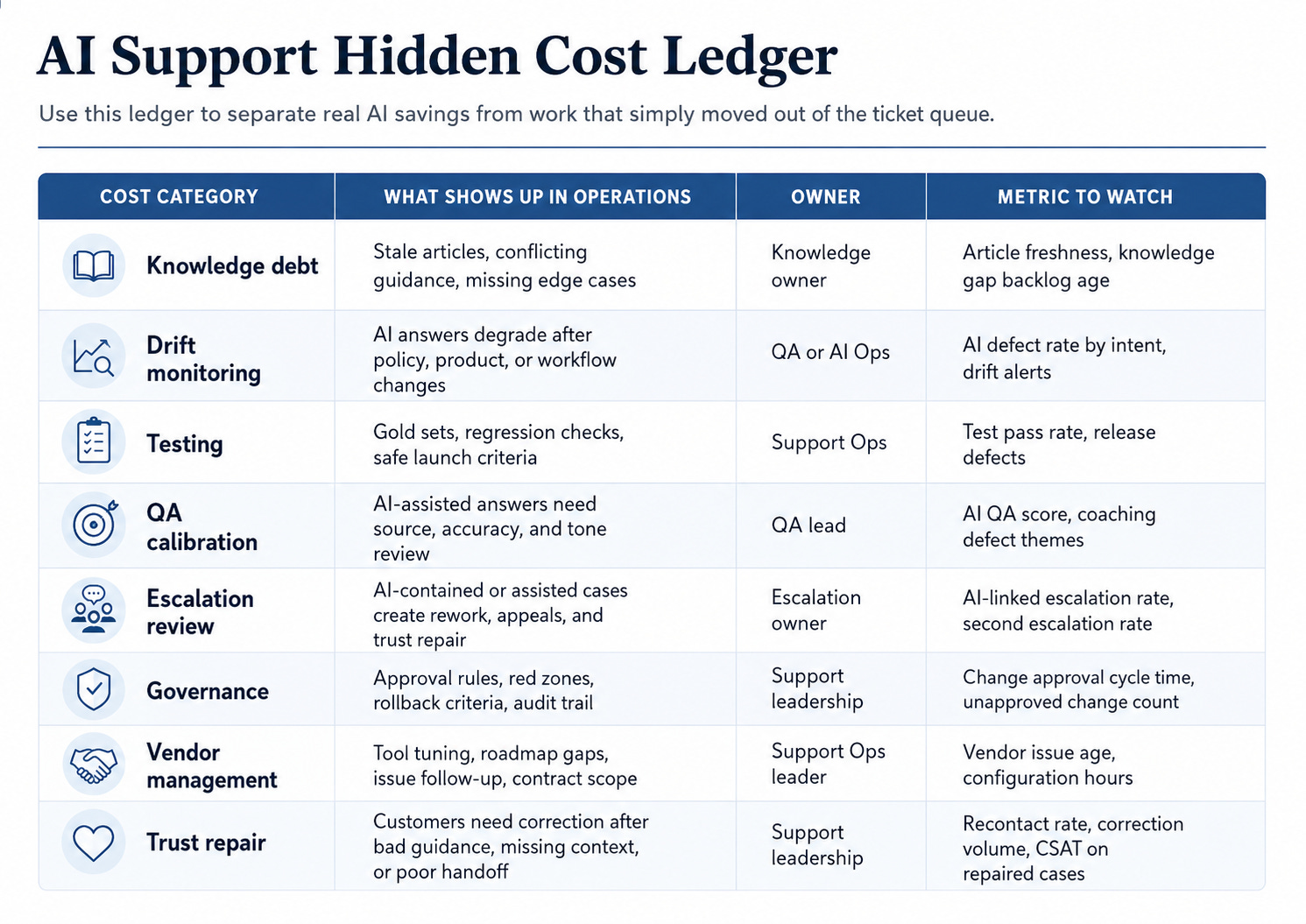
The goal is not to make AI look expensive. The goal is to stop treating the second operation as free.
A containment rate tells you how much work AI touched. It does not tell you how much work AI truly removed. That difference matters because work often comes back through recontacts, escalations, corrections, QA defects, and customer trust repair.
A practical decision rule
Use this rule before expanding any AI workflow:
Every new AI scope needs four booked controls: an owner, a source of truth, a QA sample, and a rollback path.
No owner means nobody fixes it. No source of truth means AI guesses from whatever content it finds. No QA sample means quality becomes a feeling instead of an operating standard. No rollback path means the team improvises during customer impact.
Here is what that looks like in practice. If the bot answers eligibility questions for a policy-heavy workflow, Support Ops owns workflow behavior, the knowledge owner owns content, and QA owns weekly sampling. The source of truth includes the public help center article, the internal policy runbook, and the system of record for customer status. For the first month, QA reviews 50 contained conversations per week, then shifts to risk-based sampling by intent. If AI defects cross the agreed threshold on high-risk answers, the team pauses the intent and routes those cases to trained agents until content and testing pass review.
This sounds basic because it is basic. Most failures in AI support do not come from mysterious model behavior. They come from unclear ownership, stale truth, thin testing, and nobody knowing who has authority to stop a bad workflow.
That is why hidden costs need to be booked early. If they are not booked in the plan, they still show up in the operation.
Example: when “contained” did not mean “resolved”
Picture a high-volume support org with multiple customer types and policy-heavy workflows.
AI starts with safe use cases: summaries, knowledge suggestions, and triage. Then it moves into customer-facing containment for routine questions. At first, the numbers look strong. The bot handles a large share of repetitive contacts. Agents get better summaries. Average handle time improves. Leaders feel confident expanding the scope.
Then a policy update lands.
The internal runbook changes first. The help center article changes later. A related macro still uses old wording. The AI continues answering based on a mixed knowledge environment.
Customers asking a routine question receive an answer that sounds clear, but the answer is incomplete for one customer segment. The bot contains those conversations. The dashboard counts them as success.
A few days later, customers return through email, chat, and phone. They include screenshots. They say support already told them something different. Agents now have to explain the policy, correct the prior guidance, document the mismatch, escalate the knowledge issue, and rebuild confidence.
That cost did not exist in the containment slide. It existed in the queue.
Suppose 1,000 AI conversations were marked contained for a policy intent. If 8 percent recontact support because the answer was incomplete, that creates 80 new contacts. If each recontact takes 12 minutes because the agent has to review prior AI guidance and correct the record, that adds 16 hours of agent time.
If 20 of those cases require escalation review at 20 minutes each, that adds nearly 7 more hours. If QA samples 50 conversations and finds a source conflict, the knowledge owner might spend 4 hours fixing articles and macros. Support Ops might spend another 3 hours tuning the flow and testing the change.
That hidden operating cost is now close to 30 hours, before you price customer frustration, executive escalations, refunds, credits, churn risk, or brand damage.
This does not mean AI failed. It means the original business case was incomplete. The better conclusion is not “turn off AI.” The better conclusion is: book the operating system.
What executives should measure
Executives need a scorecard that prevents fake savings. I would track five signals:
Verified AI resolution rate: AI-contained conversations with no recontact, no escalation, no QA defect, and no correction within the review window.
AI operating hours: Time spent on QA, knowledge fixes, workflow tuning, vendor follow-up, testing, and escalation review.
AI-linked rework: Recontacts, handoff failures, wrong summaries, bad routing, and public replies needing correction.
Risk exposure: AI defects grouped by risk tier, especially for policy, money, account access, cancellation, compliance, or legal language.
Trust repair: Cases where support had to correct AI guidance, apologize, involve a manager, or rebuild customer confidence.
These measures do not replace automation rate. They complete it.
A strong AI program should reduce manual work without increasing rework, risk, or trust damage. That is the actual economic test.
Where the hidden costs land
Vendor decks tend to show the clean side of the ledger: automation rate, ticket deflection, agent productivity, faster response time, and cost per contact reduction. Those metrics matter. I have used them. I care about them. They are still not enough.
The missing costs usually land in the same places. Knowledge debt grows when stale articles become AI inputs. Drift appears when policy, product, customer behavior, or content changes. Testing becomes necessary every time a new flow expands scope. QA calibration changes because AI-assisted answers need source review, not generic ticket scoring.
Escalation review gets harder because the cases reaching humans carry more emotion and ambiguity. Governance matters because someone has to decide what AI must never answer, what needs approval, and when to roll back. Vendor management becomes real operational work because the tool does not manage itself. Trust repair shows up when the next human response has to solve both the issue and the confidence damage.
Those costs are not reasons to avoid AI. They are reasons to run AI like operations.
The hard part people miss
The hardest hidden cost is not QA. It is decision latency.
When AI gives a bad answer, support has to move fast. The team needs to know whether the issue is content, workflow, policy, model behavior, routing, or agent usage. Most companies do not have that path defined.
So the issue bounces. Support says the bot is wrong. Product says the article is unclear. Engineering says the tool is working as configured. The vendor asks for examples. QA asks for a sample size. Managers ask whether agents were trained. Executives ask whether the risk is material.
Meanwhile, customers keep receiving the same flawed answer.
This is how a small defect turns into an operational incident.
The fix is straightforward. Name the decision path before launch. For each AI workflow, define who owns content, who owns workflow behavior, who owns QA review, who owns customer communication, who has authority to pause or roll back, and who tells executives when risk crosses the line.
Without that structure, support debugs ghosts. A bad article looks like a bot problem. A routing issue looks like an agent issue. A policy ambiguity looks like a QA issue. A vendor limitation looks like a leadership failure.
The customer does not care which internal label is correct. The customer only knows the company gave them a bad answer.
What support leaders should do next Monday
You do not need a perfect model to start. You need a first ledger.
Next Monday, do this:
Pull the top five AI-assisted or AI-contained intents by volume.
Name the risk tier for each one: low, medium, or high.
Assign owners for content, workflow, and QA review.
Review the last 25 AI-contained conversations for each high-risk intent.
Count recontacts, handoff failures, corrections, escalations, and hidden operating hours from the past week.
Pick one weak workflow. Improve the control or reduce the AI scope.
Keep this lightweight. The goal is not to build a finance museum. The goal is to stop treating hidden labor as free.
The executive conversation
If I were talking to a CFO, COO, or CEO, I would not lead with “AI is risky.” That framing creates the wrong debate.
I would lead with this:
AI support ROI is real only when the company measures both sides of the ledger.
The company should want automation. It should want better summaries, faster triage, stronger self-service, cleaner agent workflows, and lower manual effort. The company should also want durable savings.
Durable savings require operating discipline. That means the AI business case must include the cost of keeping answers accurate, workflows safe, escalations clean, and customer trust intact.
An executive does not need to approve every AI configuration change. They do need to ask whether the AI program has a cost model beyond “the vendor said containment.”
Instead of asking only how much AI contained, executives should ask what work AI truly removed, what new work it created, which customer moments became riskier, which roles own knowledge and QA, what happens when AI performance degrades, and where customer trust required repair.
Those questions move the conversation from demo math to operating math. That is where support leaders should want the conversation to go.
The real ROI question
Back in that meeting, the dashboard was not wrong. Ticket volume was down. AHT improved. AI was helping.
But the backlog told the rest of the story. The work had moved into knowledge, QA, governance, escalation review, and trust repair. The team was not resisting AI. They were operating it.
“The dashboard showed the savings. The backlog showed the cost.”
That is the part leaders need to book.
The future of AI in support will not be won by the company with the prettiest automation rate. It will be won by the company that knows what the automation costs, what risk it changes, and what trust it preserves.
AI support ROI is not automation rate. It is the relationship between cost, quality, risk, and retained customer trust.
So here is the question I would ask every support leader and executive:
Which AI support cost is your team already paying, but your business case has not booked yet?