


The clean invoice was the problem
The vendor deck looked good.
Not flashy. Not ridiculous. No cartoon robot shaking hands with a customer, which already placed it above most AI sales material. The dashboard showed thousands of “resolutions.” The line chart moved in the preferred executive direction. The cost per resolution looked lower than the internal cost per ticket.
Finance liked the simplicity. Every resolved conversation had a price. Every price had a line item. Every line item looked easier to defend than headcount, overtime, QA time, knowledge work, escalation cleanup, and the assorted operational debris support teams inherit because humans invented software and then made other humans explain it.
Then Support Ops pulled up the recontact view.
A different picture showed up. Some customers came back two days later with the same issue. Some accepted an AI answer because it sounded confident, then opened a ticket when the answer did not work. Some conversations were marked resolved, but the human team still had to review the account, fix the workflow, or explain the exception.
Some handoffs arrived with a summary so thin the agent had to ask the customer to repeat everything.
The invoice said resolution. The operation said unfinished work.
That is the per-resolution trap, and it starts when leaders accept the vendor’s definition before they define their own.
What changed
AI support vendors moved the pricing conversation away from seats, licenses, and usage. Many now sell outcomes. That sounds better, and in some ways it is better. Support leaders have been asking vendors to stop selling tools and start proving value, so we should not act shocked when vendors put a price on the outcome.
The problem is the definition.
In support, a resolution is not a closed conversation. It is not the last AI message. It is not the absence of a live-agent handoff. It is not a customer leaving the chat because the bot gave a polished answer and everyone decided to pretend the work was done.
A real resolution means the customer’s issue stayed solved. The answer matched policy. The risk stayed inside the right boundary. The support team did not absorb hidden cleanup later.
That is the shift leaders need to understand before they accept per-resolution pricing. The pricing model is not the issue. The issue is letting the vendor define the unit of value before Support defines the operating reality.
By the end of this article, you will have a practical way to read per-resolution pricing without letting a vendor redefine your economics for you.
The economic problem
Per-resolution pricing is attractive because it makes AI feel variable. If the vendor resolves more, you pay more. If volume drops, you pay less. Finance sees alignment. Procurement sees predictability. Executives see a clean unit cost.
Support sees the missing denominator.
The vendor claims 40,000 resolutions at $1.25 each. That looks like $50,000 for work you did not need humans to handle. Compare it against a $6 or $9 internal cost per contact and the ROI starts glowing like a dashboard built by someone with no consequences.
But the cost per vendor-defined resolution is not the same as the cost per clean resolution.
A clean resolution survives four tests:
It does not create a related recontact.
It does not require human cleanup.
It does not cross a risk boundary.
It does not hide an excluded case inside a success number.
If the vendor resolves 40,000 conversations, but 8,000 create repeat contact, 3,000 need agent cleanup, 2,000 involve weak handoffs, and 1,000 should have been excluded from automation, the economics change. Not a little. A lot.
You did not buy 40,000 clean resolutions. You bought a mix of resolved work, deferred work, misclassified work, and operational debt. Neat trick. We turned support quality into invoice fog.
The operating mistake leaders make
The mistake is accepting the vendor’s definition of “resolution” before defining your own.
This usually happens because support leaders get pulled into the pricing discussion too late. By then, the vendor has framed the business case. The CFO has seen the savings slide. The COO has seen the automation rate. The executive team has heard a clean story: pay only for what gets resolved.
Then the support leader has to be the person who asks, “What do we mean by resolved?”
That question sounds small. It is not. It decides whether the company pays for customer outcomes or vendor events. It decides whether support capacity drops in a responsible way or whether teams get squeezed while hidden work grows. It decides whether AI improves trust or creates a quiet recontact machine.
Per-resolution pricing is not the trap. The trap is signing a contract where the vendor owns the definition, the measurement window, the exclusions, and the proof.
That is how a clean contract creates messy operations.
The better model
The better model starts with a support-owned definition of resolution. That definition should be simple enough for Finance to understand and strict enough for frontline operators to trust.
Here is the rule I would use:
A billable AI resolution should mean the customer received a correct, complete, policy-safe answer, no human cleanup was required, and no related recontact occurred inside the agreed measurement window.
That rule is not anti-vendor. It is pro-clarity. Good vendors should welcome it because it protects the use cases where AI works well. It prevents bad expansion. It keeps the conversation honest when routine volume drops and complexity rises.
Weak vendors will call it too strict. Translation: they were hoping to charge for some fog.
The Resolution Integrity Scorecard
Before you sign or renew a per-resolution contract, you need one practical tool: a scorecard that pressure-tests vendor pricing, vendor claims, and monthly reporting.
Use this scorecard before accepting vendor-reported resolution numbers:
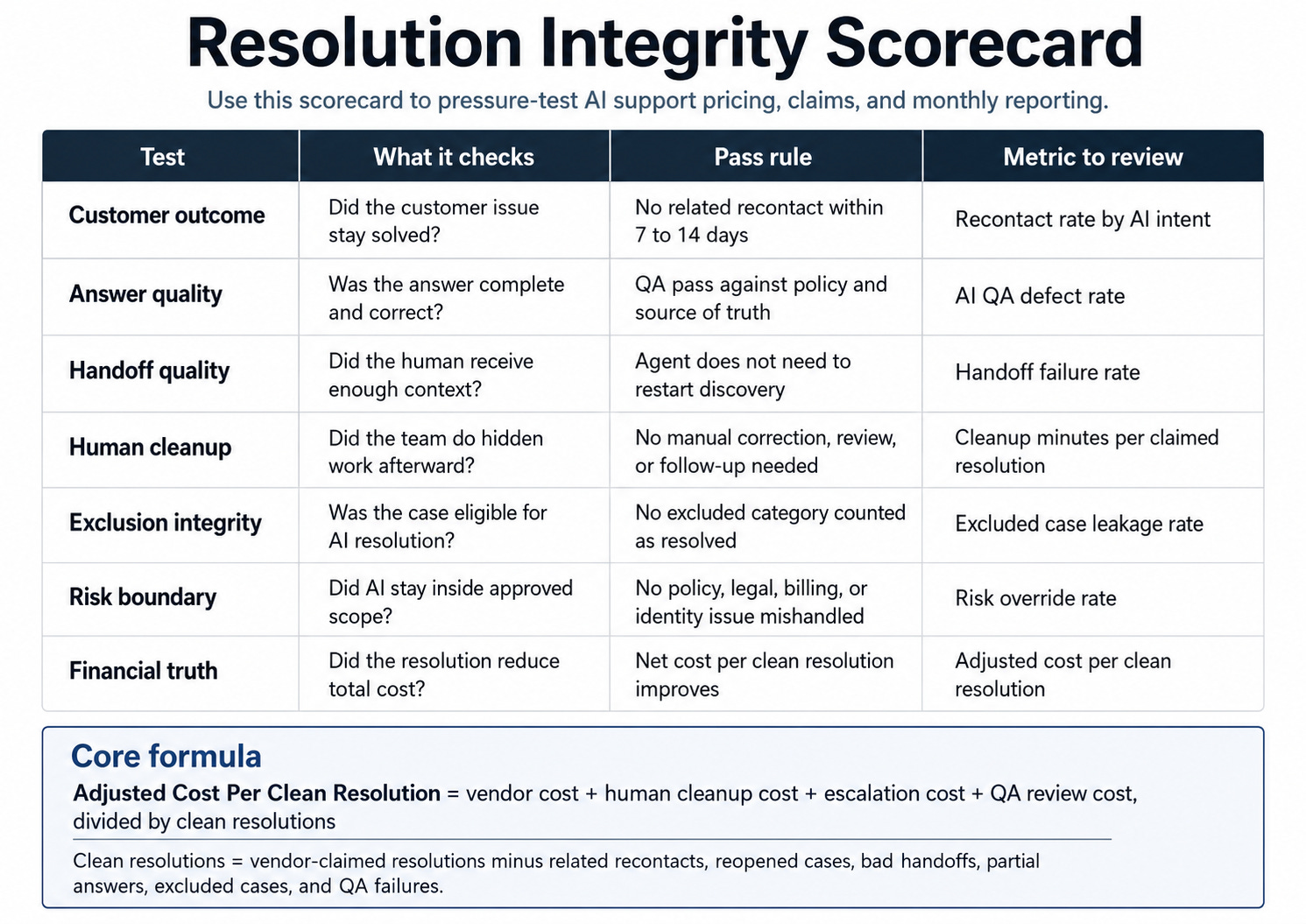
The scorecard turns vendor-reported resolution into an operating review.
The formula matters because it adds the work vendors often leave out:
Adjusted Cost Per Clean Resolution = vendor cost + human cleanup cost + escalation cost + QA review cost, divided by clean resolutions.
Clean resolutions are vendor-claimed resolutions minus related recontacts, reopened cases, bad handoffs, partial answers, excluded cases, and QA failures.
This changes the conversation. It moves the review away from “How many conversations did the AI close?” and toward “How much work stayed solved without increasing risk?”
That is the conversation support leaders need executives to have.
How this works in a real support org
Use a realistic support example.
A company launches AI on routine account, billing, and order-status questions. The vendor charges $1.20 per resolution. In the first month, the vendor reports 25,000 resolutions. The invoice is $30,000.
The vendor business case compares those 25,000 resolutions to a $7 internal cost per human contact and claims $145,000 in avoided cost. Beautiful math. Too beautiful. When math starts wearing perfume, check the assumptions.
Support Ops runs a 30-day integrity review.
Out of 25,000 vendor-claimed resolutions:
3,500 customers recontacted support within seven days on the same issue.
1,750 conversations required human cleanup.
900 handoffs lacked enough context for the agent to continue.
600 conversations involved excluded categories AI should not have handled.
250 failed QA because the answer was incomplete, outdated, or too confident.
That leaves 18,000 clean resolutions.
Now add hidden costs. Human cleanup took 420 hours. At a loaded support cost of $38 per hour, that equals $15,960. Escalation cleanup took 80 hours across leads, Support Ops, and policy owners. At a blended cost of $55 per hour, that equals $4,400. QA sampling and review took 55 hours. At $45 per hour, that equals $2,475.
Total cost is no longer $30,000. It is $52,835.
The vendor-reported cost per resolution was $1.20. The adjusted cost per clean resolution is $2.94.
That still might be a good deal. This is the part vendors hate and operators respect. The goal is not to make AI look bad. The goal is to make the economics real.
If the internal cost of a comparable clean human resolution is $7, then $2.94 still works. Expand carefully. If the clean resolution cost rises to $6.50 and recontacts climb, the savings are thin and trust risk is rising. Fix the workflow before expanding.
If excluded case leakage includes billing disputes, policy exceptions, identity issues, or legal language, stop counting those as success. Move them to a governed path.
This is how a support operator reads the contract. Not with fear. Not with hype. With math tied to work.
Where per-resolution pricing goes wrong
Per-resolution pricing fails when it rewards closure instead of durable resolution. The failure usually shows up in four places.
First, recontacts get treated as new demand.
A customer gets a partial answer from AI, leaves, then returns later. The vendor counts the first interaction as resolved. The support team handles the second contact. Finance sees two events. The customer experienced one unresolved issue.
This matters because repeat contact is one of the clearest signs of broken support economics. It creates more work, more frustration, and more noise in reporting. If recontacts do not debit the vendor’s success claim, the vendor gets paid while the support team pays the operational tax.
Second, partial answers look successful.
AI handles the easy half of the issue and leaves the hard part behind. A customer asks, “Where is my reimbursement?” The AI explains the general policy. The real issue involves missing documentation, a state-specific rule, or a failed system sync. The conversation ends, but the case is not done.
This is where leaders confuse answer generation with resolution. A useful answer is not always a resolved issue.
Third, handoffs become invisible labor.
A bad handoff shifts cost to the agent. If the customer has to repeat the story, the AI did not assist the team. It annoyed the customer first, then made the agent clean the room.
A clean handoff includes customer intent, verified facts, attempted steps, source used, risk flags, and recommended next action. Anything less is a summary-shaped burden.
Fourth, exclusions get blurry.
Every AI program needs red zones. Escalations. Policy exceptions. Payments. Identity verification. Legal language. Sensitive data. High-emotion complaints. Any workflow where a confident wrong answer creates disproportionate risk.
If the contract lets the vendor count excluded or borderline cases as resolutions, the company is paying for risk exposure while calling it efficiency.
The contract questions every support leader should ask
Before accepting per-resolution pricing, ask questions in plain language. Do not let the conversation disappear into procurement fog. That place has claimed enough souls.
The goal is not to make the vendor defensive. The goal is to make the economics real before the contract turns a reporting definition into a business case.
1. What exactly counts as a billable resolution?
Ask for the operational definition. A closed conversation, no live-agent handoff, or customer inactivity should not qualify on its own. A resolution should mean the customer received a correct, complete, policy-safe answer and no hidden support work followed.
2. What recontact window debits the resolution?
Use 7 to 14 days for many support workflows. Billing, reimbursement, compliance, implementation, and policy-heavy issues might need a longer window. The window should match the customer journey, not the vendor dashboard.
3. Are partial answers billable?
If AI explains the general policy but a human finishes the actual case, do not count it as a full resolution. That might have assist value. It is not resolution value. There is a difference between answering part of the question and resolving the customer’s problem.
4. How are handoffs scored?
The contract should define successful handoff quality. A clean handoff includes customer intent, verified facts, attempted steps, source used, risk flags, and recommended next action. If the agent restarts discovery, the handoff failed.
5. Which cases are excluded from automation and billing?
Name the red zones before launch. Policy exceptions, refunds, identity mismatch, legal threats, account security, system defects, high-risk complaints, and sensitive-data scenarios should not drift into the billable resolution count.
6. Who owns QA, sampling, and dispute rights?
Support needs audit rights. The vendor should not grade its own homework without review. Set a sample size, review cadence, dispute process, and correction timeline before the first invoice review.
7. How are knowledge gaps handled?
If bad source content drives wrong AI answers, the fix needs an owner, a timeline, and a reporting loop. Otherwise, the same issue becomes billable noise every month. The contract should explain how knowledge issues get logged, prioritized, fixed, and retested.
8. What happens when the resolution integrity rate drops?
Put remediation terms in writing. Pause expansion. Review intents. Adjust eligibility. Add human verification. Fix knowledge. Change the handoff design. If resolution quality drops, the answer should not be “keep billing and admire the chart.”
The best vendor conversations do not avoid hard questions. They answer them early, before pricing, reporting, and executive expectations harden around the wrong definition of success.
What executives should measure
Executives do not need every support metric. They need the few numbers that show whether AI is reducing cost without increasing risk.
Start with these:
Core financial metric
Cost per clean resolution: Total AI program cost plus hidden support costs, divided by clean resolutions.
Quality and risk checks
Resolution integrity rate: Clean resolutions divided by vendor-claimed resolutions.
AI recontact rate: Percent of AI-resolved conversations followed by related customer contact inside the agreed window.
Handoff failure rate: Percent of AI-to-human handoffs where the agent lacks enough context to continue.
Excluded case leakage: Percent of AI-resolved conversations that should have been routed to a human path.
QA defect rate by intent: Percent of sampled AI answers that fail source, policy, completeness, or tone standards.
Complexity shift: Change in remaining human ticket mix, including escalations, exceptions, handle time, and senior-agent involvement.
Together, these metrics show whether AI is reducing work or moving it.
If cost per clean resolution drops while recontact, handoff failure, and excluded case leakage stay low, AI is working. If automation rate rises while recontact and complexity rise, AI is shifting work. If vendor-reported savings rise while support leaders add QA, knowledge, escalation, and policy-review labor, the ROI model is incomplete.
What support leaders should do next Monday
Here is the practical move for next Monday. Do this before vendor-reported resolutions become the whole story.
1. Pull one month of vendor-claimed resolutions.
Do not start with every workflow. Choose one high-volume AI intent and one medium-risk AI intent. You want enough volume to see patterns and enough risk to expose hidden costs.
2. Define clean resolution in writing.
Use your business language. Include the recontact window, handoff quality bar, exclusion rules, QA expectations, and human cleanup rules. If Support, Finance, Procurement, and the vendor use different definitions, your ROI model is already broken.
3. Audit a sample of 100 claimed resolutions.
Tag each claimed resolution as clean, recontacted, partial, bad handoff, excluded, QA fail, or cleanup required. Keep the categories simple. The point is to find economic distortion, not build a taxonomy museum.
4. Add hidden labor cost.
Estimate agent cleanup time, lead review time, QA time, escalation time, and Support Ops time. Use loaded hourly cost. Do not use hope, vibes, or “it only takes a minute,” the official anthem of bad capacity planning.
5. Calculate adjusted cost per clean resolution.
Compare vendor-reported cost per resolution against adjusted cost per clean resolution. Then compare both against the human cost for comparable work. The question is not whether AI looks cheaper on the invoice. The question is whether clean outcomes cost less after hidden work gets added back.
6. Review results with Finance and Support Ops together.
Do not let Support complain in one room while Finance models savings in another. Put the same data on the same page. Show vendor cost, hidden labor cost, clean resolutions, recontacts, handoff failures, exclusions, and QA defects together.
7. Change the vendor scorecard before renewal.
Add resolution integrity rate, recontact debit, handoff quality, exclusion leakage, QA defect rate, cleanup minutes, and dispute rights to the commercial review. If those terms are not in the scorecard, they will not matter when the renewal pressure starts.
8. Decide where to expand, pause, or redesign.
Expand only where clean-resolution economics hold. Redesign where AI creates value but quality breaks. Pause where risk exceeds savings. The goal is not to slow AI down. The goal is to stop paying for work that only looks resolved because the reporting system stopped looking.
This does not require a new department. It requires one clean definition, one honest audit, and one scorecard that refuses to confuse closed conversations with solved customer problems.
The hard part people miss
The hard part is emotional, not technical.
Executives want a clean AI story. Vendors want a clean ROI story. Support leaders want AI to work because the team needs relief from repetitive work. Everyone has a reason to believe the clean number.
But support economics after AI are not clean. They become more sensitive.
A small recontact rate matters when volume is high. A small handoff defect matters when the remaining cases are complex. A small exclusion leak matters when the wrong answer affects money, access, compliance, or trust.
This is why support leaders need to be in the contract conversation before the pricing model hardens. Not after procurement signs. Not after the CFO repeats the vendor’s resolution number in a planning meeting. Not after headcount assumptions change.
Before.
Support owns the operating reality. Finance owns the model. Procurement owns the terms. The vendor owns the product. If those four groups do not agree on what resolution means, the contract will reward the wrong behavior.
The danger is not paying per resolution. The danger is paying for a definition of resolution your operation would never accept.
Close
Back in that vendor review, the invoice was not wrong. It was incomplete.
The vendor did resolve some work. The AI did reduce some routine volume. The team did benefit from automation in the right places. But the dashboard told only the clean part of the story.
Support had to bring the rest: the recontacts, the partial answers, the bad handoffs, the excluded cases, the agent cleanup, and the customer trust risk.
That is the job now: bringing the full operating reality into the economic model.
AI support ROI is not automation rate. It is the relationship between cost, quality, risk, and retained customer trust.
Before you accept the next per-resolution claim, ask one question:
Would you rather defend vendor-reported resolutions, or clean resolutions after recontact, handoff, exclusion, and QA review?