


The customer had paid for our highest support tier. Their billing integration had stopped processing records during a month-end run, and the first message made the impact clear. Transactions were backing up, finance was waiting, and the customer needed to know whether the problem sat in their configuration or our platform.
The support team moved quickly. AI summarized the history, identified two related cases, and helped the first agent draft a response. The customer received an acknowledgement within the promised window.
Then the real work started.
The ticket landed in the billing queue, but the issue involved an integration. An agent manually rerouted it. The integrations team asked for logs. The account manager started a separate Slack thread because the customer had contacted them directly. One lead posted, “Ask Sarah, she knows how this workflow behaves,” because Sarah had helped with a similar issue six months earlier. An old escalation macro promised an update every 30 minutes, but nobody owned the updates.
The customer explained the business impact to support, then repeated it to the account manager and engineering. Our first-response SLA stayed green while the case moved through side channels, manual handoffs, and several people trying to help.
Then the customer asked the question the support plan should have answered before the issue started:
“Who owns this until we are processing again?”
We had sold faster access. The customer thought they had purchased ownership.
The SLA Was Green. The Customer Was Still at Risk
Support leaders have spent years improving response speed, and for good reason. Slow acknowledgement increases frustration. Long queues make customers wonder whether anyone has seen the problem. During a critical incident, silence quickly becomes part of the incident.
Speed matters.
AI has also made speed easier to deliver. Automated triage identifies intent. Summaries reduce reading time. Agent assist surfaces knowledge and drafts replies. Better routing moves routine work without waiting for a person to inspect every ticket.
In one support organization I led, we reduced average handle time from seven minutes to four while maintaining first-contact resolution above 80 percent. Those gains helped the team absorb growth without treating every increase in volume as a headcount request.
They did not explain why a customer should pay more for support.
When routine questions receive immediate answers, a premium response time starts losing some of its value. The highest-value customers are not paying for someone to acknowledge a password reset three minutes faster. They are paying because a failure in billing, access, data movement, onboarding, or a core workflow creates business risk.
Customers do not pay a premium for speed alone. They pay for reduced risk and clearer ownership.
Why Smart Teams Price the Wrong Thing
Most paid support tiers begin with features that are easy to define and compare.
Faster response times. Longer coverage hours. Priority queues. Named contacts. More channels. Access to senior staff.
The mistake is understandable.
Response time fits neatly into a contract. Sales knows how to explain it. Procurement knows how to compare it. Support already reports it. Finance sees a clear relationship between coverage hours, staffing, and cost.
Customer risk is harder to package. It changes by workflow, product dependency, technical maturity, and business model. A two-hour outage might create mild inconvenience for one customer and stop revenue for another.
So companies price what they control and measure most easily.
The trouble starts when the delivery feature becomes a substitute for the customer outcome.
A 15-minute response does not guarantee the right person owns the issue. Priority routing does not guarantee the ticket reaches someone with the right skills. A named contact does not help much when the person lacks decision rights. Access to senior support does not mean engineering, product, or operations will respond with the same urgency.
The company sells a clean promise. The support team inherits the messy version.
Where the Cost Moves
When ownership stays unclear, work does not disappear. It spreads.
The customer contacts support again because the last update lacked a decision. That repeat contact creates more reading, more summarizing, and another reply. A lead steps in because the routing path failed. Engineering receives an escalation without complete evidence and asks support to gather more information.
The account team opens a second communication path because they fear losing control of the customer relationship. Managers start coordinating through Slack. Senior agents quietly monitor the case between their normal tickets because everyone trusts them to notice what others miss.
By the time executives hear about the problem, several versions of the story exist.
The weekly support report still shows a successful first response. The account team reports customer frustration. Engineering reports an incomplete escalation. Support reports hours of hidden coordination that never appeared in the original staffing model.
This is how weak support packaging creates business risk.
A broken handoff creates repeat contact. Repeat contact creates rework. Rework pulls senior people away from other cases. Poor escalation evidence wastes engineering time. Conflicting updates damage customer trust. Leadership then spends more time repairing the relationship than the original issue required.
The support tier might look profitable because none of that hidden work sits neatly on the invoice.
A premium support plan fails the moment the customer becomes the project manager.
Price the Customer Risk, Not the Queue
Paid support should operate like a product.
A product has a customer, a problem, a promise, boundaries, a delivery model, and a way to judge whether it worked. Support tiers need the same discipline.
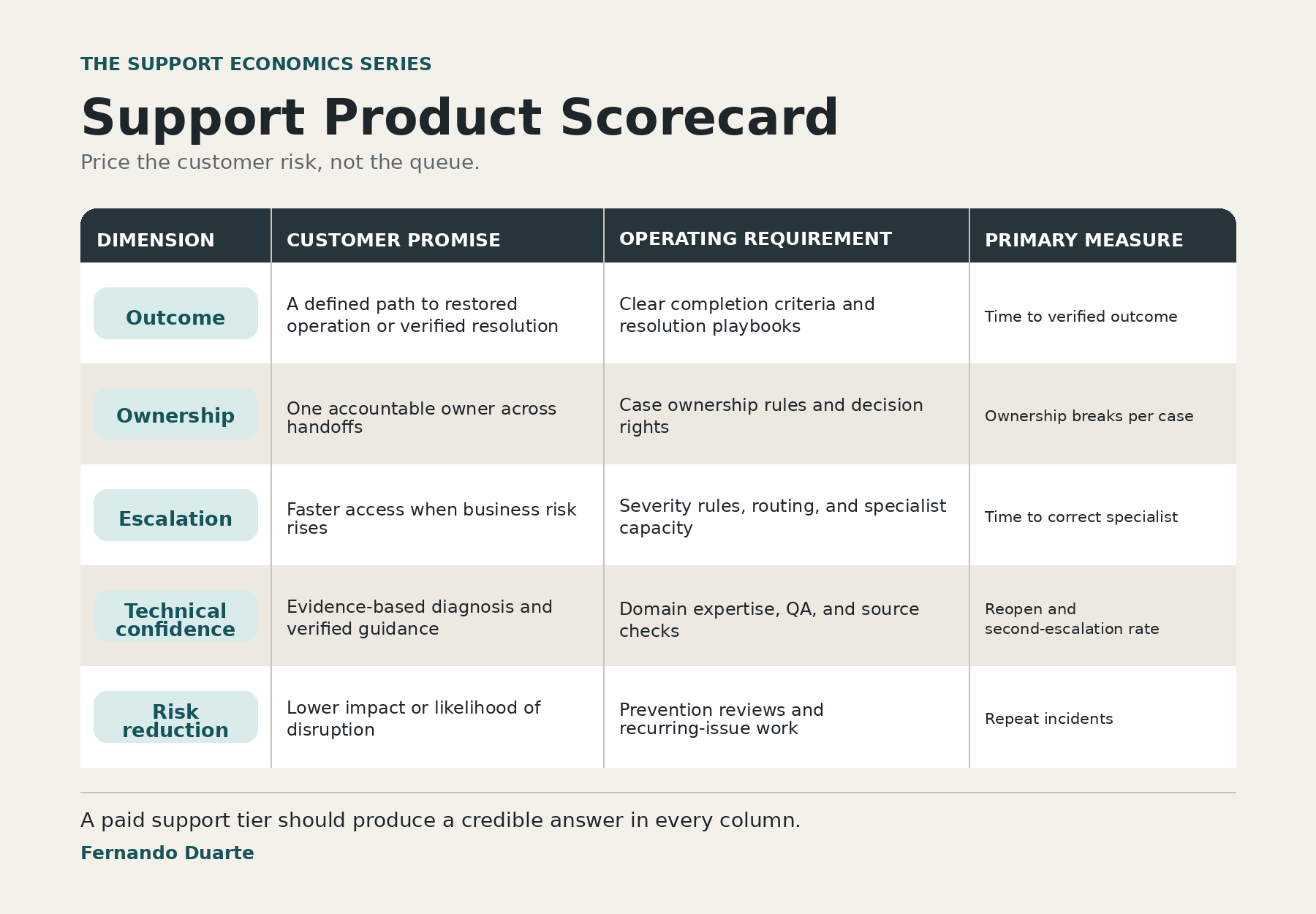
Before calling an offer premium, ask five questions.
Outcome: What result does the customer receive beyond a fast reply?
The answer might be restored service, a verified diagnosis, an approved workaround, or a coordinated path to resolution. “Priority handling” describes internal movement. It does not describe what changes for the customer.
Ownership: Who stays accountable when the case crosses teams?
Ownership does not mean support personally fixes every product defect, infrastructure problem, or third-party failure. It means one person holds the case narrative, drives internal actions, manages customer communication, and confirms when the outcome has been reached.
Escalation: What changes when business impact rises?
A useful escalation path defines severity, evidence requirements, communication frequency, specialist access, and decision rights. Without those rules, escalation means an agent searches Slack for someone willing to look.
Technical confidence: Why should the customer trust the answer?
Premium support should provide stronger source verification, sharper diagnosis, and confirmation that the proposed fix worked. AI helps gather and organize information. Human judgment still owns decisions with material customer impact.
Risk reduction: What becomes less likely after the customer buys this tier?
The answer might include shorter incidents, fewer repeat failures, safer launches, reduced employee downtime, or fewer executives pulled into routine coordination.
These five questions form the Support Product Scorecard.
Use this scorecard before creating or repricing a paid support tier.
What the Customer Thought They Bought
Return to the billing integration case.
The customer did not expect support to write production code or override engineering priorities. They expected a clear operating path.
They wanted one person to understand the impact, collect the right evidence, involve the right team, and provide one reliable version of the truth. They wanted to know what we had ruled out, what we were testing, and when the next decision would happen.
Instead, several people worked hard inside a weak model.
The first agent did the right thing. The lead did the right thing. The account manager tried to protect the relationship. Engineering asked for reasonable evidence. Sarah helped because she knew the history.
The failure did not come from a careless team. It came from a support product that promised speed without defining ownership. Leaders should fix the model, not blame the people compensating for it.
What a Better Tier Looks Like
Under a standard support model, the customer receives reliable help for routine product use. The team provides documented response targets, self-service, pooled support, and escalation for confirmed product issues.
AI works well in this layer. It handles triage, summaries, knowledge retrieval, suggested replies, and selected low-risk resolution.
A higher tier should change more than the clock.
For a customer running a critical billing workflow, paid support might include a named incident owner, agreed severity definitions, specialist access, communication standards, and a review after major incidents. The customer receives less coordination work and a faster path from symptom to verified outcome.
For a customer planning a major launch, the work might begin before the first ticket.
Support reviews likely failure points. The team checks whether the escalation route still points to the right group. Knowledge owners review the articles agents and AI will use. Product and engineering agree on the evidence needed for urgent escalation.
This is often where leaders discover the real system.
The runbook names someone who left the company. The macro references an old process. The queue still routes by product area even though expertise now sits elsewhere. Agents have been fixing the problem manually for months without anyone updating the workflow.
AI did not create those gaps. Implementation exposed them.
The paid support product should remove those gaps before the customer depends on the promise.
The Pricing Logic
Start with the real delivery cost.
Annual delivery cost = coverage floor + ownership capacity + specialist capacity + escalation reserve + governance
The coverage floor reflects the staffing required to provide the promised hours, including quiet periods.
Ownership capacity covers coordination, customer updates, internal follow-up, and case management beyond normal ticket handling.
Specialist capacity includes senior technical or domain expertise. The escalation reserve protects time for high-severity work so every critical incident does not destabilize the rest of the operation.
Governance includes reporting, playbook upkeep, incident review, quality control, and prevention work.
For example, assume a paid tier costs $150,000 per year to deliver once coverage, specialist time, incident coordination, and reporting are included. If one failed billing cycle or delayed launch exposes the customer to several times that amount, the value story is credible. If the tier only provides faster replies to low-risk questions, it is not.
Then compare the delivery cost against the customer’s exposure.
Estimate the cost of downtime, internal coordination, repeat incidents, delayed launches, employee disruption, and executive involvement. Use ranges. False precision will not improve the decision.
Sometimes the premium tier will have a clear value story. Sometimes the customer does not face enough risk to justify the price. That is useful information, not a sales failure.
The tier might still be the right choice, but not yet, or not for every customer.
Measure the Handoffs, Not Only the Clock
Response time should stay on the scorecard. It shows whether the team started moving.
Executives also need to see what happened after the acknowledgement.
Time to accountable owner: How long passed before one person accepted responsibility for driving the case?
Time to risk containment: How long passed before the immediate business impact stopped growing?
Time to verified outcome: How long passed before the customer confirmed restoration or accepted a clear path forward?
Repeat contact rate: How often did the customer return for the same issue within a defined period?
Second-escalation rate: How often did the first escalation path fail to produce progress?
Ownership breaks: How often did the customer repeat context, chase updates, or ask who was responsible?
Gross margin by tier: Does the price cover the full delivery model, including hidden coordination and specialist time?
For the highest tier, add one prevention measure. Track recurring incidents removed, launch risks resolved, or high-impact workflows reviewed before failure.
This creates a more honest view of support economics. The company sees cost, quality, risk, and customer trust in the same frame.
What Leaders Should Change Next Monday
Review ten high-value escalations. Find where ownership changed, where the customer repeated information, and where side channels replaced the documented process.
List every promise in the current paid tiers. Separate customer outcomes from delivery features such as channels, coverage hours, and response targets.
Calculate the full delivery cost. Include lead involvement, specialist time, reporting, incident coordination, and prevention work.
Define one accountable owner for severe cases. Give the role authority to coordinate work and set the customer communication path.
Replace the executive SLA report. Add time to containment, time to verified outcome, repeat contact, ownership breaks, second escalation, and margin.
Do not start by changing the price.
Start by deciding what the customer is paying the company to own.
The Promise Behind the Clock
The billing customer received a fast response. Several good people worked hard. Our SLA stayed green.
The customer still had to manage the problem across our teams. That is the line paid support should never cross.
AI will keep making fast answers cheaper. Customers will still pay for judgment, technical confidence, escalation paths, and an owner who stays with the issue when the normal workflow breaks.
AI makes fast answers easier to provide. It makes accountable ownership more valuable.
When a critical issue crosses support, engineering, and the account team, who owns the customer outcome in your current model?