


The slide was the best one in the deck. Average handle time down 43 percent. Ticket volume down 38 percent. Cost per contact falling every month. The room read it as a win, because the numbers agreed with them.
I ran that support org. We served families managing high-stakes education funding, deadlines, eligibility, money that shaped a child’s year. Months earlier we had launched two states on the same day, two sets of rules, one operating day where every answer had to hold. We built the training, the routing, an AI voice bot, and rollback plans, and it worked. So when the AI numbers came in clean, the instinct in the room was to scale everything.
Then a manager opened one escalation.
A customer had asked a simple account question. The AI gave a fast, polished answer and marked the ticket resolved. The customer followed the guidance, found a different result in the product, and came back. A human corrected the answer. The correction did not match what the first response had promised, so the customer came back a third time, now doubting every answer support gave. The case climbed to a senior agent, then a manager, then the account team.
The dashboard recorded one AI resolution. The customer lived through three contacts, two conflicting answers, one escalation, and a fresh reason to question the renewal.
The slide measured what that first contact cost us. It said nothing about whether the customer trusted the answer enough to keep going. We had gotten good at the first number and stopped watching the second.
That gap is where support savings turn into lifetime value risk.
What changed when answering got cheap
For years the expensive part of support was the answer. People, time, handle. AI took most of the cost out of producing an answer, and leaders did the natural thing. They started managing the cost of support instead of the value of it.
The shift is quiet and expensive. When answering is cheap, containment and speed look like pure savings. A cheaper interaction still destroys value when the response creates recontact, correction work, frustration, or doubt. And AI changes the scale of that risk. A strong agent gives one customer a weak answer. An automated flow repeats the same weak answer hundreds of times before anyone sees the pattern.
Resolution is an event. Customer lifetime value is a relationship.
Cost per contact tells you what the event cost. It tells you nothing about the relationship.
Here is what you leave with: a way to measure whether your AI support protects lifetime value, not only whether it closed the ticket.
The window the dashboard stops watching
The dashboard measures the moment the AI marks a ticket resolved. The customer keeps experiencing the outcome for days after. That period, the days after the system says the work is done, is where trust holds or breaks. I track it as the Customer Confidence Window.
For most intents, watch the next 7 to 14 days. For billing, onboarding, eligibility, or account changes, use a longer window tied to how long the real outcome takes to appear. During that window, five signals tell you whether the resolution held.
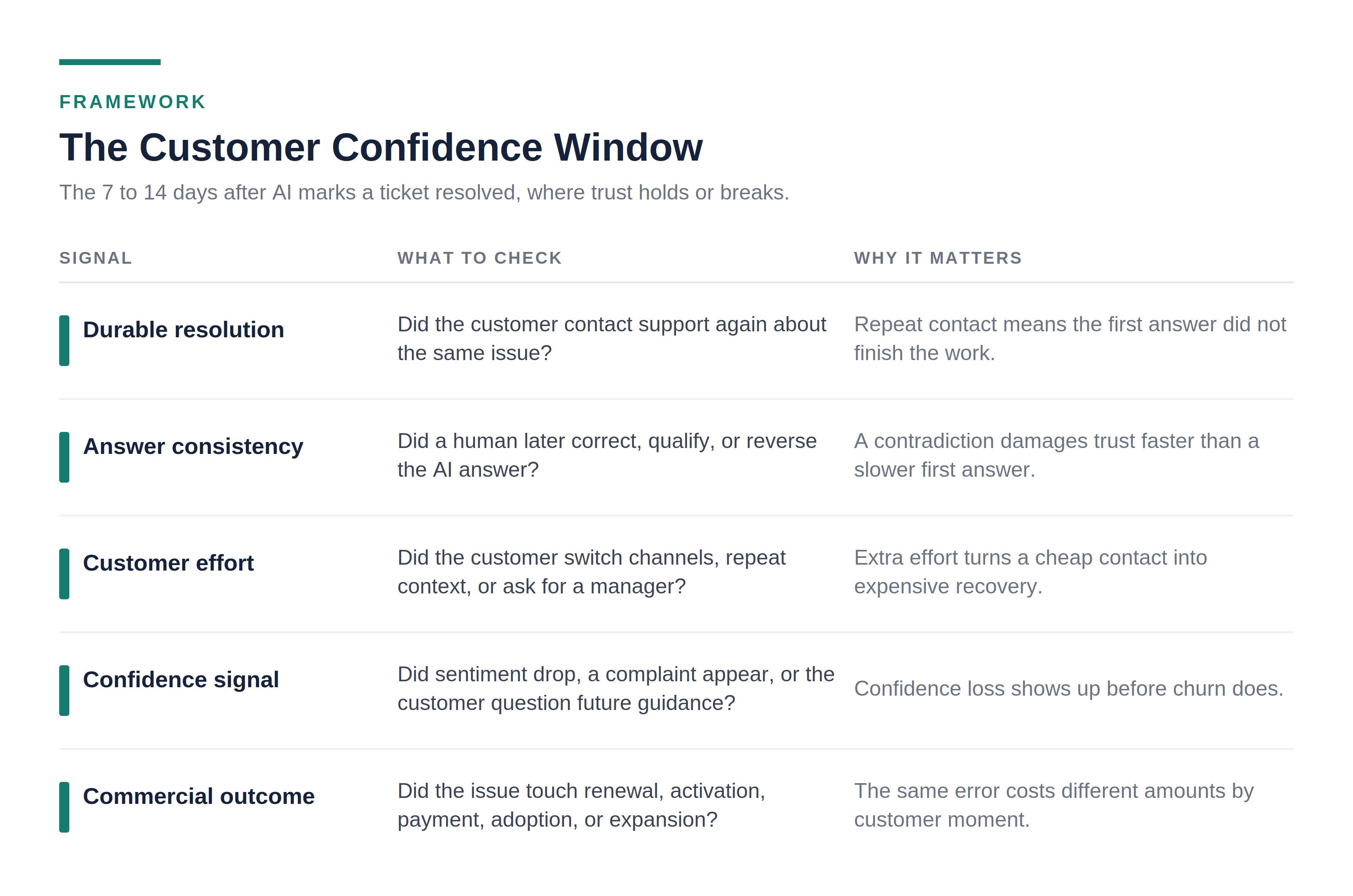
These five signals combine into one number worth more than raw containment.
Trust-Adjusted Resolution Rate = AI resolutions with no same-issue recontact, no human correction, no avoidable escalation, and no negative confidence signal during the window, divided by all AI resolutions marked resolved.
No metric captures trust perfectly. This one still beats containment, because it checks whether the answer survived contact with the customer. Track it by intent, risk tier, segment, and lifecycle stage. Do not average a password reset against a payment dispute. Do not average a customer in onboarding against a mature account asking a routine question. The segmentation is the work. Without it, the average becomes management theater with nicer charts.
Why the savings number lies
Most AI support business cases start with one clean equation. Contacts handled by AI, times human cost per contact, equals savings. The equation is useful and incomplete, because a support interaction produces several economic outcomes after the first response. The issue stays solved, or the customer returns with the same problem, or a human corrects the AI, or the case escalates, or the customer quietly loses confidence and stops believing future answers.
Only the first outcome shows up in most AI dashboards. The rest sit in other systems, owned by other teams. Finance sees lower support cost. Support sees fewer tickets. Customer Success sees renewal friction. Product sees complaints. The customer sees one company.
Leaders celebrate the expense reduction while the revenue risk moves somewhere no one is looking.
The honest equation is wider. Net AI support value is operating savings, minus recontact cost, minus correction cost, minus escalation cost, minus expected trust loss. That last term does not need false precision. Use a range: affected customer value, times an estimated increase in churn or downsell risk. For a subscription business, use remaining gross margin, not contract value. For a transactional model, use expected future contribution margin. For a public program, replace revenue with participation, completion, or compliance. The point holds across all of them. Support outcomes continue after the conversation ends.
Run the wider equation once and the picture changes.
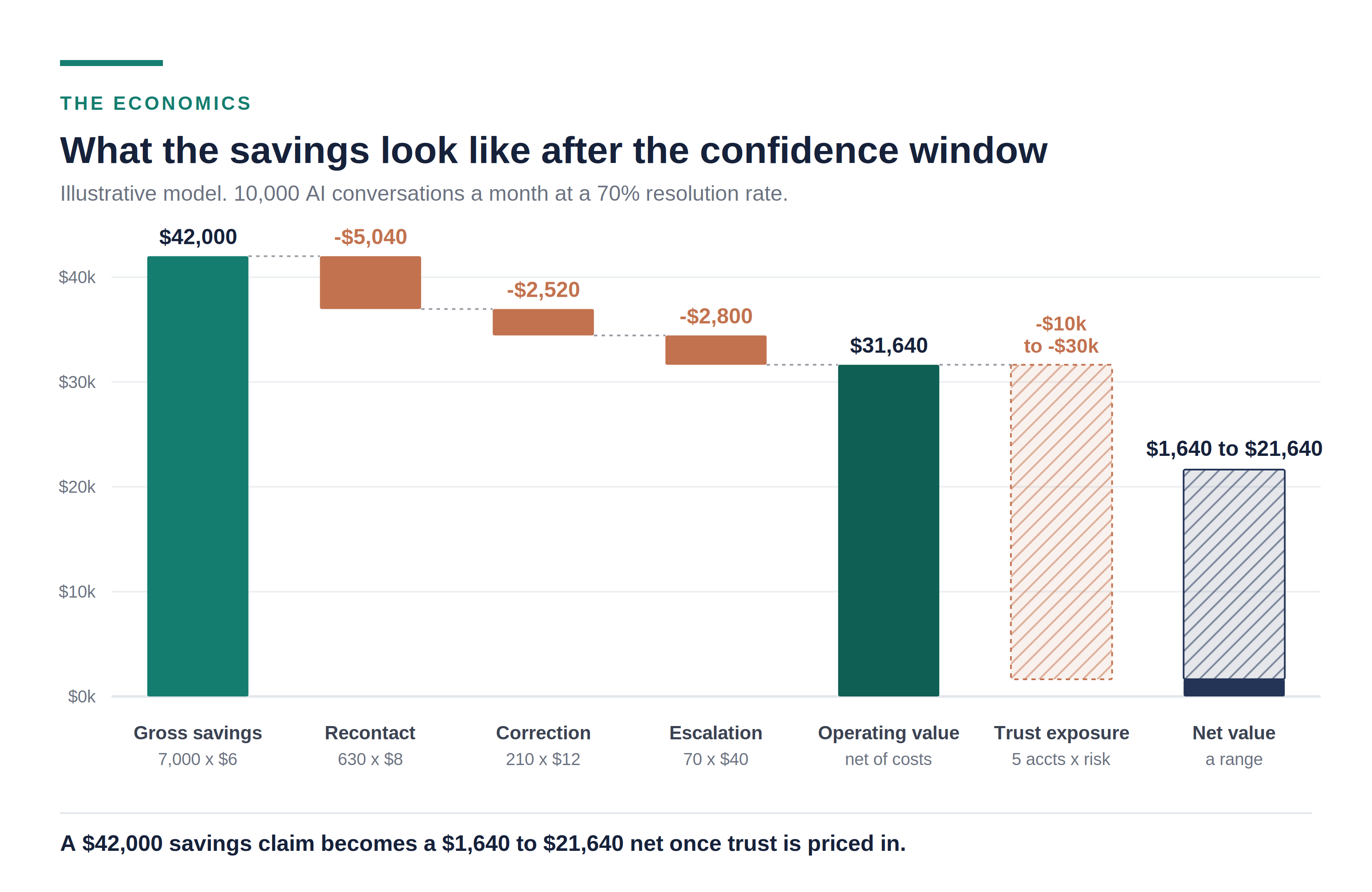
Take an organization with 10,000 AI conversations a month and a reported 70 percent resolution rate. That is 7,000 resolutions. At $6 of avoided human cost each, the gross savings read $42,000. Now open the confidence window. Nine percent of those resolutions create a same-issue recontact, three percent need a human correction, one percent escalate. Cost those at $8, $12, and $40, and the downstream operating cost reaches $10,360. Gross savings fall to $31,640. Still positive.
Then add customer value. Say five of those escalations touch accounts with $40,000 of remaining gross margin, and the account team estimates the trust incident adds a 5 to 15 percent risk of churn or downsell. Expected exposure runs $10,000 to $30,000. Net value now lands somewhere between $1,640 and $21,640.
The range is less satisfying than a clean savings number. Reality behaves badly around executive decks. But the value of the model is not the exact figure. It is the decision the model changes. Without the window, you scale the flow because it looks like $42,000 saved. With the window, you separate the low-risk intents from the trust-sensitive ones, keep automation where answers are stable, add verification or human review where answers are conditional, and fix the knowledge or workflow behind the escalations. The goal is not less AI. The goal is better economics.
The mistake: treating speed, containment, and confidence as one thing
The common error is assuming speed, containment, and customer confidence move together. Sometimes they do. A customer asks how to reset a password, the AI gives the right steps, the customer succeeds. Faster and cheaper is better.
Now change the intent. A customer asks whether a billing change affects service access. The right answer depends on account status, contract terms, product behavior, and timing. The AI answers confidently from an article missing one condition. The customer acts on it, then learns the answer was incomplete.
The interaction was fast. The damage was not.
This is why one blended containment rate tells you so little. It mixes low-risk, stable questions with high-risk, conditional ones, and the average hides the intents where trust is most exposed. CSAT hides the same way. Customers who abandon, escalate through another channel, or stop replying fall out of the survey, so a high AI CSAT reflects the customers who stayed long enough to rate you, not the ones who gave up. Resist two comforts. The operational one says the ticket closed, so the work ended. The financial one says the contact cost less, so the company gained. Both fail the moment the customer comes back less confident than before.
The hard part: trust does not live in one field
Support systems record tickets. CRM records accounts. Product analytics record behavior. Finance records revenue. Survey tools record the customers willing to answer. Customer confidence sits across all of them, which makes ownership easy to dodge. Support says retention belongs to Customer Success. Customer Success says answer quality belongs to Support. Product says the workflow belongs to Operations. Finance says the risk is too hard to attribute. So the business case gets built from the easiest number in the building, which is containment.
The fix is to assign every AI failure an owner by fix path, not by blame. A knowledge owner repairs incomplete, conflicting, or stale sources. A workflow owner repairs routing, handoff, and broken steps. A policy owner clarifies rules where reasonable people reach different conclusions. And the support leader decides where AI answers, where it assists, where it verifies, and where it stops before trust is exposed.
Then watch for the trap inside the data. An account cancellation intent often shows low repeat contact, because frustrated customers leave without asking again. Silence reads as resolution on the dashboard. Sometimes silence means the customer stopped believing support would help. That is the same lesson the escalation taught us in the operating review, arriving in a different disguise. Pair that intent with cancellation reasons and account feedback before you call the flow a success.
Your Monday morning plan
Run this without new tooling. You need a sample, a scorecard, and a standing meeting.
Choose three intents. One high-volume, one high-risk, one tied to renewal, payment, activation, or adoption. Owner: support leadership.
Set the confidence window. 7 or 14 days for most cases, longer where the real outcome takes longer to appear. Owner: support ops.
Sample twenty resolved conversations a week. Read the whole journey across channels, and include the cases where the customer went silent. Do not sample only the failures. Owner: a QA reviewer.
Score the five signals and calculate trust-adjusted resolution. Compare it to the vendor’s resolution rate. The gap is your hidden work. Owner: the QA reviewer.
Join support data to revenue data. Match affected accounts to renewal and expansion status. Owner: ops plus rev-ops.
Assign every failure an owner. Knowledge, workflow, policy, or leadership, by fix path. Owner: support leadership.
Change one decision rule. Keep automation, add verification, require human approval, or stop automation for the weakest intent. Owner: support leadership.
Report the economics as a range. Gross savings, downstream operating cost, and expected customer value exposure, on one slide. When trust-adjusted resolution drops below your floor, you are losing, not winning. Owner: whoever owns the executive slide.
Review weekly for operations, monthly for customer value. The process feels slower than celebrating containment. It also produces decisions worth trusting.
Back to the slide
The first dashboard was not wrong. The AI resolved that first contact exactly as the system defined resolution. The system stopped watching too soon. The customer did not experience one resolved ticket. The customer experienced a chain of answers and decided whether we deserved the next renewal.
Fast and cheap support creates value only when the customer stays confident after the resolution.
Cost per ticket tells you what support spent. Lifetime value tells you what it earned.
Which AI-supported journey in your queue looks successful on the first contact, then turns expensive over the next 14 days? Reply and tell me how you spotted it.