


You are in a leveling calibration meeting. Six names on a spreadsheet, ranked by average handle time and tickets closed. The rubric is clean. The math is clean. Promote the top two, hold the rest, move on to the next queue.
Then someone on the call says a name that is not in the top two.
Reason: three weeks ago, that agent caught an AI-drafted answer that quoted an old policy version. Wrong effective date, right-sounding sentence. If it had gone out, a family would have made a decision on bad information. The agent flagged it, fixed the macro behind it, and the fix protected every case that used that article afterward.
None of that shows up in average handle time. None of it shows up in tickets closed. The spreadsheet does not have a column for it.
That is the moment you learn what the leveling model is actually measuring, and what it is missing.
I have led support teams through AI-assisted resolution, containment, and rapid scaling. None of the gains came from leaving the roles unchanged. The job changed, and the ladder underneath it had to change with it.
Most support career ladders were never rebuilt for that shift. They still reward the old job while the team quietly does a new one.
The spreadsheet does not have a column for the fix that protected every case behind it.
What Changed
The old ladder measured a narrow set of behaviors: how many tickets you closed, how fast you closed them, how well you handled escalations, how long you had been in the seat. Those numbers meant something when the agent’s job was to answer the ticket in front of them.
AI changed what “the ticket in front of them” means. The routine cases get absorbed by chat and voice automation. What is left is heavier: cases where the AI draft is plausible but wrong, where two policy sources disagree, where the answer touches money, identity, or a deadline. The agent’s real job on those cases is not typing speed. It is judgment. Did they verify the source. Did they catch the gap. Did they escalate with evidence instead of a guess. Did they flag the article or macro that caused the problem, so it does not happen again.
That work is real. It protects customers, it protects the business, and right now it is mostly unpaid, because the comp plan never learned to see it.
The cost of skipping this is not a morale problem. It is an attrition problem with a dollar sign on it. The people doing the invisible verification and correction work are usually your best people. When the ladder does not name that work, they eventually notice, and they leave for a role that does.
The Fix, Early: The Comp Impact Test
Before you finalize a raise, a level, or a promotion packet, run this one test on the work in question.
If you removed this person’s [specific behavior] for a month, would [risk, cost, or quality] go up? Fill in the behavior. Fill in the consequence. If the honest answer is yes, that behavior already belongs in the comp conversation, whether or not it is on the current rubric.
Run it on the agent from the calibration meeting. If you removed their habit of checking the policy source before sending, would a bad answer have shipped? Yes. That is not a soft skill. That is risk management, and risk management gets paid.
Rebuilding the Ladder Around Ownership, Not Tenure
A leveling model built for the AI era has to answer a different question than the old one. The old question was how long have you been here and how fast do you move. The new question is how far the consequences of this person’s decisions travel.
The new question is how far the consequences of this person’s decisions travel.
In the org I ran, that question mattered because the stakes were real. AI cut average handle time 43 percent, seven minutes to four. Chat containment settled around 74 percent, voice containment near 40 percent in steady state, after a stronger 53 percent on launch day itself, when Louisiana and Georgia went live the same day, March 1, 2025. Onboarding compressed from two weeks to three days. None of that happened because the ladder stayed the same. It happened because the people running point on the hardest cases were operating with real ownership, and the org eventually had to name what they owned.
Separate AI usage from AI ownership. Using AI well during normal tickets is baseline competence. Owning AI means the person finds failure patterns, fixes the source article behind a bad answer, coaches a teammate on when to slow down, or shapes a workflow so the next hundred cases go better. Usage keeps the queue moving. Ownership is what a comp plan should reward, because ownership is what compounds.
Build the evidence portfolio into the promotion packet, not around it. A small, real record works: one AI issue caught, one knowledge fix suggested, one strong escalation, one peer coaching moment, one pattern identified and reported upward. When that portfolio sits inside the promotion conversation instead of living in someone’s head or a stray Slack thread, promotion stops being a popularity contest and becomes an evidence review.
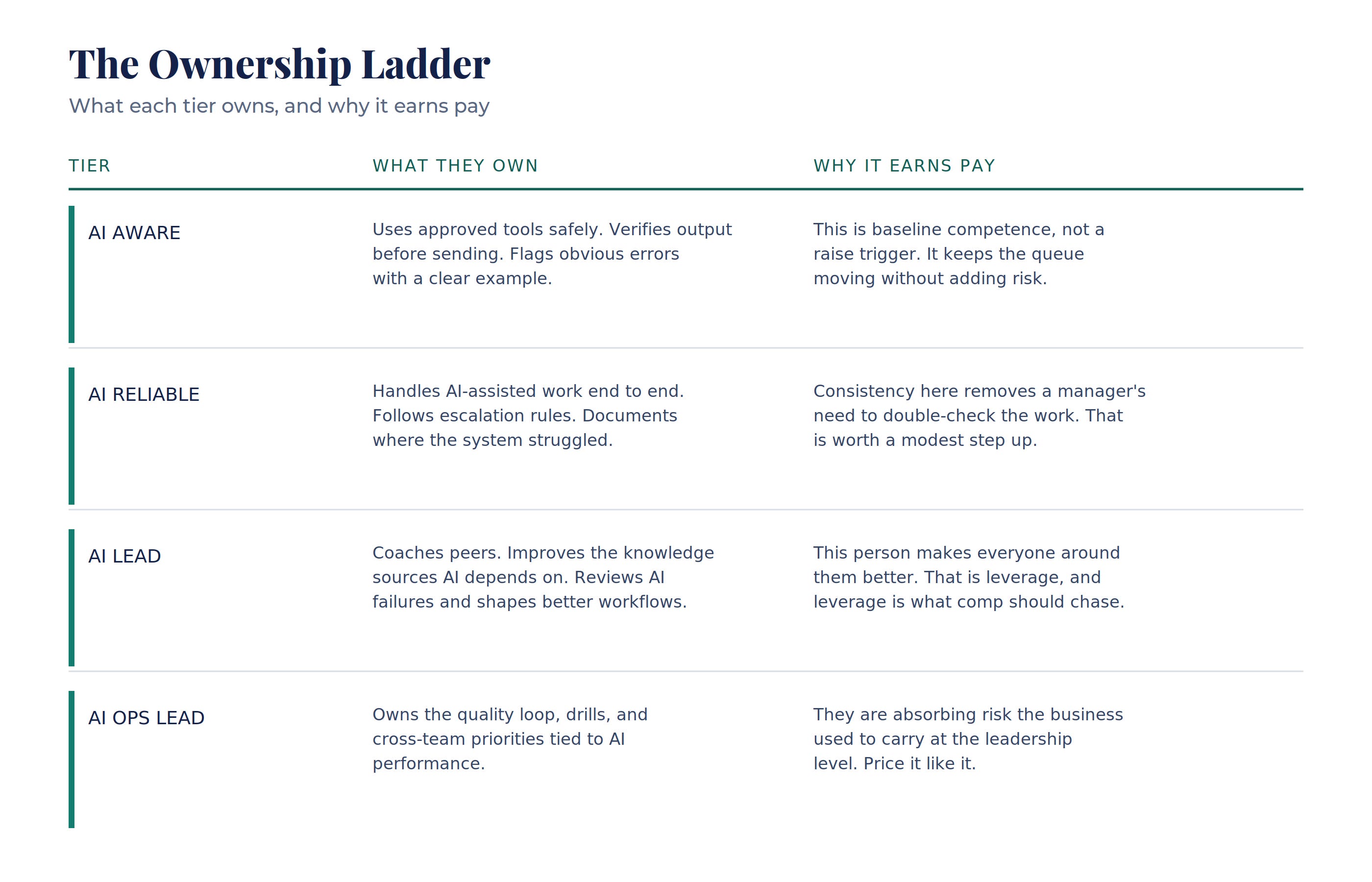
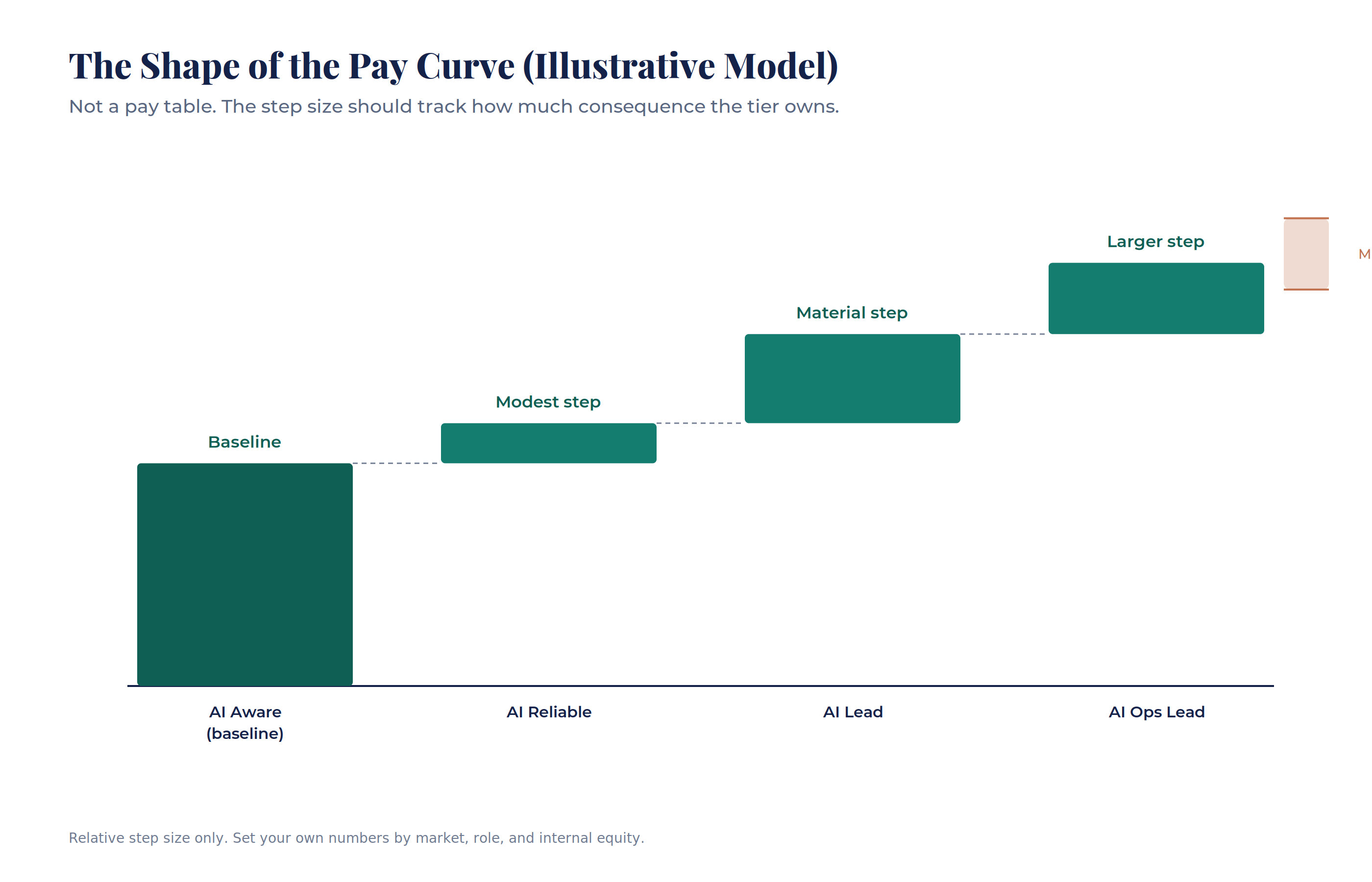
Price the tiers explicitly, and say the number out loud. A four-level structure works well in practice: an agent who uses AI safely, one who handles AI-assisted work reliably end to end, one who leads peers and improves the sources AI depends on, and one who owns the quality loop across the team. The move from safe execution to formal ownership should create a material compensation step, because the employee now carries wider risk and creates value beyond personal ticket output. The amount should reflect your market, internal equity, role scarcity, and the consequence of getting the work wrong. The principle matters more than the figure: pay should rise when judgment begins protecting the business, not only when tenure accumulates.
Let the ladder branch instead of narrowing to management. Not everyone who is excellent at this work wants to run a team. Some are strongest staying close to customers on the hardest cases. Some are strongest fixing the knowledge base so AI stops making the same mistake. Some are strongest reading the data and calibrating the quality loop. A ladder with one destination pushes your best technical people into management roles they do not want, or out the door entirely.
Usage keeps the queue moving. Ownership is what a comp plan should reward, because ownership is what compounds.
The Failure Mode Nobody Names on the Slide
Here is the failure mode I see most often, and it rarely gets said out loud in the room where it matters. Leadership rewards AI adoption. Adoption is easy to measure: log-ins, tickets touched with AI assistance, containment rate per agent. None of that tells you whether the agent is making AI safer or just faster.
Reward adoption alone, and you get agents who use AI more without getting better at catching it when it is wrong. Meanwhile the people who are quietly doing the harder work, the verification, the correction, the escalation, watch their peers get recognized for volume while their own judgment goes unmeasured.
The fix is to score the decision behind the reply, not the reply itself. In quality reviews, ask what the agent verified, what they changed, what they escalated, and what they flagged, not only whether the final message read well. That single shift moves the incentive from using the tool to owning the outcome, and it is the difference between a ladder that retains your best people and one that quietly trains them to leave.
What Executives Should Measure
Leveling is a support conversation. Whether it is worth funding is a P&L conversation, and the two rarely use the same language. Four measures close that gap.
Ownership capacity. The percentage of paid time assigned to verification, knowledge, workflow, coaching, and AI quality work, instead of pure queue handling. If that number is zero on paper while it is clearly non-zero in practice, the org is getting the work for free.
Reusable improvements. Knowledge fixes, routing changes, test cases, or automation adjustments shipped each month. This turns “someone caught a bad answer” into a countable asset instead of a one-off save.
Avoided correction work. Recontacts, escalations, reopened cases, and manual corrections tied to the domain a given tier owns. This is the number that shows whether ownership is actually reducing downstream cost, not just adding a title.
Talent risk. Pay compression and unwanted attrition among the specialists who carry system knowledge. This is the number that shows up as a resignation letter if nobody is watching it first.
Track those four, and the leveling conversation stops being a debate about fairness and becomes a conversation about what the business is buying.
Track those four, and the leveling conversation stops being a debate about fairness and becomes a conversation about what the business is buying.
Your Monday Morning Checklist
Pull last quarter’s promotion packets. Owner: you or your leveling committee. Check whether any of them mention a caught AI error, a knowledge fix, or a coaching contribution. If none do, your rubric is invisible to the real work.
Run the Comp Impact Test on your two strongest agents. Owner: their direct manager. Cadence: this week. If removing a specific behavior would raise risk or cost, write that behavior into the next leveling cycle.
Separate usage metrics from ownership metrics in your QA rubric. Owner: quality lead. Measurement: percentage of QA score tied to verification and escalation quality versus percentage tied to speed and volume.
Start a lightweight evidence portfolio for your ownership-tier agents. Owner: the agent, reviewed monthly by their manager. If nobody is filling it in three months from now, the tier is not real yet, only aspirational.
Price at least a draft version of the new tiers, even roughly. Owner: you, with HR or finance. If you cannot say a number, even a modeled one, the ladder is a poster, not a policy.
Ask your top three performers directly what they think the ladder is missing. Cadence: this month. What to do if the answer surprises you: believe it before you argue with it.
Review pay compression before the next comp cycle. Owner: you, with HR or finance. Compare experienced specialists, ownership-tier employees, team leads, and new hires. When the pay difference no longer reflects the difference in responsibility, fix the band before someone else prices the role for you.
Back to the Calibration Meeting
The scene above is a composite, but the decision behind it is one I have faced repeatedly. In the better version of that calibration meeting, the agent gets the promotion. Not because someone overrules the spreadsheet out of guilt, but because the room finally has language for what the spreadsheet is missing. That is the whole fix. Not a new tool. Not a new title. A ladder that can see the work your team is already doing, so you can finally pay for it.
If you removed your best agent’s judgment for a month, what would break first, and is that written into how you pay them?