


I have watched this decision happen three times in my career. A COO walks into the board meeting in October with a new initiative. The support team needs AI. A vendor quote came in at $200,000 annually. The COO looks at the licensing cost and does the math. “We could build this in-house for less,” she says. An engineer volunteers. A product manager gets reassigned. By January, the build is three months in. The engineer is now full-time. The product manager has split focus between product and the new AI system. Nobody budgeted for the infrastructure costs. By March, a customer files a complaint. The AI system gives a policy answer the support team disagrees with. Now there is discovery work, testing, code review. The fix takes two weeks. The system goes down once because the knowledge base update script was fragile. Support reverts to manual answers for a day.
That is when the COO asks a different question: “If we had bought, what would this cost right now?”
The answer is not the $200,000 quote. The answer is messy. It includes the vendor’s contract term, the maintenance they promised, the renewal negotiations that probably would have started, the features the team would have asked for and then not used, and the escape clause buried in the licensing agreement. But it also includes a number the build team never calculated: what happens when the engineer leaves.
Build versus buy is not a feature choice. It is a financial choice, and one most support leaders make without modeling both paths.
You walk away from this article with a worked cost model. It compares tooling, staffing, knowledge, maintenance, and exit costs across three years. More importantly, it introduces a principle CFOs should track but usually do not: the hidden cost of commercial software feature bloat. By year two, unused capabilities compound into real expense. By year three, the calculus shifts.
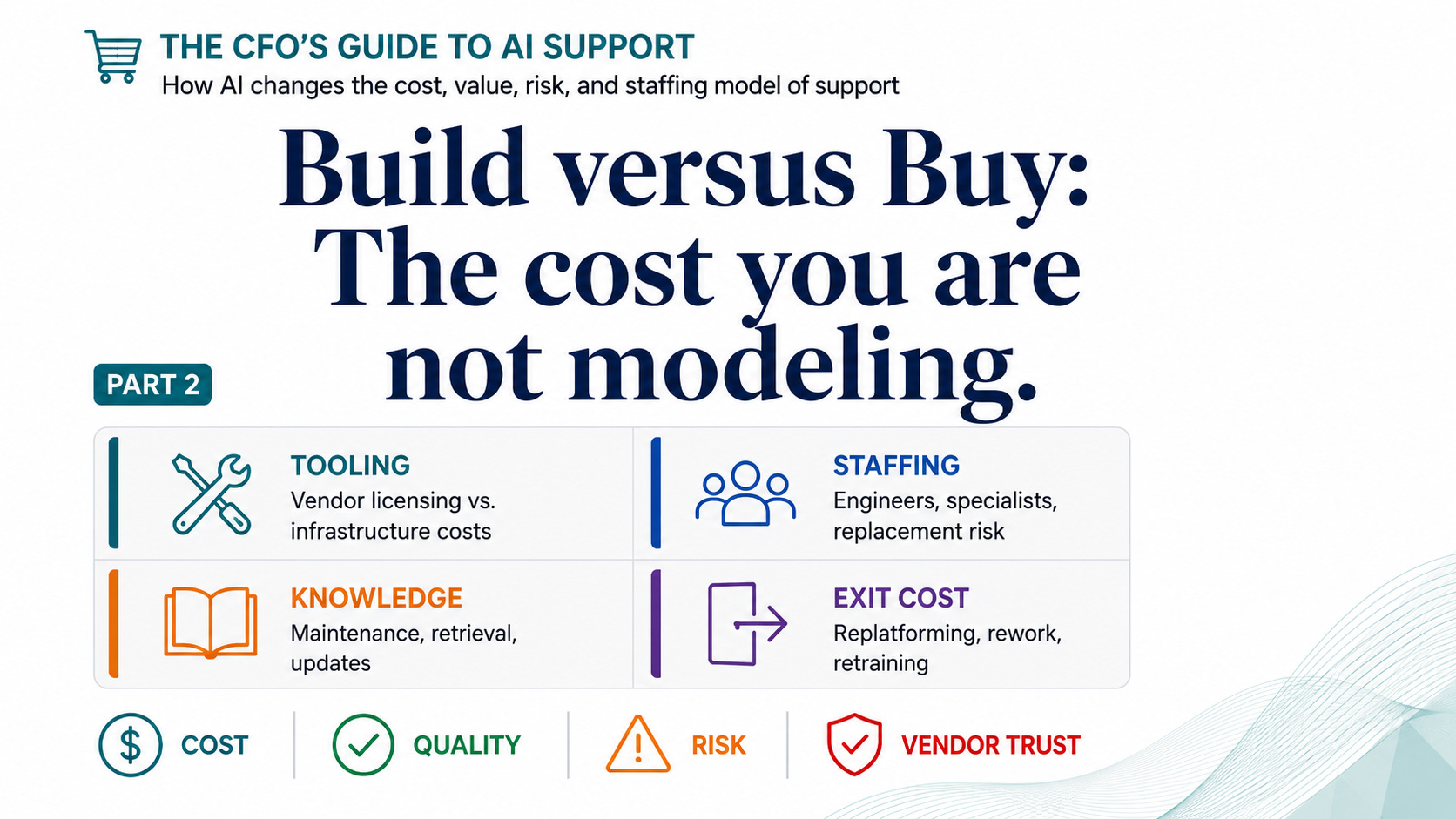
The Five-Cost Model
Most organizations compare build and buy on price alone. A vendor costs $200,000 per year. Building in-house costs engineering time, maybe $150,000 in salary. Engineering looks cheaper. That math ignores four other cost categories. When you model all five, the picture changes.
The Cost Model: Tooling + Staffing + Knowledge + Maintenance + Exit Cost = True Three-Year Price. Compare these five categories across year one, two, and three. Ignore any one and the decision drifts away from reality.
Tooling cost is the most obvious. Buying means a vendor contract and licensing. Building means infrastructure: servers, databases, compute, model access, APIs, monitoring. If you build an AI agent for support, you are licensing an LLM or running inference. That cost does not go away. It moves to your infrastructure bill. A vendor absorbs some of that cost in their margin. You absorb it in full.
Staffing cost determines whether a build project stays on schedule or drifts. You assign an engineer, maybe two. One works on the system itself. One works on integrations and ongoing tuning. They have salary, benefits, and opportunity cost (they are not building features for your product). Building assumes they stay. If they leave after year one, you replace them, onboard them, and lose productivity during transition. A vendor gives you staffing elasticity. You do not hire people. You pay for access.
Knowledge cost is the most underestimated. An AI system needs knowledge: product documentation, support playbooks, policies, FAQs, previous tickets that show the pattern. If you buy, the vendor’s system retrieves what is in your knowledge base. If you build, your engineers have to structure that knowledge, test it, update it, and debug retrieval failures. That is ongoing operational work. One support operator might own it. They are not answering customers anymore. They are maintaining knowledge source, running experiments on retrieval, fixing hallucinations, updating policies. Building assigns that cost to your team. Buying assigns it to you differently: you still maintain knowledge, but the vendor’s system does the retrieval work.
Maintenance cost grows over time. A build system needs monitoring, security patches, dependency updates, performance tuning, and bug fixes. An engineer owns this work as systems accumulate complexity. Buying means the vendor handles maintenance. You delegate that work but not the cost. The cost appears in your renewal negotiation. The vendor includes maintenance in the license. You pay for it whether you use all the maintained features or not.
Exit cost is the cost of leaving. If you build, exit means replacing the system, migrating conversations and knowledge, retraining your team on new tools, and managing the transition. If a build becomes unmaintainable, the cost of leaving grows every quarter. If you buy, exit means contract termination (sometimes with penalties), data export, retraining on a new vendor’s system, and rebuilding workflows you had to customize to fit their platform.
The Hidden Cost of Feature Bloat
Here is a principle most CFOs do not yet measure: Vendors license bundles of capabilities. You use some. You do not use others. That unused capacity still costs you. It appears as maintenance burden, forced upgrade cycles, renewal negotiations you do not want, and knowledge overhead your team carries but does not activate.
A vendor’s AI support system includes routing, agent assist, chatbot, voice, knowledge management, reporting, and escalation workflows. You might use routing and chatbot. You do not use voice. You already have knowledge management in a different system. You have custom escalation logic that does not fit the vendor’s workflow. By year two, you are licensing five features and using two. The vendor stops supporting the older version you are on. Renewal time, they push you to upgrade. The upgrade includes features you did not ask for. Your team has to test, integrate, retrain.
Every unused feature is a tax on your budget and your team’s cognitive load. You pay licensing for it. You maintain knowledge about it. You integrate with it or around it. You retrain on it when the vendor updates it. By year three, that tax compounds into real dollars.
Building avoids this. You build what you need. No bloat. No forced upgrades. No license for capabilities you never use. The downside is maintenance becomes your responsibility. The upside is flexibility. You own the roadmap.
That trade is not obvious in year one. By year two, it becomes real. By year three, when a vendor renews at 15% higher rate and bundles three features nobody asked for, the flexibility premium of a build becomes quantifiable.
Year-by-Year Cost Breakdown
Let us model both paths across three years. We will use a fictional support team of 50 people, handling 100,000 monthly contacts. They want to deploy AI to handle routine questions.
Build scenario:
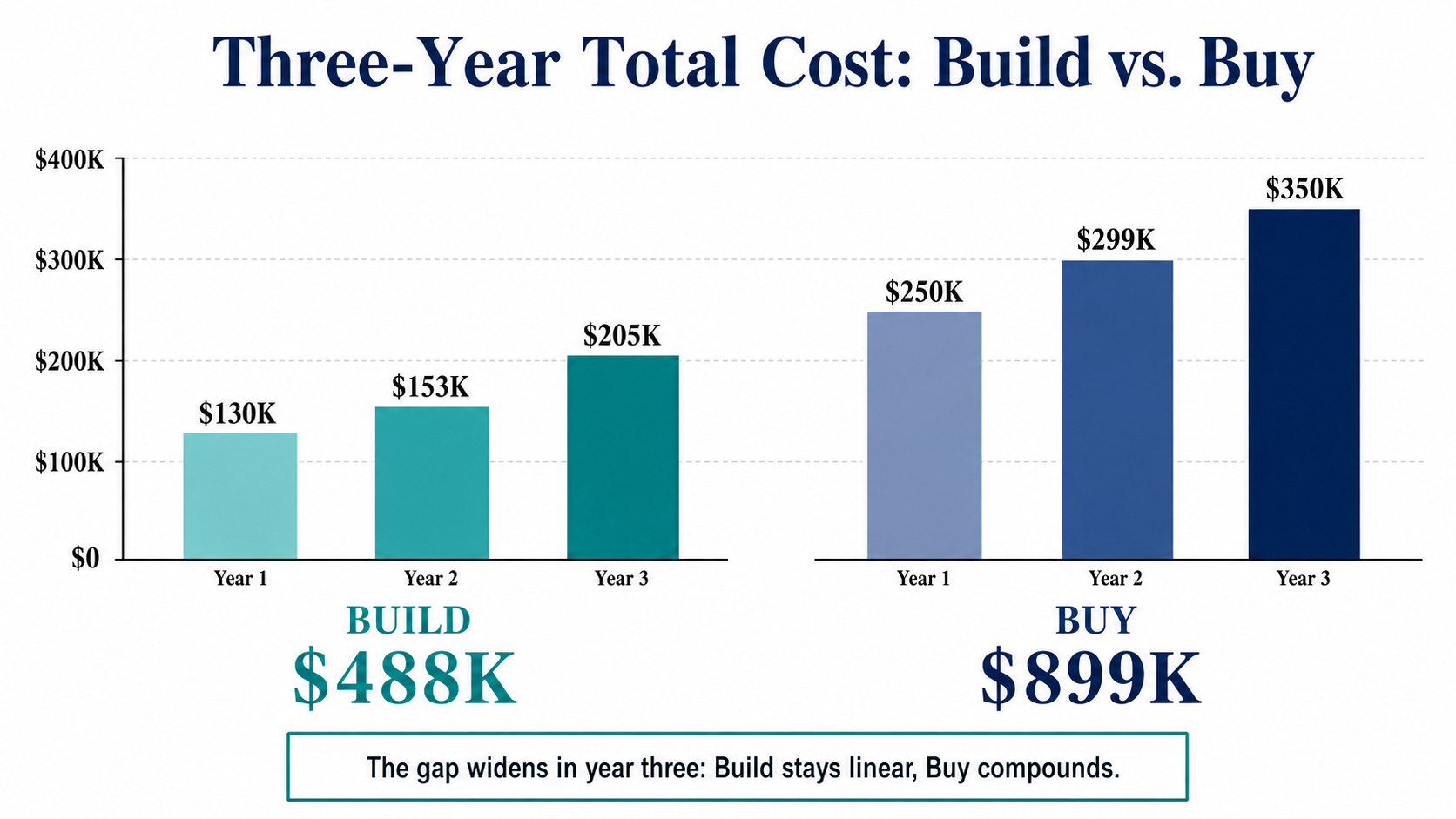
Year one: Assign one engineer (60K salary, 30% of time on this), engineer infrastructure costs ($15K), LLM API access ($10K), integration work (another 40% of a second engineer, 30K). Total: $115K. The team also maintains knowledge sources (one part-time support operator, $15K allocated). Total year one build cost: $130K.
Year two: The engineer is now full-time on this system (60K). LLM access grows as volume increases ($18K). The support operator who maintains knowledge stays ($25K full-time now). A second engineer joins to handle scaling ($50K). Total year two build cost: $153K.
Year three: Two engineers at full capacity ($120K). LLM access stabilizes ($20K). Knowledge operator ($25K). One QA person joins to test AI changes before they go live ($40K). Now you are carrying the team that built it and the team that maintains it. Total year three build cost: $205K.
Buy scenario:
Year one: Vendor contract at $200K. The team learns the system ($5K in training). You hire a vendor specialist role to configure the system and maintain integrations ($35K). One support person manages the knowledge feeds ($15K). Total year one buy cost: $250K.
Year two: Vendor renews at $218K (9% increase, fairly typical). You keep the specialist ($36K). Knowledge management stays ($15K). You add a second role because the vendor has three new features that need to be evaluated and integrated ($30K). Total year two buy cost: $299K.
Year three: Vendor renews at $237K (9% again). You have the specialist ($37K), knowledge management ($16K), feature integration role ($30K). But you also have hidden costs: contract renegotiation time (lawyers, procurement), training on the new version, and a compliance audit because the vendor’s system stores data in a region your company wants to avoid. Total year three buy cost: $350K plus legal and compliance hours.
Three-year totals: Build $488K. Buy $899K.
The spread widens in year three because build is linear (you add staff as demand increases) and buy is exponential (the vendor increases pricing, adds features, and creates friction). This is the hidden cost of feature bloat. You are not paying just for what you use. You are paying for the entire platform.
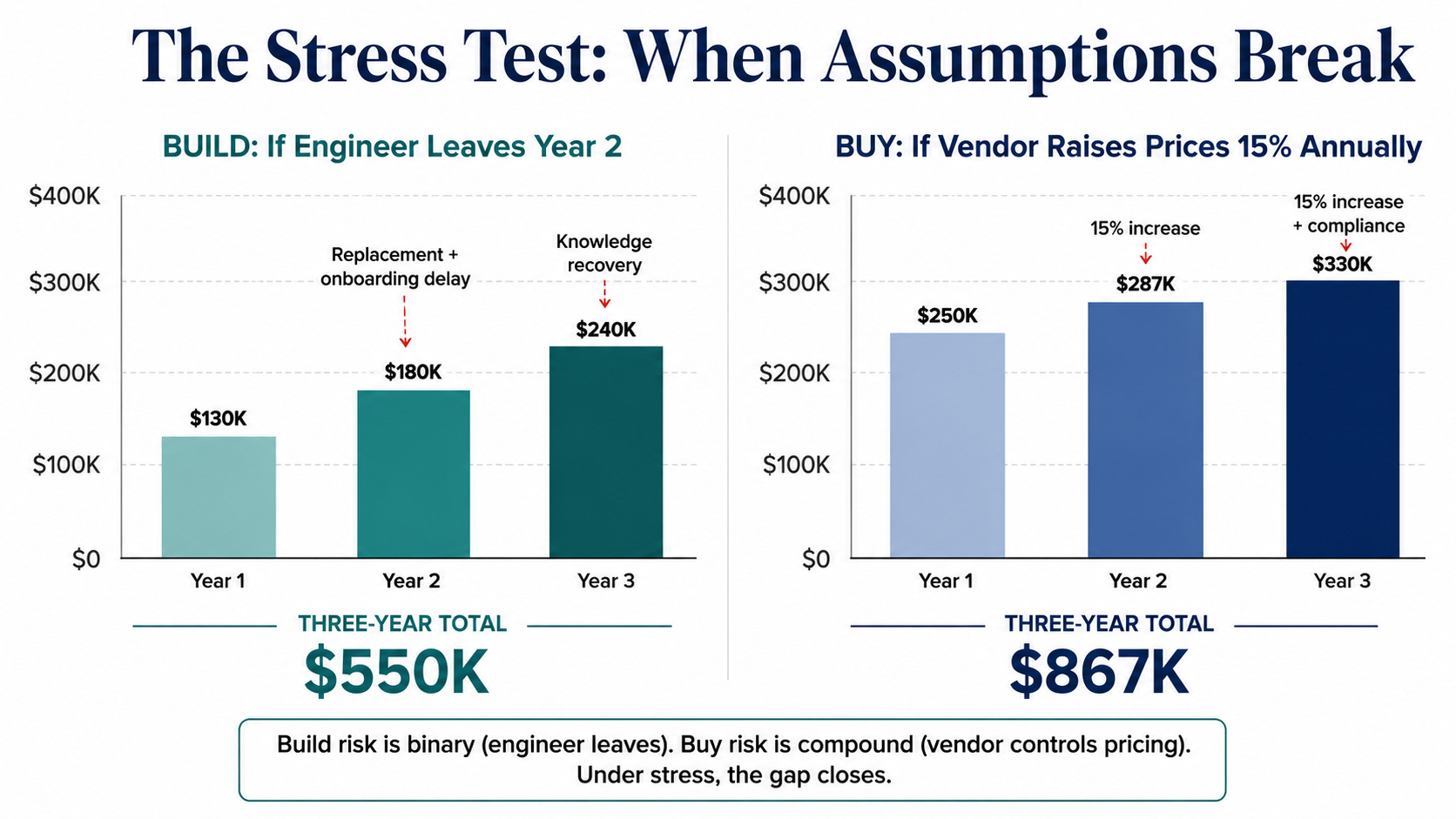
But this model has a catch. The build scenario assumes your engineer does not leave. If the engineer leaves in year two, you lose institutional knowledge, you need time to hire a replacement, and productivity drops. If your engineer leaves in year two and your replacement takes four months to understand the system, build suddenly costs more. It also assumes your LLM API costs do not skyrocket if your volume doubles unexpectedly. API pricing can be unforgiving.
The buy scenario assumes a stable vendor relationship. If the vendor is acquired, they might change their roadmap. If a competitor launches better features, you might want to switch. The exit cost of switching vendors is not zero. You have to migrate conversations, update integrations, retrain your team.
When Build Makes Sense
Build makes sense when three conditions hold.
First: Staffing stability. You have an engineer who will stay for three years, or you have a culture where replacements are easy to onboard. If your engineering team turns over quickly, building a critical system is risky. You inherit someone else’s code debt.
Second: Knowledge retention. Your support knowledge is messy. Your knowledge base is spread across five systems. Your policies are in spreadsheets and Slack threads. A vendor’s system will struggle with this chaos. Building lets you clean up knowledge on your terms. You control the retrieval logic. A vendor has to fit into your mess.
Third: Competitive advantage. Building is expensive. It only makes sense if you get something you cannot buy. That something is not “lower cost” because, from the three-year model, cost is similar. That something is “behavior we want that no vendor offers.” Maybe you want AI to explain policy edge cases in your specific voice. Maybe you want escalations to route to people by expertise, not availability. Maybe you want the AI to learn from every escalation and update itself daily. Those are differentiated features. If the feature exists in a vendor’s product but you are renting it, buy. If you cannot buy it anywhere, build.
Build wins when: (1) Your engineering staff stays. (2) Your knowledge cleanup is a competitive advantage. (3) The differentiated behavior you need does not exist in any vendor product. Without all three, cost advantage disappears and risk grows.
When Buy Makes Sense
Buy makes sense when two conditions hold.
First: You want staffing elasticity. You do not want to hire engineers. You want to pay a vendor and let them handle maintenance, security, scaling, upgrades, and support. That is not cheaper. It is just different. You trade capital for operational simplicity.
Second: The vendor’s feature set matches your needs. If you use 80% of the vendor’s capabilities and skip 20%, buying is reasonable. If you use 40% and skip 60%, every unused feature is a tax on your budget and your team’s cognitive load. If you find yourself customizing heavily to fit the vendor’s platform, you are building anyway. You are just paying the vendor’s margin on top of your engineering costs.
Buy wins when: (1) You want someone else to maintain and scale the system. (2) You use 75% or more of the vendor’s capabilities with minimal customization. Below that threshold, you are renting features you do not use and engineering around their constraints.
The Failure Mode People Miss
The most expensive mistake is this: you choose build or buy without modeling both paths. You model cost in isolation and miss the dynamics. You count the vendor’s $200K quote against your engineer’s salary and decide build is cheaper. You do not count knowledge work, maintenance, exit cost, and staffing replacement risk. You do not count renewal negotiations, feature bloat, and vendor lock-in.
By year two, you are trapped. If you chose build and your engineer leaves, you cannot switch to buy without losing the previous two years of customization. If you chose buy and the vendor raises prices 20%, you cannot switch to build without rebuilding what you customized.
The fix is this: before you choose, model both paths. Use the five-cost framework. Include year two and year three. Model both the base case (steady staffing, stable vendor relationship) and the stress case (engineer leaves, vendor raises prices 15%). The path that looks cheapest in year one might look expensive in year three.
Monday Morning: What to Do This Week
Start here.
Step 1. Assemble your finance and support leadership. Bring an engineer or product person who understands your technical architecture. This is not a support decision. It is a capital allocation decision.
Step 2. Identify what you are building or buying. “AI support” is too broad. Are you building a chatbot, agent assist, knowledge retrieval, or voice system? The cost model changes by use case.
Step 3. Get real numbers. What is the vendor quote? What is your fully loaded cost for an engineer for three years (salary plus benefits plus infrastructure plus replacement time)? What is your LLM API cost, your infrastructure, your knowledge maintenance work?
Step 4. Build both models using the five-cost framework. Do this in a spreadsheet. Year one, two, and three. Include tooling, staffing, knowledge, maintenance, and exit.
Step 5. Stress test both models. What if your engineer leaves in year two? What if vendor raises prices 15% per year? What if you discover you need two engineers, not one? How much does cost change?
Step 6. Map your specific situation against the three build conditions and two buy conditions. Which do you meet? Does that change your preference?
Step 7. Write one page for your board with the comparison, the three-year total, and the conditions that favor each choice. Include the caveat: “This model assumes [staffing stability / vendor stability]. If either changes, revisit.”
This is not a recommendation to build or buy. This is a recommendation to decide on data, not intuition.
Back to the Board Meeting
The COO returns to the board six months after she asked the build question. She had modeled both paths. The spreadsheet said build was cheaper by $150K over three years. But she also modeled the stress case: what if the engineer leaves. Loss of knowledge, three-month replacement cycle, delay in improvements, and API cost overruns pushed build to $600K over three years. She also modeled the buy stress case: vendor price increase to 15% per year (they are eager to keep you, then aggressive at renewal). Buy became $950K over three years.
She chose buy with conditions. The contract included a two-year term with one-year renewal and a 5% annual increase cap. She budgeted for a knowledge specialist to manage feeds. She documented everything the vendor’s system does and does not do. In year two, she will revisit.
Build versus buy is not a binary. It is a financial choice with conditions. When you model it, you see the real cost. When you see the real cost, the choice becomes clear.
The decision rule: Do not decide on year-one price. Model five cost categories across three years. Stress-test for staffing turnover and vendor price increases. Map your situation against the build conditions and buy conditions. Then choose.