


In May of 2025 we moved our procedural handbooks out of Google Docs and into Notion. On paper, a tooling decision. It was not.
The handbooks were the source our agents read and the source our bot read. They lived in a folder open to anyone with the link. Nobody owned them. When a state changed a policy, the change reached the handbook whenever someone remembered to make it, and the bot answered from whichever version it found.
Knowledge maintenance had become its own program by then. More than five hundred articles tagged and classified. Updates going out three times a week. A target of two thousand articles.
Then someone asked the question that ended the meeting. Who does this?
Not who approves it. Who sits down on Tuesday and does it.
There was no answer, because there was no job. So we built one. One of my agents had been carrying the work informally, on top of a full queue, because someone had to. We wrote a job description, changed the title to documentation specialist, and moved the role out of the queue.
That promotion was a real cost. It landed in payroll, not in the AI budget. It was caused by the AI deployment. And no model we had built predicted it.
By the end of this article you will have a four-bucket cost model you will build in a week, populate with numbers you already have, and defend when a board member asks where the savings went.
The Arithmetic Was Fine. The Model Was Wrong.
Every financial model I have seen for AI support, including early ones I helped build, reduces to one sentence. AI handles some percentage of contacts. Each contact costs some amount. Multiply those two numbers. Call the product savings.
The arithmetic is fine. The model is wrong, because it assumes support cost sits in one place and AI subtracts a slice of it.
Support cost has never sat in one place. And AI does not subtract. AI moves work across a boundary, and cost follows work wherever it goes.
When we moved contacts to the bot, the handling cost for those contacts fell. That part of the model held. What the model had no line for was the reviewer who now read bot conversations instead of agent conversations, the documentation specialist who now owned the source the bot read from, and the escalation path we rebuilt in March after production issues showed us the original reporting was missing unresolved cases.
None of those people appeared in the business case. All of them appeared on payroll.
This is why the one-number model survives longer than it should. It is never wrong in the direction it points. Containment goes up, human handling cost goes down, and the first quarterly report confirms the thesis. The model fails on magnitude and on location, and both failures take months to surface. By the time they do, the model has already been used to set a headcount plan and sign a contract.
A model that is right about direction and wrong about magnitude is more dangerous than one that is wrong outright. Nobody audits a forecast that looks correct.
Support Cost Under AI Sits in Four Buckets
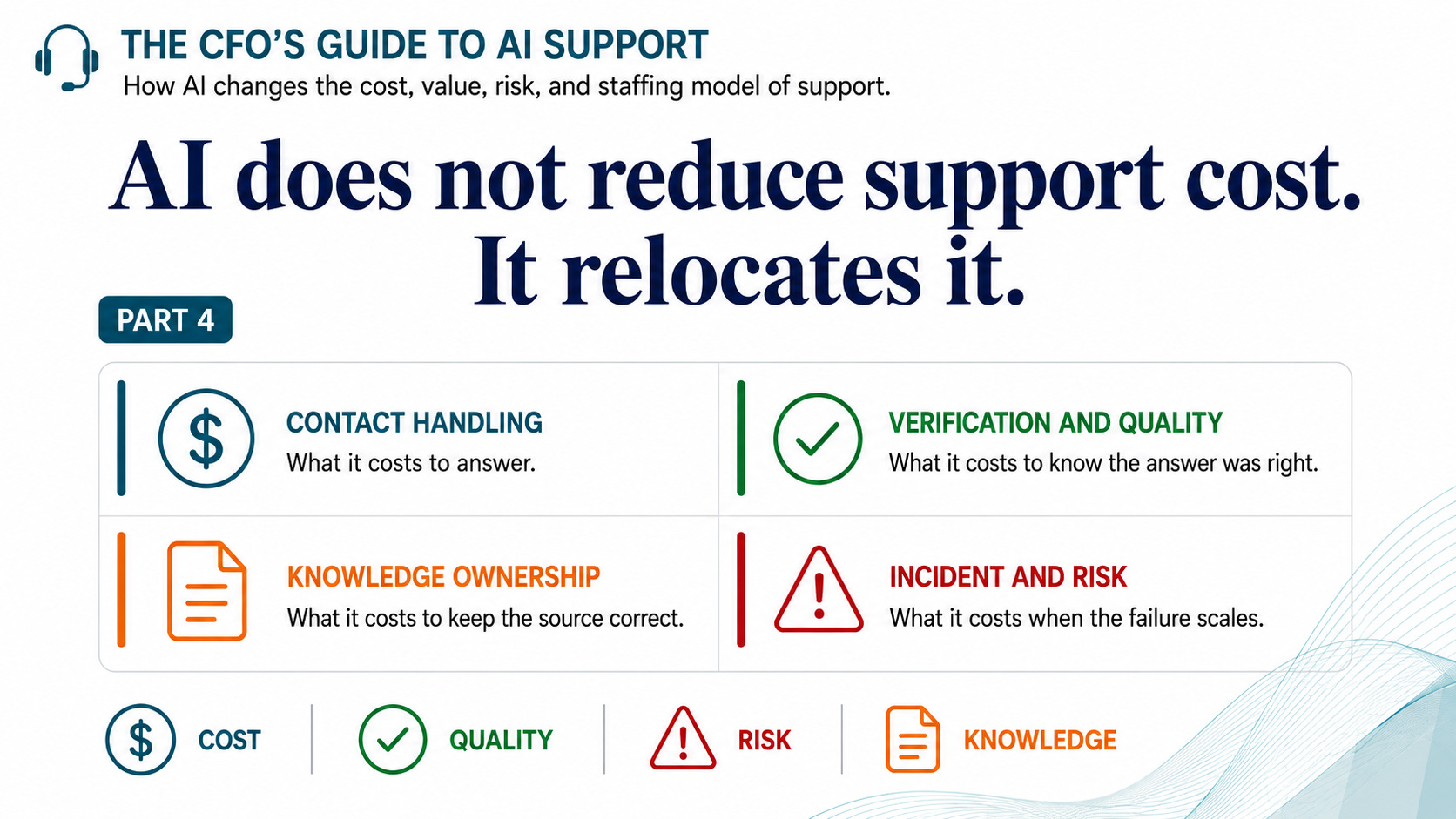
The model I use now has four categories. Not because four is elegant, but because these are the four places the money goes, and a model that names fewer than four will miss a cost that is already being paid.
Contact handling. The labor and tooling required to answer a customer. Human agent time, AI usage or per-resolution fees, telephony, licenses. Every model already tracks this bucket, and most models track nothing else. It is also the only one of the four that reliably falls when AI works.
Verification and quality. The labor required to know whether the answers were right. QA review, escalation supervision, reopen investigation, sampling, coaching. Before AI, this bucket scales with agent headcount, and Finance treats it as overhead attached to the agent line. That attachment is the assumption that breaks.
We eventually ran an AI review layer across every conversation, with human reviewers going deeper on the exceptions it flagged. That sounds like automation replacing QA labor. It was not. It changed what the humans read. They stopped reading a random sample and started reading the cases the machine failed to settle, which are the hard ones by definition.
Knowledge ownership. The labor required to keep the source of truth correct. Article creation, classification, policy updates, migration work, and the person who owns all of it. Before AI, knowledge is a shared chore. After AI, knowledge is a dependency, because the bot cannot answer better than the document it reads.
Incident and risk. The labor and exposure created when the system fails at machine speed. Incident response, rollback, reporting you have to rebuild because it did not surface the failure, and the customer trust you spend while fixing it. A human agent gives one wrong answer. A misconfigured bot gives the same wrong answer eight hundred times before anyone notices.
In March, after launch, we changed call flows and escalation handling because production showed us problems the design had not anticipated. We rebuilt reporting because unresolved escalations were slipping past the view we had. That work was staffed by people whose time was already committed elsewhere.
Contact handling is visible. Verification is hidden inside overhead. Knowledge gets relocated from everyone to someone. Incident and risk gets amplified. A model that tracks only the first one will report a win in month three and a mystery in month nine.
The Four Buckets
Contact handling: what it costs to answer.
Verification and quality: what it costs to know the answer was right.
Knowledge ownership: what it costs to keep the source correct.
Incident and risk: what it costs when the failure scales.
One Bucket Falls. Three Do Not Follow It Down.
Here is the model worked end to end. The numbers below are illustrative and rounded, built on a hypothetical operation, not on any deployment I have run. Use the mechanics, not the figures. Your fully loaded cost per contact and your team composition will produce different results.
Take an operation handling 100,000 contacts a year at a fully loaded cost of $6.00 per contact.
Before AI, the four buckets look like this. Contact handling, $600,000. Verification and quality, $70,000. Knowledge ownership, $40,000. Incident and risk, $30,000. Total support cost, $740,000.
The One-Number Model Answers in One Line
Now deploy AI and contain 40 percent of contacts. The one-number model runs immediately. Forty thousand contacts times $6.00 equals $240,000 in annual savings. That figure goes into a deck and a board reads it.
Run the Same Deployment Through Four Buckets
Contact handling falls, as predicted. Sixty thousand contacts still reach a human at $6.00, which is $360,000. Forty thousand contacts reach the bot at $1.00, which is $40,000. The bucket lands at $400,000, down $200,000 from where it started.
Verification and quality does not move. It sits at $70,000. That result surprises people more than the rest of the model, and it matched what we saw. QA hours stayed roughly flat. What changed was composition. Reviewers stopped sampling agent conversations for coaching and started working exceptions on bot conversations instead, which is harder work requiring a more experienced reviewer. The model that assumed QA would shrink alongside agent headcount assumed the wrong relationship. QA was never attached to headcount. QA was attached to risk, and risk did not fall.
Knowledge ownership rises from $40,000 to $95,000. A documentation specialist now exists. A migration happened. An update cadence runs three times a week and does not stop.
Incident and risk rises from $30,000 to $55,000. Failures reach more customers faster, reporting gets rebuilt to catch what the original design missed, and someone owns the response.
Add the four buckets after AI. Four hundred thousand, seventy thousand, ninety-five thousand, fifty-five thousand. Total, $620,000.
Real annual reduction: $120,000. The one-number model predicted $240,000.
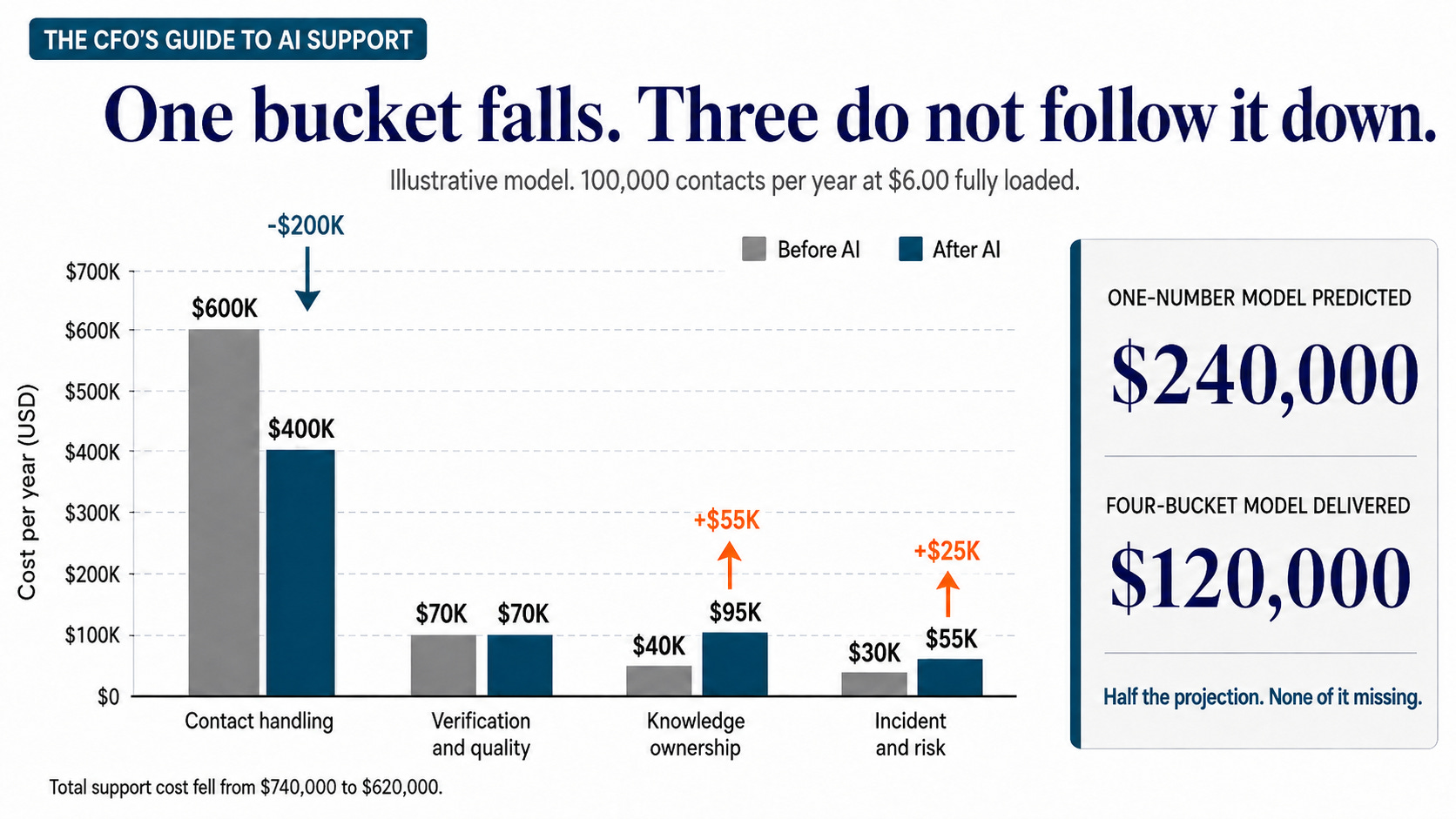
The savings were real. They were also half the projection, and the gap is not a rounding error or a bad vendor. Contact handling fell by $200,000, exactly as the simple model said it would. The other three buckets absorbed $80,000 of that reduction on their way back up. Nothing was lost. Cost was relocated, and only one of the four locations was being watched.
Contact handling fell by two hundred thousand. Three other buckets absorbed eighty thousand of it before anyone read the report.
The Promotion Belongs in the Model
Go back to the documentation specialist.
In a one-bucket model, that promotion is a payroll increase with no obvious cause. It shows up in a headcount review, someone asks why support added a specialist role during a year the team was supposed to shrink, and the honest answer sounds like an excuse.
In a four-bucket model, that promotion has a home. It sits in knowledge ownership, it was caused by the AI deployment, and it was predictable the moment we made a bot dependent on a document nobody owned. The role is not a cost overrun. The role is the price of the containment rate, and the containment rate is worth the price.
That is the difference a model makes. Same person, same salary, same year. In one version, unexplained drift. In the other, a budgeted consequence you predicted and defended.
A cost you did not model is not a surprise. It is a cost you decided not to look for.
The Buckets Do Not Arrive on the Same Schedule
This is the part that damages business cases, and it has nothing to do with the size of the numbers.
Contact handling falls immediately. The week the bot goes live, human contact volume drops and the savings are visible on the first report.
The other three arrive late. Verification pressure builds as reviewers work out what bot failure looks like, which takes a quarter. Knowledge cost arrives when the source of truth breaks under load, which is usually month four or five, when a policy change reaches customers before it reaches the article. Incident cost arrives the first time something scales wrong.
So a model measured at month three shows a win that has not finished happening. Contact handling has fallen and the other three buckets have not moved yet. The number looks better than reality, and everyone builds on it. Headcount plans get written against it. Renewal terms get signed against it.
Then month nine arrives and the operation is spending money in three places the plan does not mention. Nothing failed. The measurement was taken before the cost finished moving.
Measure Each Bucket on Its Own Clock
The fix is not more precision in the estimate. The fix is measuring on the right schedule. Contact handling gets reported monthly, because it moves monthly. The other three get reported quarterly against a three-year curve, because a single quarter tells you nothing about a cost that has not arrived yet. When someone asks for the savings number in month three, give them the contact handling figure and say plainly that three of four buckets are still forming. That answer is less satisfying and it is the one you will be able to defend in month twelve.
AI did not remove support operations. It added a second operation inside support. That second operation has staffing, cadence, ownership, and a budget, whether or not anyone wrote one.
Contact handling savings arrive in week one. Verification, knowledge, and incident costs arrive in months three through nine. A business case measured at month three is measuring one bucket with a stopwatch and ignoring three that have not started.
Build the Model Before You Need to Defend It
You have most of these numbers already. They are sitting in payroll, in your ticketing system, and in your vendor invoices. What you do not have is the structure that holds them together. Here is a week.
Monday. Fix your denominator. Pull twelve months of contact volume and your fully loaded cost per contact, including benefits, tooling, management overhead, and vendor seats. One number, written down, that everyone agrees on. Every bucket that follows depends on this.
Tuesday. Separate verification from headcount. List everyone spending time on QA, escalation supervision, reopen investigation, and coaching. Calculate the annual cost. Do not attach it to the agent line. It gets its own bucket, because it will not move the way the agent line moves.
Wednesday. Name the knowledge owner. If you cannot name the person who owns the source of truth the AI reads, you have found an unbudgeted cost, not an absence of one. Someone is doing that work at night or nobody is doing it and your containment rate is decaying. Cost the role properly, at the level it needs to be staffed.
Thursday. Price a bad week. Take your worst AI incident, or your worst near miss. Count the hours of response, the rework, the reporting you had to rebuild, and the contacts affected. That is your unit cost for an incident. Multiply by a realistic annual frequency. Two per year is not pessimistic.
Friday. Model three years, not one. Populate all four buckets for year one, two, and three. Assume contact handling falls first and the other three rise on a lag. Show the board the shape of the curve, not a single savings figure.
The Model Gets Rebuilt, Not the Operation
Set the cadence. Review the four buckets monthly with Finance in the room, and name an owner for each bucket who reports actuals against model. When a bucket comes in off model for two consecutive months, the assumption is wrong and the model gets rebuilt. Not the operation. The model.
That last rule matters more than the rest. Most teams respond to a model that stops matching reality by pressuring the operation to match the model. The operation is the evidence. The model is the guess.
When actuals and model disagree for two months running, the model is wrong. Rebuild it. Do not manage the operation into a spreadsheet.
The Money Did Not Leave. It Changed Job Titles.
We moved handbooks into Notion because the source the bot reads from had no owner. We promoted an agent because that document needed an owner and no owner existed. Both of those were AI costs. Neither of them appeared in an AI budget line.
The containment rate was real. The cost reduction was real. What was never real was the idea that the money left. It moved, and we found it in payroll under a job title that did not exist a year earlier.
AI does not reduce support cost. AI relocates it, and a model that names one bucket will find the savings and lose the destination.
If you rebuilt your AI business case tonight with four buckets instead of one, which bucket would you have the least data for: verification, knowledge, or incident? Tell me which one you would struggle to populate.