


A parent asked our bot an eligibility question shortly before a funding deadline. The bot answered in seconds. The parent trusted the speed as much as the answer and acted on it.
The answer had missed one condition.
The parent escalated to a state representative. The issue was resolved inside the deadline. There was delay and there was stress, and there was no financial or programmatic harm. We were fortunate, and the outcome does not change what the failure was.
Trace the causes and you will not find a model problem. The model performed. Retrieval performed. What failed was that the eligibility rules for that outlier scenario were not clearly or fully documented at the time. The condition existed in the judgment of people who had handled that situation before. It did not exist in any document.
Before the deployment, that gap cost approximately nothing. The handful of cases that hit it reached an experienced agent who knew to check. After the deployment, the same gap reached a parent in seconds, with total confidence, at the worst possible moment in her calendar.
I had known about the shape of that problem for a year.
In March of 2024, a year before any of this went live, I compiled the resources our agents referenced daily and found that none of our macros contained that information. Agents were answering correctly by going outside the system. The risk I wrote down at the time was that agents and future AI systems would give inconsistent answers depending on which resource they happened to consult.
That was the debt. The eligibility call was the payment.
By the end of this article you will have a way to price a workflow gap, a five-area audit to find the gaps before they find you, and a sequence for running that audit against a deployment calendar rather than a budget calendar.
Every Operation Runs on a System Nobody Documented
Every support operation runs on two systems. There is the one in the documentation, and there is the one in the people. The second one is faster, more flexible, and completely invisible in every report leadership reads.
Experienced agents know which article is current and which one somebody forgot to retire. They know that the official queue for a particular exception is wrong and the case needs to go to a specific person. They know the macro that reads well and creates a follow-up contact two days later. They know which rare cases have a condition attached that is written down nowhere, and they know to check before they answer.
None of that is failure. It is competence, and it is the reason the operation works at all. It is also a liability that no ledger holds. The organization is paying for that knowledge every day in the time it takes good people to compensate, and it receives no record and no line item in exchange.
AI does not inherit that second system. It reads the first one, which is the incomplete one, and executes it at volume without hesitation.
The workflow gap did not appear when we deployed AI. It appeared in a report for the first time when we deployed AI.
This is the distinction that matters for a financial decision-maker, and it changes the conversation from a technology conversation to a balance-sheet conversation. Part 4 of this series argued that AI relocates cost into buckets your model does not track. That is a real effect and it is a different effect from this one. Relocation is new cost created by the deployment. What we are discussing here is old cost, already being paid, that nobody had a way to see. The deployment did not create it. The deployment recognized it.
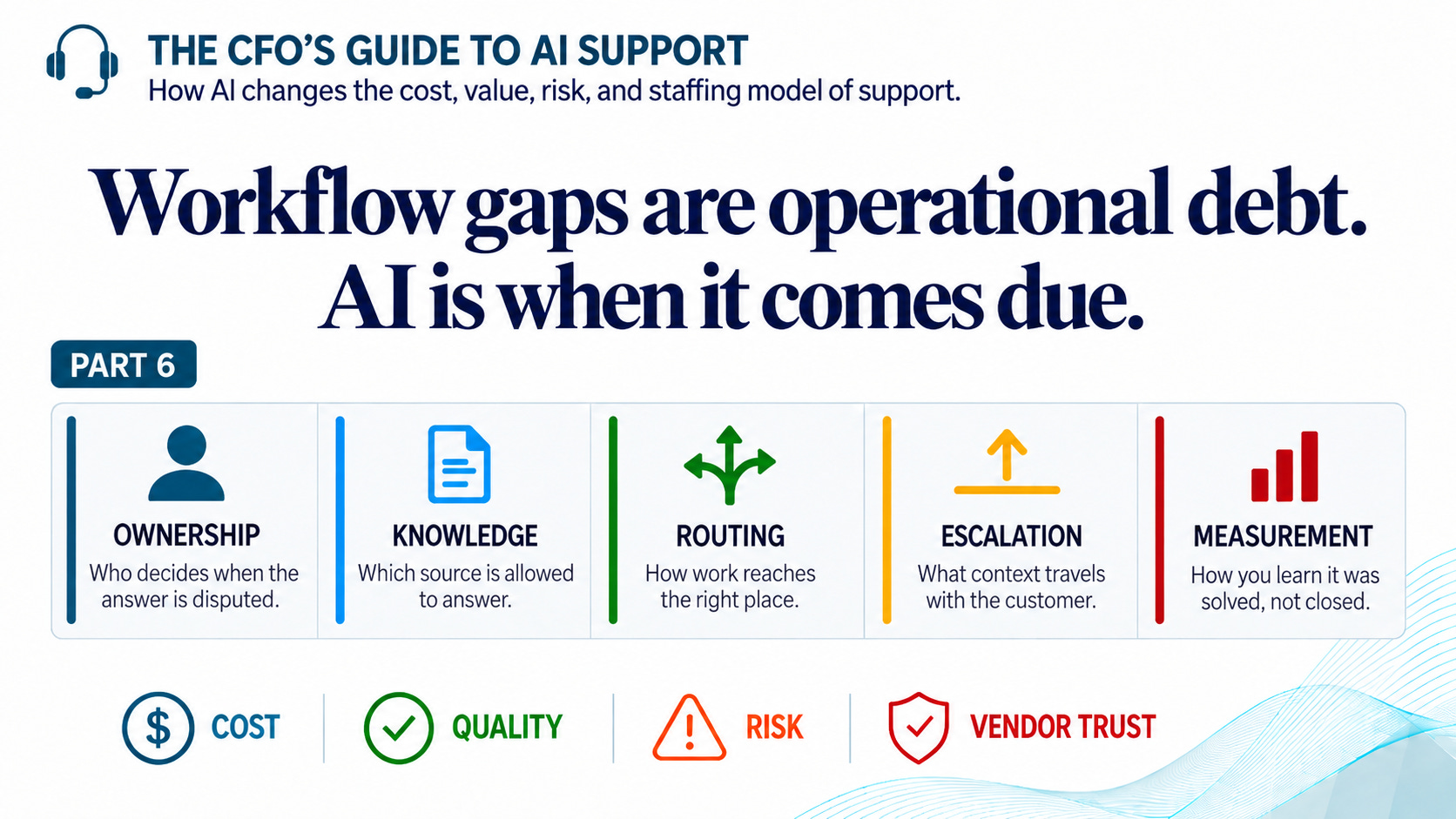
Workflow gaps are operational debt. AI is when it comes due.
A Workflow Gap Has a Carrying Cost and Nobody Books It
The reason these gaps survive for years is not that leadership does not care about them. It is that one side of the equation is visible and the other side is not.
Fixing a gap requires a decision, a person, a calendar, and an approval. Somebody has to write the rule, update the routing, revise the article, and train the team. That work has a cost, the cost is one time, and it is easy to count. It shows up in a planning conversation as a request.
Leaving the gap in place also has a cost. It recurs every week for as long as the gap exists, it is absorbed by people who were hired to do something else, and it produces no artifact. It never shows up in a planning conversation at all.
So the fix gets compared against zero, and the fix loses. It has lost this argument in every support organization I have worked in, including ones I ran.
The correction is arithmetic, and it fits on one line. Take the number of times a week the gap occurs. Multiply by the minutes somebody spends absorbing it. Convert to hours, annualize, and apply your loaded hourly rate.
Here is the populated version. The numbers are illustrative and rounded. Use the mechanics and substitute your own.
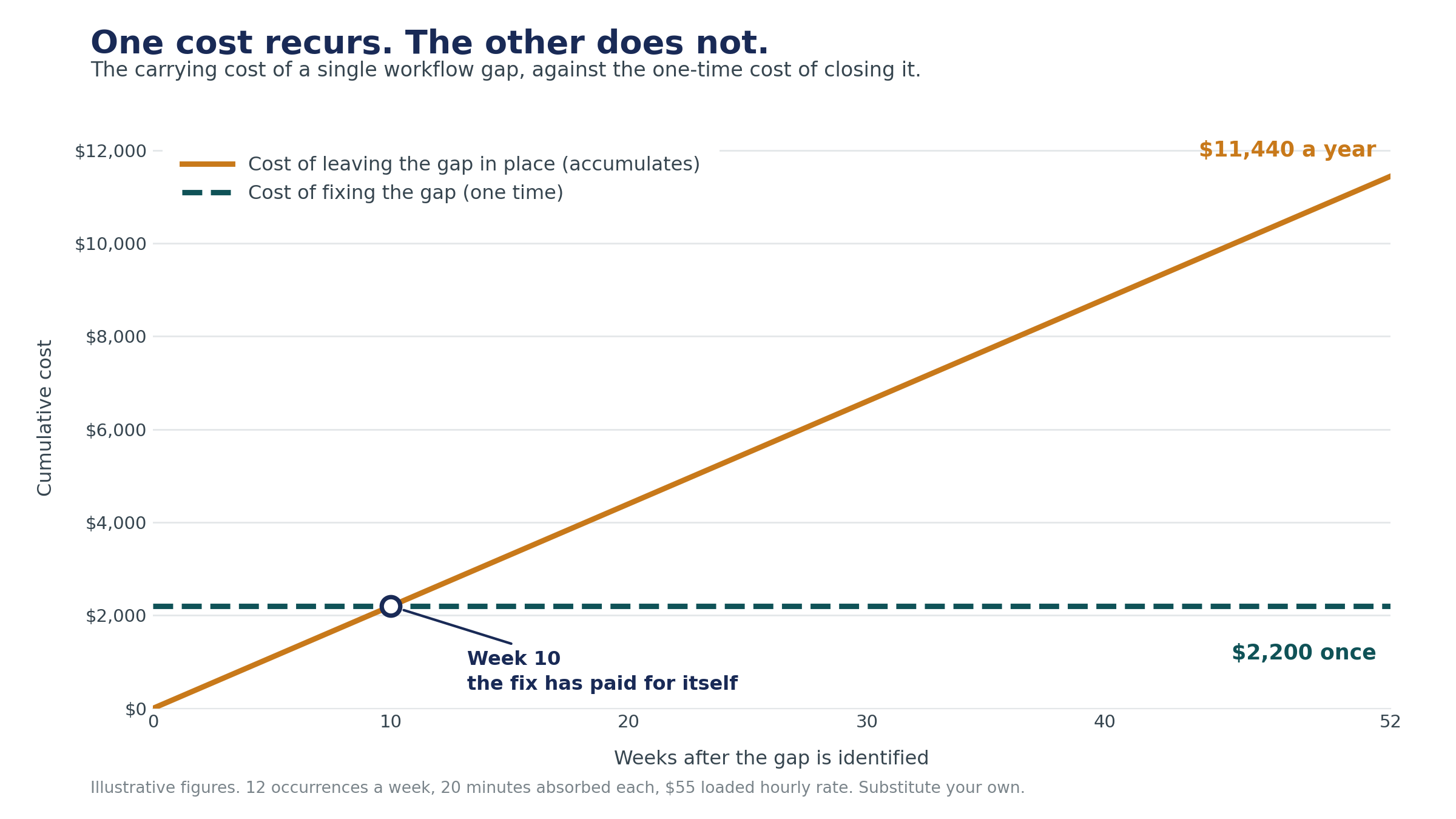
A routing gap on a policy exception occurs twelve times a week. Each occurrence takes a lead about twenty minutes to notice, reroute, and brief the receiving team. That is four hours a week, 208 hours a year, and at a loaded rate of $55 an hour it is $11,440 a year that nobody has ever written on a piece of paper.
Now price the fix. Writing the decision rule, updating the routing logic, revising the two articles that disagree, and training the team runs roughly forty hours across operations, knowledge, and training. At the same loaded rate, $2,200.
The fix pays for itself in about ten weeks and then keeps paying every week after that. Nothing about that math is difficult. The difficulty is that until somebody writes the first number down, the second number looks like a request for budget rather than a return on it.
The Carrying Cost of a Workflow Gap
Occurrences per week, times minutes absorbed per occurrence, divided by 60, times 52, times your loaded hourly rate.
That is the annual cost of leaving it alone.
Price the fix the same way. Compare the two numbers. One of them recurs.
Five Places the Debt Sits
Before expanding AI into a workflow, I look at five areas. They are not exotic and your team knows about most of them already, which is exactly the problem. Familiarity is what makes them survive.
Ownership. One team owns the outcome when there is disagreement. The failure this reveals is the operation where the real answer is to ask the person who always knows. That is not ownership, it is dependency, and it holds until volume rises or that person takes a week off. The cost is concentrated in a small number of senior people who are absorbing decisions that should be rules, which is the most expensive labor in the building doing the least visible work.
Knowledge. One approved source answers the question. Most operations run on five versions of a policy where the agents know which one is current and no document says so, which is the condition our macros were in a year before launch. Until AI arrives, the cost sits in rework and in the corrections senior agents make before a reply goes out, which is a real expense that no report has ever itemized.
Routing. Work reaches the right place without manual correction. Plenty of routing logic functions only because experienced agents quietly fix it all day. Automation removes the invisible correction and forces the design to stand on its own. The cost before that point is handle time and transfers on cases that were never routed correctly in the first place, distributed thinly enough across the queue that no single ticket looks expensive.
Escalation. Context moves with the customer when ownership changes. A ticket moving from one queue to another is not a process. When the receiving team lacks what it needs, the customer pays by repeating the story and the business pays twice, once in the handle time of the second conversation and once in the trust it spends getting there.
Measurement. The business knows the issue was solved rather than contained. A reporting layer built to count what happened is blind to what did not, and our unresolved escalations were slipping past the view we had. We did not know that until production showed us. A gap you cannot see has no carrying cost on paper and full carrying cost in payroll.
Most organizations have gaps in three or more of the five. That is not a criticism of those organizations. It is what happens when capable people are allowed to compensate for long enough.
The Routing Held Because Somebody Designed It
The counterexample is worth as much as the failures, and we have one.
Our call routing was designed with redundancy before launch. The caller reached a state support line, an IVR answered, the IVR passed the call to the voice system, and the voice system either resolved it or routed the caller to the correct agent group. The voice system sat in the middle of the chain rather than being hardwired into the IVR.
That design decision looked like over-engineering when we made it. On launch day, when our primary vendor’s telephony provider hit a connection cap and parents started reporting that they were unable to get through, we redirected the call flow to the backup vendor while the provider added lines. No full outage. The operation held.
Routing was the one area of the five where we had done the work in advance, written the design down, and built for the failure case. It is also the one area that did not cost us anything under pressure.
That is the argument, and it is not a coincidence. A workflow that exists in a document behaves predictably when it is handed to a machine or handed to a crisis. A workflow that exists in people behaves predictably only while the people are there to run it.
The Same Gap Costs More Once a Machine Runs It
The eligibility call is worth returning to, because the mechanism inside it is the one a CFO needs and it is easy to miss while reading it as a customer story.
A gap absorbed by a person costs one unit of labor per occurrence and generates no record. The same gap executed by a system costs correction, recontact, escalation, and trust repair, and it occurs at the frequency of the automation rather than the frequency of the exception. The error rate does not need to rise for the error volume to rise. Containment does that on its own.
The dashboard logged a fast resolution. The parent remembered a company that answered quickly and wrongly at the worst possible moment.
Run that forward. Every point of containment you add moves more of that exception category out of human judgment and into a documented rule, and where the documented rule is incomplete, the volume flowing through the incomplete part rises in exact proportion to your success.
Your cost of quality scales with adoption unless you retire the gap before you scale the workflow.
No Budget Line Holds This Work
There is a cost in this article that I am unable to give you a number for, and the reason is the argument.
We ran an active knowledge program. More than five hundred articles tagged and classified, updates going out three times a week, a target of two thousand. Support Operations, QA, documentation, workforce management, leads, managers, and vendor teams all carried pieces of the operating environment.
I cannot tell you what that cost. Not because the information is confidential, but because no clean cost center ever existed for knowledge maintenance, AI supervision, prompt and rule updates, or bot incident response. The work was real, it was continuous, and every hour of it came out of a headcount approved for a different purpose.
That is the condition most operations are in right now, and it is worse than paying the cost. Paying a known cost is a decision. Paying an unknown cost is a variance nobody can explain at the end of the quarter, and the explanation that gets offered is almost always the wrong one. Support looks inefficient. The vendor looks expensive. The AI investment looks like it underdelivered. None of those diagnoses is correct and all of them are actionable, which is how organizations end up renegotiating a contract to solve a documentation problem.
A cost with no budget line does not go unpaid. It gets paid quietly, and it surfaces as a number nobody can reconstruct.
The Repayment Terms Get Worse After Launch
The same fix has three different prices depending on when you make it.
We paid the second price on our escalation intake. In March, after the launch, we changed call flows and escalation handling because production showed us problems the design had not anticipated, and we rebuilt reporting because unresolved escalations were not surfacing. None of that work was harder than it would have been in February. It was simply larger, and it arrived while the operation was carrying live volume. Every hour of it came out of a week that had already been planned around other work.
There is a third price, which is the one to worry about. Never fix it, and you pay the carrying cost every week indefinitely while containment climbs and the error volume climbs with it.
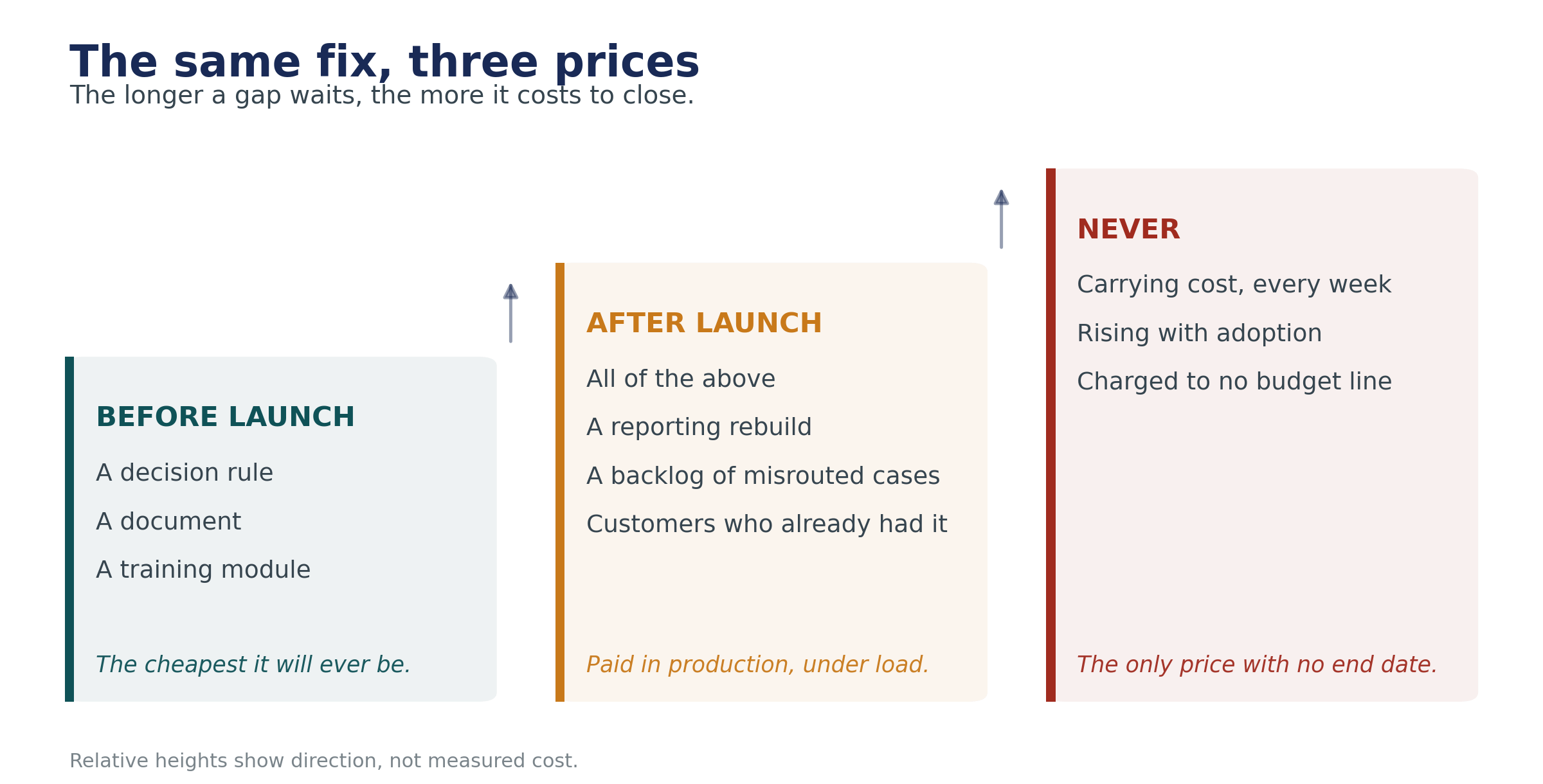
This is why workflow readiness belongs in the AI business case rather than in a separate operational plan that gets deferred. The two are the same document. A business case that funds the tool and defers the workflow has not saved money. It has scheduled the expense for a quarter when it will cost more.
The Only Return I Can Trace Ran Through a Form
I want to be specific about what the workflow work returned, and equally specific about what I am able to attribute to it.
One result has a cause I can name. Standardizing our escalation intake reduced mean time to resolution by about 30 percent. The intake was a form and a decision rule about where a case goes and what travels with it. No model changed in that window. The improvement came from the receiving team knowing what it was receiving.
Other numbers moved over the same period. New-hire onboarding fell from two weeks to three days. Average handle time fell from seven minutes to four. First reply time on one workflow went from 63.4 hours to 12.3 hours across three weeks. Our weekly intent analysis caught a 30 percent rise in payment-related questions and we corrected the cause the same day.
I cannot give you a clean attribution for most of those, and I want to be direct about why rather than pick the flattering explanation. We were rebuilding workflows and deploying AI in the same quarters. We did not run the counterfactual, because no operation under that kind of load ever does. Any leader who tells you they cleanly separated the two is reconstructing after the fact.
What I can tell you is where the traceable work sits. The one result with a documented cause came from a form. The report that caught the payment spike was a weekly review somebody was responsible for reading. Neither is a model capability and neither appeared on a vendor roadmap.
The AI mattered, and it absorbed volume we would not have staffed for. But the piece I am able to trace ran through a workflow that got written down, assigned an owner, and measured, and that is the piece requiring a budget rather than a contract.
Audit Against the Deployment Calendar, Not the Budget Calendar
Workflow gaps do not surface on a fiscal schedule. They surface on a deployment schedule, and the audit should follow the same clock.
Before you turn anything on, take the two or three workflows the AI will touch first and map each one from customer question to final answer, including every queue, article, macro, system, escalation, and handoff. For each one, answer five questions in writing. Who owns the outcome when there is disagreement. Which single source of truth should answer this. Where the case goes next. Where a human has to verify before anything moves. Which metric proves the workflow improved. Gaps you find here are the cheapest gaps you will ever fix.
In the same week, price the three largest gaps using the carrying cost line above and bring those numbers to the funding conversation alongside the tool cost. This is the step that gets skipped and it is the one that decides whether the remediation is funded. A workflow fix requested on its own merits loses to every other request in the room. A workflow fix presented with an annual carrying cost and a ten-week payback does not.
Through weeks one to four of production, treat every miss as an audit finding rather than a tuning ticket. Sort each one into ownership, knowledge, routing, escalation, or measurement before anyone touches a prompt. The sorting is the diagnosis. A team that routes every miss to the AI configuration will tune indefinitely and fix nothing, because the configuration was not the problem.
From month two forward, give the work an owner and a cadence. Somebody reports weekly on gaps found, gaps closed, and gaps still carrying cost. When the same gap appears in three consecutive weeks, it stops being an operational annoyance and becomes a budget item with a number attached.
When it fails, and some of it will, check the source before you check the system. Our default question after a bad answer was whether the document was right. That single habit is worth more than any prompt library, because it puts the investigation where the cause usually lives.
A Year Passed Between the Gap and the Invoice
I found the macro gap in March of 2024. A parent paid for it a year later.
Nothing happened in between. No incident, no escalation, no line on any report. The gap sat there being absorbed by agents who knew to check, which is what made it invisible and what made it survive. Had anyone priced it then, it would have looked like a documentation request competing against a roadmap.
The bot did not fail that parent. It followed a rule that was missing a condition, at the speed and consistency you pay a machine for. That is what it will do with every other rule your operation never finished writing down.
AI does not expose your workflow problems. It stops absorbing them, and the cost your people were quietly carrying arrives in a quarter when nobody remembers deciding to take it on.
Take the workflow your AI touches most and find the rule your best agents check before they answer. If that rule is not written down, what is it costing you this week, and would you be able to get the fix funded before a customer finds it for you?