


By the end of this article, you will know how to load the full cost of a premium support tier, which part of its price AI is eroding, and what to price instead.
The renewal call was on the calendar as a formality.
Earlier in my career, at a B2B software company, I sat in on a renewal review with one of our premium support customers. The details below combine several renewals from that period into one. The customer had bought our highest tier two years earlier for one reason: faster responses. The contract promised a one-hour first response on urgent tickets, and we had met it on nearly every ticket they opened.
The account executive opened with our numbers. Response times well inside the target. Priority routing on every case. A named contact. Finance had the tier on the renewal forecast at the same price as the year before.
Then the customer’s operations director spoke. “We are moving to the standard plan.”
The account executive asked whether the issue was price. It was not. She walked through three problems from the past year. Each had reached us fast. Each had then moved between support, the account team, and engineering for days while her team explained the same business impact to different people. One of them had ended with her CFO on an email thread with our leadership.
“We paid for fast answers,” she said. “We needed someone to own the problem.”
The account team offered a discount to keep the tier. She declined. The premium revenue left. The work those three problems had created inside our company did not leave with it. That work had already been spent, and none of it had ever appeared against the tier.
The tier reported a healthy margin right up to the day the customer stopped paying for it.
Speed Is the Part of the Price AI Is Making Cheap
Most premium support tiers are built on speed. Faster first response, priority routing, longer coverage hours, a named contact. The model made sense for years. Response time fits cleanly into a contract. Sales knows how to explain it, Procurement knows how to compare it, and Finance can connect coverage hours to staffing cost.
AI changes both sides of that equation at once.
On the revenue side, fast response is becoming standard in every tier. Automated triage, case summaries, and agent assist shorten the time to a useful first reply for everyone, including customers on your base plan and customers of your competitors. As those tools mature, the gap between a premium response target and a standard one narrows. When the gap narrows, the price the gap supports narrows with it.
On the cost side, the tier was never as profitable as its report showed. The work that decides whether a premium customer renews happens after the first response: coordinating specialists, keeping one version of the truth, and driving the case to a verified outcome. When nobody owns that work, it spreads into engineering, the account team, and senior agents, and it gets booked wherever those people sit.
A premium tier priced on speed is losing its price and hiding its cost at the same time. Finance sees the first movement late, at renewal. The second one never appears on a report at all.
A Premium Tier Has Three Lines on Its P&L
Most tier reviews use two lines: revenue from the tier and the support cost to deliver it. Subtract one from the other and you get a margin. That view is incomplete in both directions. A full tier review needs three lines.
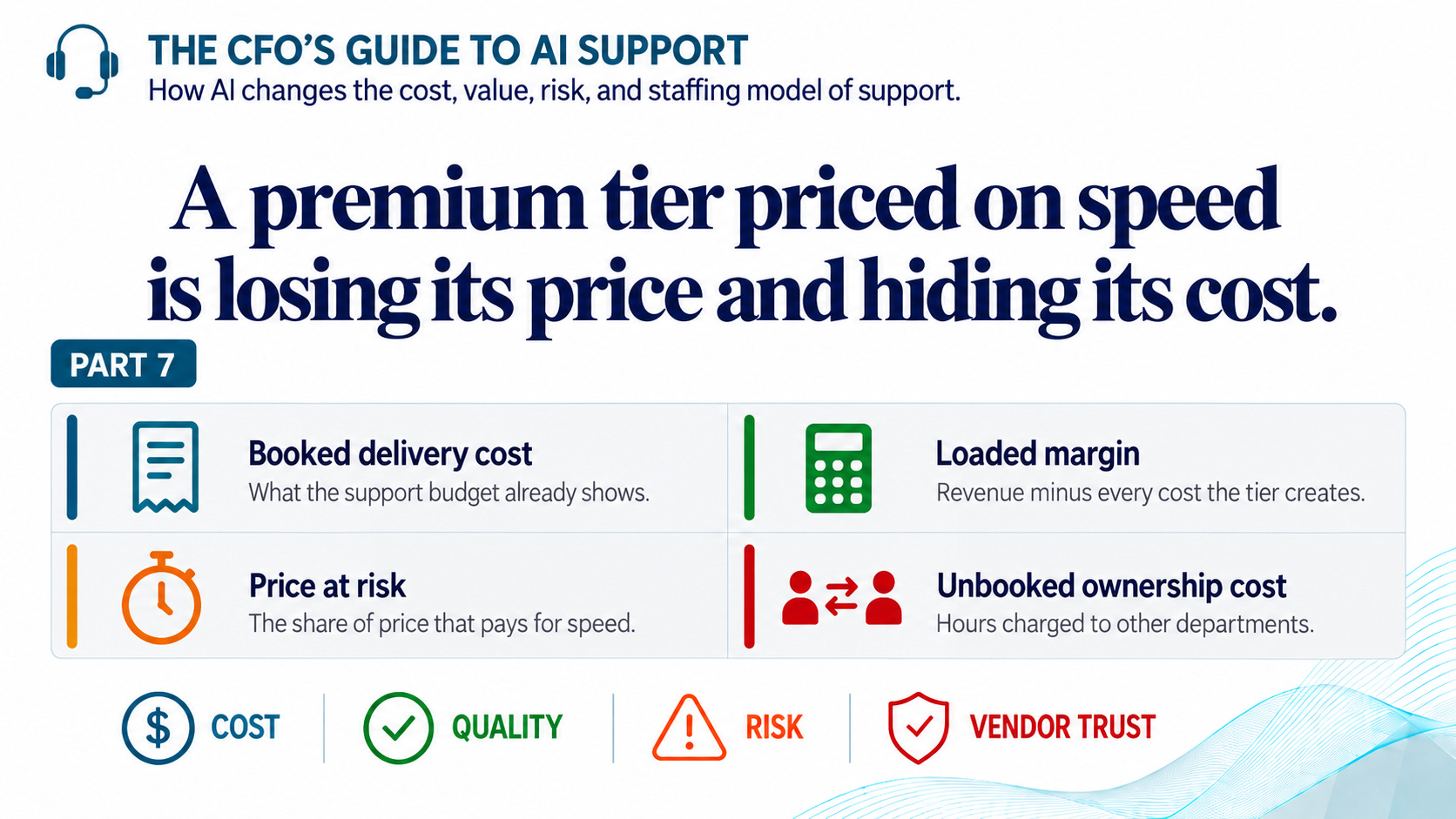
Price at risk is the share of the tier’s price that pays for speed. Response targets, priority routing, and coverage hours are real features, and customers value them. They are also the features AI makes cheapest to match. Any portion of the price that rests only on speed will face pressure at renewal as the standard experience catches up. The question for Finance is how much of the price sits on features that will not hold their value.
Booked delivery cost is what the support budget already shows. The agents and leads assigned to premium queues, the coverage floor for the promised hours, the named contacts, the reporting. Most companies measure this line well because support owns it and reports against it.
Unbooked ownership cost is the coordination that premium cases pull from outside support. The account manager who opens a side thread because the customer called them directly. The engineer who joins a call before troubleshooting is complete. The lead who reroutes a case by hand. The director who gets copied on day three. Each of those hours is real labor, charged to a department that does not report against the tier.
The third line is where the renewal decision gets made. The customer on that call never mentioned our response times. She described the unbooked line from her side of it: the hours her own team spent managing our handoffs.
The Loaded Margin Tells a Different Story
Run the three lines through an illustrative model. These figures are illustrative and are not drawn from any company I have worked with.
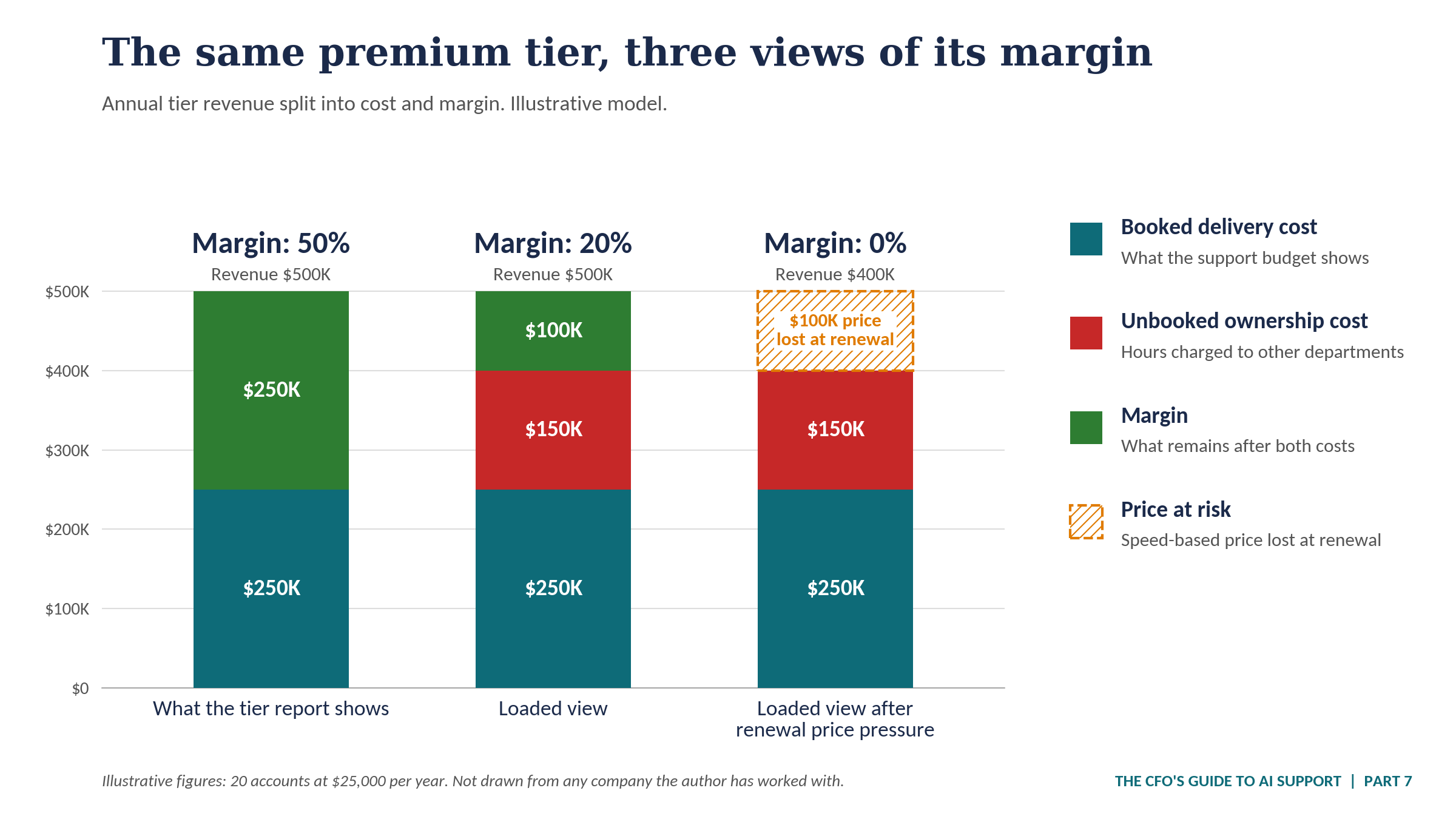
Assume a premium tier sold to 20 accounts at $25,000 per year, for $500,000 in tier revenue. The support budget shows $250,000 to deliver it. The tier report shows a 50 percent margin, and on that report the tier looks like one of the healthiest lines in the support organization.
Now load the third line. Sample the high-severity premium cases from the past year, count every hour that engineering, account management, and leads spent coordinating them, and price those hours at loaded rates. Assume the total comes to $150,000.
Loaded margin = (tier revenue minus booked delivery cost minus unbooked ownership cost) divided by tier revenue
With the illustrative figures, $500,000 minus $250,000 minus $150,000 leaves $100,000. Divided by $500,000, the loaded margin is 20 percent. The reported margin was 50 percent. Thirty percentage points of it were cost booked somewhere else.
Then apply the first line. Assume standard-tier response times improve enough that customers push the premium price down 20 percent at renewal. Tier revenue falls to $400,000. Cost does not fall, because the coordination work was never tied to the clock. $400,000 minus $250,000 minus $150,000 leaves nothing. The loaded margin is zero.
Illustrative model. Reported margin: 50 percent. Loaded margin: 20 percent. Loaded margin after one renewal cycle of speed-driven price pressure: 0 percent. The tier report showed none of that movement.
Your figures will differ. The pattern to test for is the same one. A tier can look profitable on booked cost, break even on loaded cost, and lose its price at the same renewal, with nothing on the standard report warning anyone in advance.
The Hours Landed in Other Departments
A case from another part of my career shows how the third line fills up.
A premium customer’s billing integration stopped processing records during a month-end run. The first reply arrived inside the promised window, and AI summarized the history and surfaced two related cases. Then the ticket landed in the billing queue, a lead rerouted it to integrations, integrations asked for logs, and the account manager opened a separate thread because the customer had contacted them directly. The customer explained the business impact to support, then again to the account manager and to engineering, before asking who owned the problem until they were processing again.
From Finance’s side, that case looked delivered. The response target was met. The first-response SLA stayed green. The lead’s time, the integration team’s time, and the account manager’s time were charged to their own departments, the normal way time gets charged. Nothing about the case added cost to the tier.
The customer on the renewal call had lived through three cases shaped like that one. Our tier report had recorded three on-time responses.
The tier report counted the response. The other departments paid for the ownership.
Several good people worked hard on that billing case. The lead, the account manager, and the integration team each did something reasonable. The cost did not come from careless work. It came from a tier that promised speed without defining who owned the outcome, which left capable people covering the gap in whatever time they had left.
Your AI Budget Is Funding the Discount on Your Premium Tier
The part most pricing reviews miss sits in a different budget entirely.
The company’s own AI investment accelerates the price pressure on its premium tier. Every dollar spent to make standard support faster narrows the distance between standard and premium response. That is the right investment for the standard tier. It is also a scheduled cut to the premium tier’s price, if the premium tier sells nothing but that distance.
Support and Finance usually review these two decisions separately. The AI business case gets approved on cost per contact. The premium tier gets renewed from last year’s price list. Nobody puts them on the same page, so nobody sees one decision eroding the other.
This is not a support performance problem. It is a pricing problem. The tier sells the one thing your own AI roadmap is making standard.
The answer is not to slow the AI rollout to protect the premium price. That trade loses on both lines. The standard tier stays expensive, and the premium tier still sells a feature competitors will match. The answer is to move the premium price onto the part of the work AI does not make cheaper: accountable ownership, technical depth, verified outcomes, and reduced customer risk.
Ownership Is the Part of the Price That Holds
At a later company I led, we sold paid support tiers with four components: a response SLA, a named contact, a technical account manager, and a monthly block of consulting hours. By the time I left, support ran as a profitable department.
Looking at that package through an AI lens, the four items split along the line this article draws. The response SLA is the item AI makes easiest to match. The named contact sits in the middle, because it holds value only when the person has the authority to drive a case across teams. The technical account manager and the consulting hours are the items AI makes hardest to match. They sell judgment and accountability over time, not a faster first reply.
That split is the pricing model.
Price speed as a feature included in the tier. Price ownership as the product.
Ownership has a delivery cost, and that cost belongs on the tier’s P&L on purpose instead of leaking into other departments by accident. It changes staffing: senior agents and specialists with decision rights, not a faster pooled queue. It changes metrics: time to accountable owner, repeat contacts on the same issue, and ownership breaks, reported next to first response. It changes the escalation path, because an owner without a defined route into engineering is a named contact with a better title.
Booking ownership against the tier will lower the reported margin at first. That is the correct outcome. The cost was already there. Booking it moves it from other departments’ budgets into the line where pricing decisions get made, which is the only place it can inform a price.
Ownership design also pays back in operating terms. At the most recent operation I ran, standardizing escalation intake reduced mean time to resolution by about 30 percent. That was not a premium tier result, and I do not present it as one. It shows that the structure around a handoff is work with a measurable return, which is the case Finance needs before it funds an ownership model.
Five Days to a Loaded Tier Margin
You do not need a pricing project to start. You need one week and the right sample.
Monday: List every promise in the tier. Pull the contract language for each paid tier and sort each promise into two columns. Speed features go on the left: response targets, priority routing, coverage hours, channels. Ownership promises go on the right: named owner with decision rights, escalation path, technical depth, proactive work. Most speed-first tiers will show a full left column and a thin right one. That imbalance is your price at risk.
Tuesday: Sample ten high-severity premium cases. Pick cases from the last two quarters that crossed teams. For each one, list every person outside support who touched it, including account managers, engineers, product managers, and directors, and ask each of them for a rough estimate of their hours. Rough is acceptable. The number you have today is zero.
Wednesday: Price the third line. Apply loaded hourly rates to those hours, scale the sample to the tier’s annual volume of comparable cases, and add the result to the booked delivery cost. Calculate the loaded margin next to the reported one. The gap between the two is the cost your tier report has been leaving out.
Thursday: Test the price at risk. Compare your premium response target to where your standard tier is heading as AI rolls out. If the gap closes within the next contract cycle, rerun the loaded margin at a lower renewal price. Finance will face that scenario at renewal whether or not anyone models it first.
Friday: Bring all three views to the pricing conversation. Show reported margin, loaded margin, and loaded margin under price pressure side by side. Decide what the customer is paying the company to own. Assign one accountable owner for severe premium cases, give that role the authority to coordinate across teams, and book that role’s cost against the tier.
Do not start by changing the price. Start by loading the cost. A price set against a partial cost is a guess with a contract attached.
Repeat the case sample every quarter. The third line moves with case mix, product releases, and team changes, and a tier margin reviewed once a year describes last year’s customers.
The Customer Was Buying an Owner
Go back to that renewal call.
Our response times were never the problem. Every number we brought to the call was accurate. The tier report was accurate too, as far as it went. It recorded what support delivered and left out what the rest of the company spent covering for an ownership role nobody had been assigned.
The customer had already done the math we had not. She had counted the hours her team spent explaining the same problem to three groups and weighed them against a fast reply. She downgraded because the premium tier had sold her the part of the work that was easiest for us to deliver.
A tier priced on ownership would have turned that call into a different conversation. The question would have been who owned her problems last year and what that owner prevented, not whether we beat the clock. That is a harder promise to keep. It is also a promise AI does not make cheap for everyone else.
Price the promise AI cannot make cheaper, and book every hour it takes to keep it.
If you loaded every hour that engineering, account management, and leads spent on your premium customers last quarter into the tier’s cost, would the margin hold, shrink, or disappear?