


By the end of this article, you will know the four inputs that set your stage, how to find the volume where owning beats buying, and which layer of your support stack you should own even while you buy everything else.
On a Saturday morning in March 2025, two states went live on the same day, and parents started reporting that they were unable to get through.
The voice AI was working. The problem sat one layer below it. The chosen vendor’s telephony provider capped the number of connections it would accept per line, and launch volume hit the cap.
No contract clause fixed that. What fixed it was the shape of the routing. Calls came in on the state line, reached the IVR, passed to the voice AI vendor, and then went to the agent group. The vendor was one step in that chain. It was not the chain. So we redirected the call flow to the backup vendor while the chosen vendor’s telephony provider added lines.
Readers who were here for Part 1 saw that morning from the dashboard side. This time I want to show you the wiring, because the wiring was a decision.
Before launch I had placed the AI vendor in the middle of the routing chain on purpose. I wanted flexibility and redundancy at a point when the company was in no position to absorb a stalled launch. We bought the AI. We did not hand over the routing.
That split was right for the stage we were in. It would have been overbuilt for the operation we had a year before, and at ten times the volume it would not have been enough.
The Same Decision Gives Different Answers at Different Volumes
Most build-vs-buy conversations treat the answer as permanent. Leadership debates it once, signs a contract or staffs a project, and moves on. The decision then sits in the budget for three years while the company it was made for changes underneath it.
I watched the operation I ran move through three stages in about two years, and the right answer moved with it.
At the one-year mark, in July 2024, my retrospective reported fourfold ticket growth on the same staff. We had built the functions an operation needs before it can absorb that kind of growth: workforce management, support operations, QA, and documentation. The AI we ran was bought and configured, which fit an operation of that size.
In late 2024 we evaluated voice AI. I compared the chosen vendor, the backup vendor, and the AI offered by the platform we already used, instead of defaulting to the incumbent. We priced every option per interaction. The modeled case for buying was strong enough to justify procurement. Owning the routing around it was the decision that made the March launch survivable.
By August 2025 the operation handled 7,446 tickets in a single week. In January of that year it had handled about 600. At that volume a per-interaction price stops being a rounding line in the vendor budget. It becomes the number the next decision turns on.
Same company. Same team. Three different right answers. Build and buy are not permanent choices. They are economic choices tied to volume, and volume does not hold still.
Part 2 gave you the five cost categories for comparing the two paths: tooling, staffing, knowledge, maintenance, and exit. This article answers the question that model leaves open, which is when the answer flips.
Four Inputs Set Your Stage
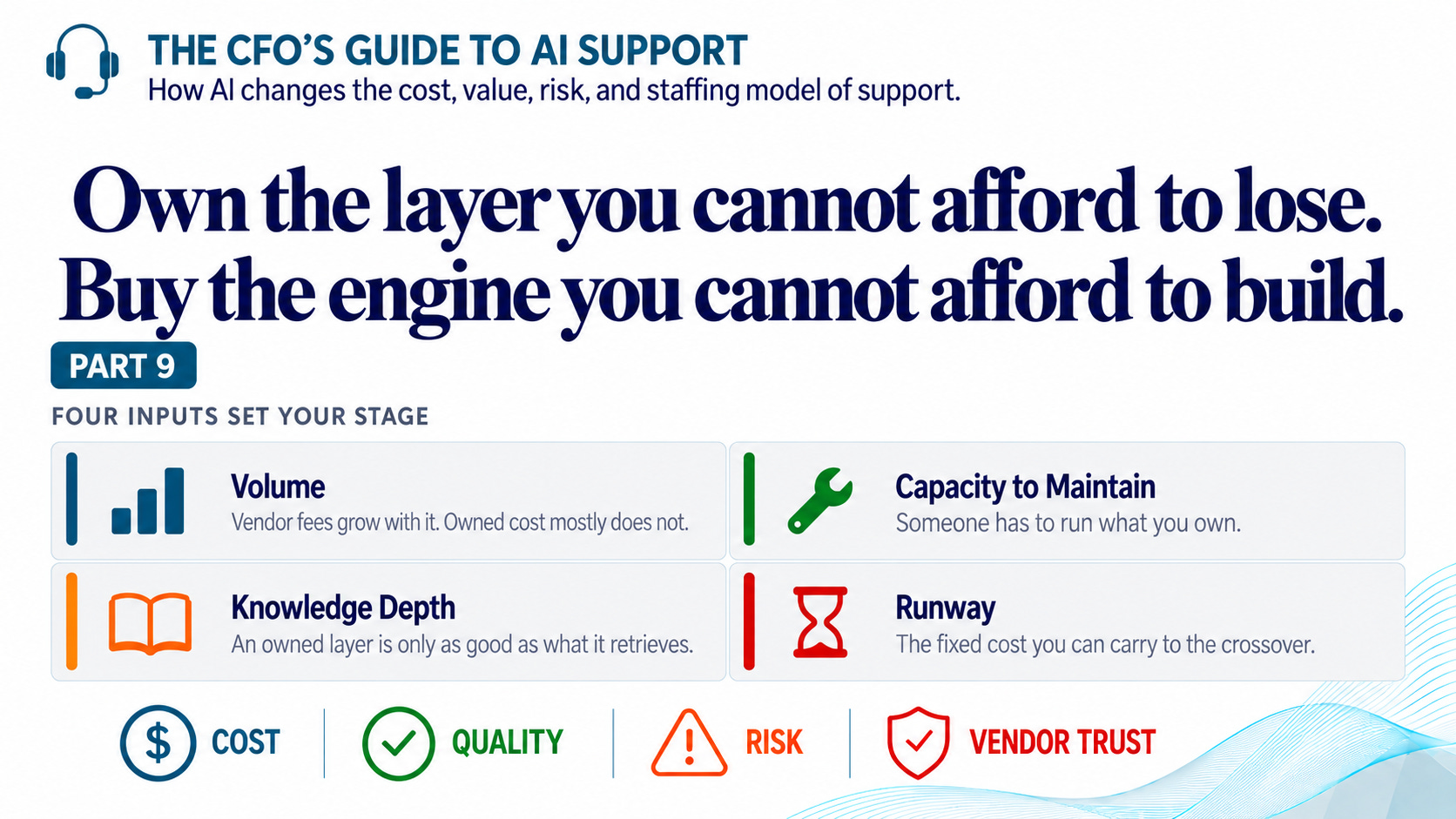
Revenue is the shorthand most executives use for stage. I will use it too, with a warning. For this decision, revenue is a proxy. Four inputs do the deciding.
Volume is the number of contacts AI handles and how fast that number is growing. Vendor pricing for AI support is usually per resolution, per interaction, or per conversation. That price scales with volume. An owned system mostly does not. Volume tells you which side of the crossover you are on.
Capacity to maintain is the engineering and support operations time available to keep an owned system running. A system you own needs someone to update knowledge sources, tune routing, review failures, and ship changes on a cadence. If that capacity comes from people budgeted for something else, the build is borrowing against another team’s roadmap.
Knowledge depth is how much of your support knowledge is documented, current, and owned by a named person. An owned AI layer is only as good as what it retrieves. A team with thin documentation that builds its own layer pays twice: once for the system, and again for the knowledge program the vendor’s out-of-the-box setup was quietly hiding.
Runway is how many months of fixed cost the company can carry before the investment pays back. A build is a fixed cost that starts on day one. The savings arrive only after volume crosses the line where owning gets cheaper. Runway decides whether you can afford to wait for that line.
A company at $50 million in revenue with 2,000 contacts a month is an early-stage company for this decision. A $20 million company with heavy, fast-growing volume and a strong operations team is closer to scale than its revenue suggests. Stage the decision on the inputs, not on the revenue line.
Find the Volume Where Owning Gets Cheaper
The crossover point is the volume where the cost of owning falls below the cost of buying. Below it, buying is cheaper. Above it, every month you keep buying costs more than owning would.
Here is an illustrative model. Your vendor charges $1.20 per AI-resolved contact. Owning the equivalent layer costs $240,000 a year in fixed cost, covering engineering time, hosting, and evaluation tooling, plus $0.30 per resolved contact in model and infrastructure usage.
Every resolved contact you own instead of buy saves you $0.90. The fixed cost is $240,000. Divide one by the other and the crossover sits at about 266,667 resolved contacts a year, roughly 22,200 a month.
Now run three companies through the same model.
The Gap (illustrative)
• Early stage, 3,000 resolved contacts a month: buying costs $43,200 a year. Owning costs $250,800. Building here spends almost six times what buying does.
• Growth stage, 20,000 a month: buying costs $288,000. Owning costs $312,000. The two paths sit $24,000 apart, inside the margin of error of any forecast.
• Scale, 100,000 a month: buying costs $1,440,000. Owning costs $600,000. Every year on the vendor contract costs $840,000 more than owning.
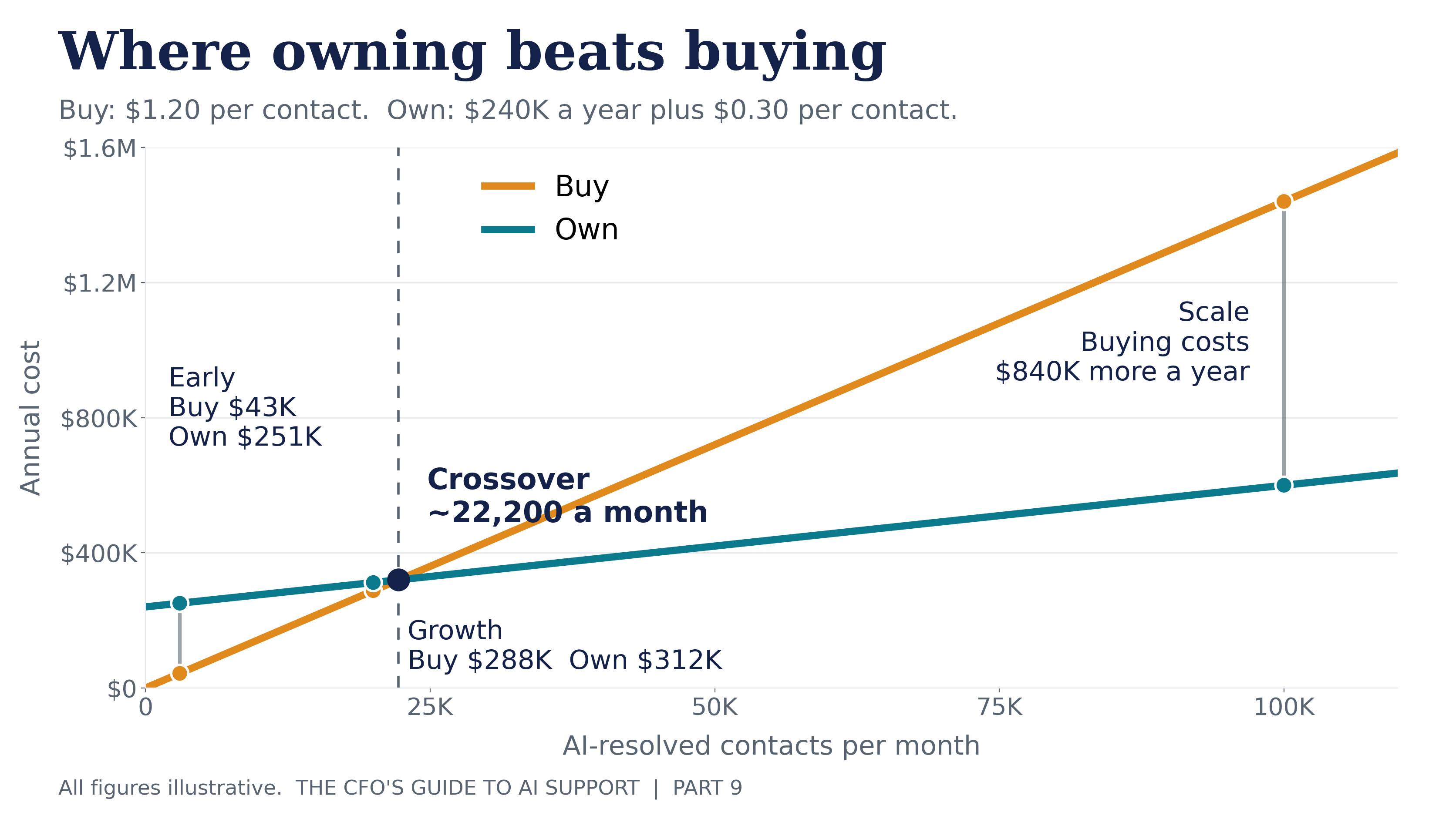
The early-stage company that builds is not saving money. It is spending runway to own a system it does not have the volume to justify. The scaled company that keeps buying is paying a growing premium for convenience it no longer needs. The growth company sits on the line, and that is where most of the bad decisions happen, because the numbers are close enough for either side to win the argument.
The early build burns runway every month until volume catches up. The late buy burns margin every month after volume passes it.
One caution before you trust the line. The fixed cost in an owned model has a cliff. If one of the two engineers carrying the system leaves, the cost of owning jumps for months while the replacement learns it. Part 2 stress-tested that case. Run the crossover with the cliff in it before you commit.
Not Every Tool Flips in the Same Direction
The crossover does not always point from buy to build. Workforce management shows the opposite pattern.
This is a composite of how forecasting evolved across the companies where I have run support, so treat the details as illustrative. Early on, forecasting lived in a spreadsheet built from historical volume and sales projections. Later we bought standalone workforce management software. Later still, we moved to workforce management software integrated with the systems we already ran.
For WFM, building came first and buying came later. The reason is the same rule running the other way.
A spreadsheet carries no license fee. Its cost is analyst time, and analyst time grows with complexity: more agents, more channels, more time zones, more schedule rules, more seasonal peaks to model. At a small team with one or two channels, that cost is close to nothing. Add channels, coverage windows, and a hiring plan tied to sales projections, and the spreadsheet becomes a part-time job that breaks every time someone edits the wrong cell.
Standalone software solved the math and left the data movement. Volume came out of one system and schedules went into another. Integration removed that step.
Put the two cases side by side and the rule is the same.
The path whose cost grows with your growth driver is the path you will outgrow.
For AI support, vendor fees grow with volume, so high volume pushes you toward owning. For forecasting, spreadsheet labor grows with complexity, so complexity pushes you toward buying. Before you decide on any support tool, name the input your company will grow fastest, and ask which path’s cost rises with it.
Every Stage Owns a Different Layer
The handoff from buy to build is not a single switch. It is a question of which layer you own, and the answer grows with the company.
Early stage: buy and configure. Under about $10 million in revenue, or under a few thousand AI-handled contacts a month, buy the platform and configure it. Your scarce resources are engineering time and runway, and both belong on the product. Spend your support operations time on knowledge and intent data, because that work transfers to any system you move to later. The failure mode at this stage is building because the vendor quote felt expensive. The quote is expensive. The build is more expensive, and it shows up in a different P&L line.
Growth stage: buy the engine, own the layer. Between about $10 million and $100 million, keep buying the AI engine and take ownership of the layer around it: routing, knowledge sources, evaluation, and the change process. That layer is small, cheap to staff relative to an engine, and it is what lets you switch, split, or add vendors without a rebuild. Our routing chain on launch day was this layer. Owning it had a real cost before launch, which I come back to below. It paid back on one Saturday morning.
Scale: own the layer, govern the engines. Above about $100 million, and well past the crossover on volume, build where the volume justifies it and govern every vendor you keep against your own definitions. At this stage the vendor becomes a component you can price, test, and replace. The owned layer stops being insurance and becomes leverage: it is where your intent data, your resolution definition, and your quality loop live.
The revenue bands are illustrative. The inputs from the previous section decide where you sit.
Executives who have been through a growth-stage tooling project often describe the result as hybrid hell. They built enough to resist buying more and not enough to own anything that matters. The custom work fights the vendor’s roadmap, every upgrade breaks something, and nobody can say what the company controls.
That outcome is real, and the fix is not to avoid hybrid. The fix is to own the right layer.
Hybrid fails when a team builds what the vendor already does well, a custom chat widget or a homegrown summarization feature, and leaves the vendor holding what the team cannot afford to lose: the routing, the knowledge source, the definition of a resolution. The company ends up maintaining commodity code while the strategic pieces sit inside a contract.
Own the layer you cannot afford to lose. Buy the engine you cannot afford to build.
Hybrid works when the split runs the other way. Our launch is the cleanest example I have. We did not build voice AI. We owned the place where calls decided where to go next, and that was enough to keep a two-state launch from becoming an outage.
The Exit Cost You Prepay
Here is the part finance teams tend to miss.
Part 2 named exit cost as one of the five categories. Owning the routing layer is how you prepay it. A team that owns routing pays a known cost up front, in design time and integration work, to make the vendor replaceable. A team that does not pays the full exit cost later, at renegotiation or at failure, when it has the least leverage.
Here is what that prepayment looked like for us. Two voice AI vendors made the final round, and the CEO made the final selection the night before launch. Until that night, either one was a live option. So both implementations ran in parallel through February, each wired into the routing chain and each kept launch-ready. I configured the IVR so either vendor was swappable at a moment’s notice, and so a new vendor was easy to swap in at a future date without rebuilding the chain. Then we tested the redirect before launch, so the swap on March 1 was a known move, not an experiment.
I did that work myself, and it was not free. Every hour spent on the second implementation and the IVR configuration was an hour taken from knowledge work and from the other projects I oversaw at the time. A three-year cost model has no line for that. It shows up as work that waited.
The cheapest exit cost is the one you pay before you need it. It is billed in hours, not dollars, and the hours come from somewhere.
The prepaid version also returns something a cost model never shows: redundancy. On launch day the backup vendor was not a contingency plan sitting in a folder. It was one tested routing change away. I had made that choice for flexibility and redundancy at a critical point for the company, and it held.
A vendor you cannot route around is not a vendor. It is a dependency with an invoice.
Ask one question in your next contract review: if this vendor failed at 9 a.m. tomorrow, how long until customers reach a working alternative, and who on our side makes that change? If the answer involves the vendor’s support queue, you do not own the layer.
Find Your Crossover This Week
You can do this in five working days with data you already have.
Monday: pull the volume. Export twelve months of contact volume by channel, and separate AI-handled contacts from human-handled ones. Mark the growth rate. Support operations owns this pull. If the AI-handled number does not exist as a clean series, that gap is your first finding.
Tuesday: price the buy path at three volumes. Take your contract’s per-unit terms and price today’s volume, twice today’s volume, and five times today’s volume. Finance owns this step. Include tier jumps and overage rates, because those are where the line bends.
Wednesday: cost the owned layer. Estimate what it would take to own routing, knowledge sources, and evaluation around your current vendor, and separately what it would take to own the engine. Include the engineer-leaves cliff. Engineering and support operations own this together. If nobody can estimate the maintenance load, you do not yet have the capacity input this decision needs.
Thursday: find the crossover. Plot both lines. Mark where you are today and where your operating plan puts you in eighteen months. If the plan crosses the line inside your contract term, your renewal strategy has changed.
Friday: set the trigger. Replace the calendar review with a volume trigger, for example a review whenever AI-handled volume grows 50 percent past the level the current decision was made at. Write it into the operating plan with a named owner. Then answer the contract-review question from the previous section and record the answer.
A calendar review tells you the decision is old. A volume trigger tells you it is wrong.
If the exercise fails on Monday because the data does not exist, stop there and fix the data first. A crossover built on guessed volume is a forecast that looks precise and rests on nothing.
Back to the Routing Chain
That Saturday morning was not about build versus buy. It was about parents who were unable to get through on a deadline day.
The decision that helped them had been made before launch, as an architecture choice. It existed because we had matched the decision to our stage: buy the engine we had no business building, and keep the layer we needed to control.
Your stage will change. The question is whether your decision changes with it, or whether you find out on the morning it matters most.
Where does your crossover sit today: below your current volume, or above it?