


AI skill should not become invisible labor
Part 9 focused on coaching and QA for AI-era performance. The core idea was simple: managers should stop scoring only the final reply and start scoring the decision behind it.
That matters because agents now do more than answer tickets. They review AI drafts, verify sources, judge risk, correct summaries, decide when to escalate, and turn messy customer language into clean operational signal.
If leaders do not name that work, it becomes invisible labor.
The strongest agents quietly become the people who catch hallucinations, fix bad handoffs, explain policy gaps, help peers use AI safely, and warn managers when workflows drift. They become the informal AI safety net.
Then everyone acts surprised when those same people burn out.
AI skill needs a visible growth path. It should show up in hiring, onboarding, coaching, QA, promotion, and team design.
That is what this final article is about.
AI-ready support is more than prompting
AI-era support skill is not one behavior. It is a stack.
An agent does not become AI-ready because they know how to write a good prompt. Prompting helps, but it is only one piece. The real skill is knowing how to work safely inside an AI-enabled support system.
That includes:
Verifying AI output before using it.
Spotting when a confident answer is wrong.
Understanding risk tiers and escalation paths.
Writing useful internal evidence.
Translating customer language into operational signal.
Knowing when speed helps and when speed creates risk.
Feeding repeated failures back into knowledge, workflows, QA, and product.
That is a career path hiding in plain sight.
The mistake is treating those behaviors like “nice to have” habits instead of role expectations. If AI has changed the work, then the job ladder has to change too.
AI skill should be leveled, coached, and rewarded like any other core support competency.
The old ladder does not fit the new work
Most support career ladders were built around volume, accuracy, tenure, product knowledge, and escalation handling. Those still matter. They are no longer enough.
In a traditional model, a Level 1 agent handles common cases. A Level 2 agent handles harder cases. A Level 3 agent handles escalations, complex customers, or internal coordination. Leads coach, monitor queues, and help managers keep the floor stable.
That model breaks down when AI enters the workflow because AI changes what “harder” means.
A harder case is not only a more complicated customer question. It may be a case where:
AI gave a plausible but incomplete answer.
The customer issue crosses policy, product, and account data.
The knowledge base has conflicting guidance.
The workflow routed the ticket to the wrong team.
The customer already tried self-service and arrived frustrated.
The answer depends on eligibility, money, identity, compliance, or timing.
The escalation needs clean evidence for Product, Engineering, Legal, or Operations.
In that environment, leveling people only by queue tier or tenure misses the real work.
The better question is:
How much AI-enabled judgment can this person reliably own?
A certification ladder for AI-era support
A certification ladder gives managers a practical way to define readiness. It also gives agents a visible path from basic AI awareness to AI operations leadership.
This does not need to become a bureaucratic mess. No one needs a 47-tab spreadsheet named “AI Competency Matrix Final Final v8.” Society has suffered enough.
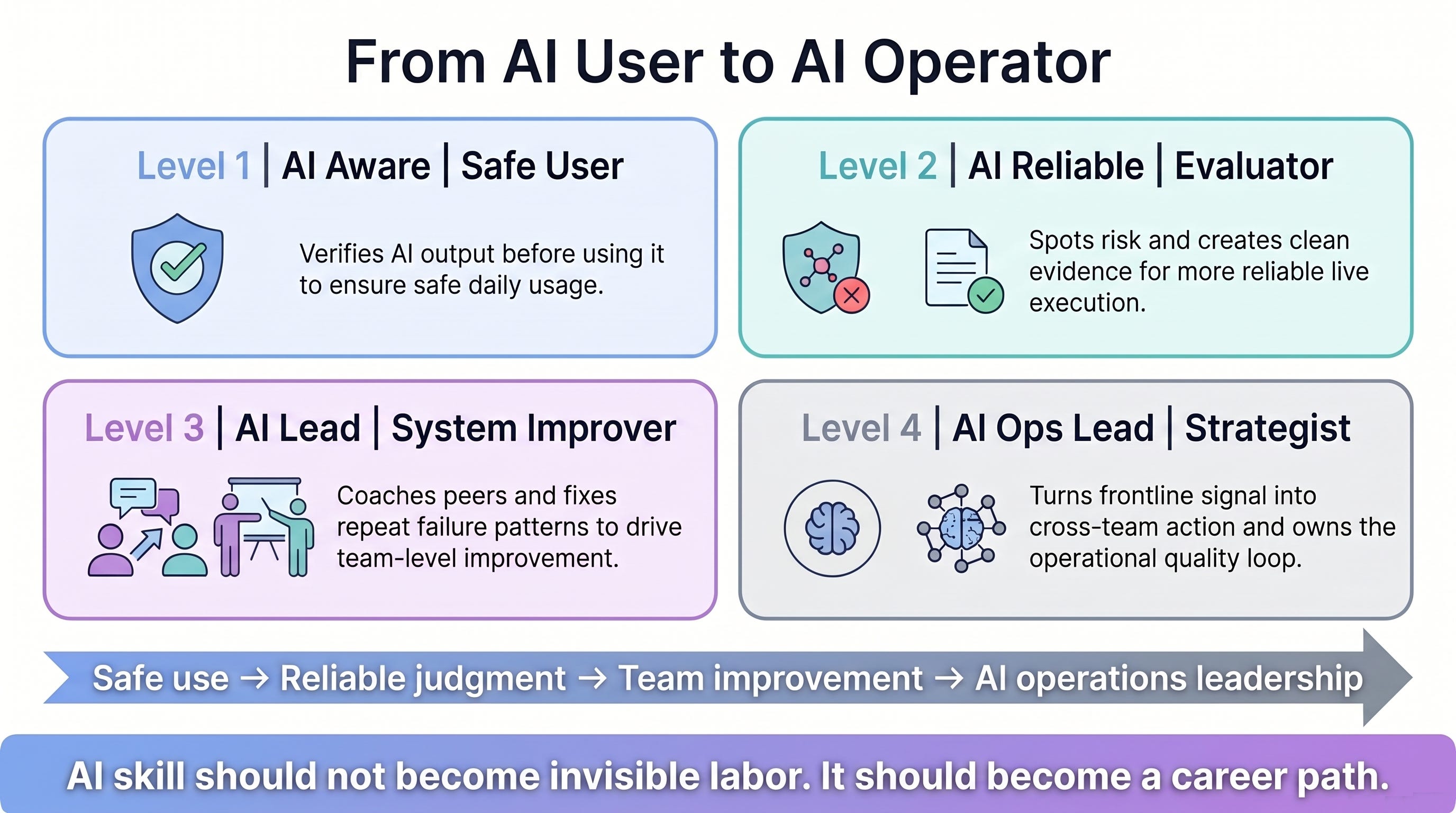
The ladder only needs four levels:
• Level 1: AI Aware
• Level 2: AI Reliable
• Level 3: AI Lead
• Level 4: AI Ops Lead
Each level should answer three questions:
• What does this person own?
• What do they prove?
• How do we certify readiness?
That keeps the ladder practical. It also keeps AI skill tied to real support work instead of vague tool enthusiasm.
Here is the ladder in one view before we break down each level.
Level 1: AI Aware
Level 1 agents understand where AI helps, where it fails, and what they must verify before using AI output. They are not expected to improve the system yet. They are expected to use AI safely during normal support work.
What they own: safe daily usage.
A Level 1 agent should be able to use approved AI tools without creating unnecessary risk. That means they know the difference between AI as a drafting tool and AI as a source of truth.
They should be able to:
• Use approved AI tools within company guardrails.
• Verify AI output against the right source before using it.
• Avoid using AI for restricted decisions.
• Spot obvious bad answers, missing details, or unsupported claims.
• Flag AI issues with a clear example.
• Ask for help when a case crosses a risk boundary.
This level matters because unsafe AI use often starts with small mistakes. The agent copies a clean-sounding answer. The source was outdated. The policy had an exception. The customer receives confident guidance that does not match reality.
That is not an AI problem by itself. That is a readiness problem.
What they prove: they do not confuse fluency with accuracy.
A Level 1 agent should show that they know AI output needs review. The goal is not speed. The goal is safe use.
A strong Level 1 answer sounds like:
“I would not send this as written. I would verify the policy source first, remove the unsupported promise, and ask a lead before responding because this touches eligibility.”
That answer tells you the agent understands the job. They are not rejecting AI. They are using it with judgment.
How to certify Level 1 readiness
Use a short scenario test with realistic tickets.
Give the agent:
• A customer question.
• One approved source.
• One AI-generated draft.
• One small risk hidden inside the draft.
Ask them to identify:
• What they would keep.
• What they would change.
• What they would verify.
• Whether they would send, pause, or ask for help.
A Level 1 pass means the agent is safe enough to use AI under normal supervision.
It does not mean they are advanced. It means they have the basic safety habits needed to work inside an AI-enabled support environment.
Level 2: AI Reliable
Level 2 agents apply AI-era judgment consistently in live work. They do not need constant coaching to catch risk, verify sources, or document decisions.
They do more than use AI. They review it. They correct it. They create clean evidence when a case needs human judgment.
What they own: reliable execution in live work.
A Level 2 agent should handle AI-assisted support without turning every risky moment into a manager question. They know when to trust, when to verify, and when to escalate.
They should be able to:
• Identify the risk level of a customer request.
• Catch missing policy conditions in AI drafts.
• Verify system data before sending guidance.
• Produce clear internal notes for complex cases.
• Escalate with evidence, impact, and requested action.
• Follow safe mode steps during known AI or workflow failures.
• Report repeated AI issues through the right process.
This level matters because most AI risk does not arrive wearing a tiny villain cape. It shows up as a reply that sounds polished but skips a condition, assumes the wrong intent, or gives guidance before the agent checks the system of record.
Level 2 agents catch that.
What they prove: they apply judgment without being dragged there by a manager.
A Level 2 agent should show consistency across case types. They do not only perform well when the issue is familiar. They stay careful when the case includes ambiguity, emotion, policy, money, identity, eligibility, or timing.
A strong Level 2 answer sounds like:
“The AI draft answers the general policy question, but it misses the effective date and does not check account status. I would verify those two fields, rewrite the reply to avoid a promise, and add an internal note explaining the decision path.”
That is the difference between a safe user and a reliable evaluator.
How to certify Level 2 readiness
Use a harder scenario test.
Give the agent:
• A multi-message customer thread.
• A system note or account detail.
• A policy source.
• An AI-generated draft.
• One hidden issue, such as an outdated source, missing eligibility condition, wrong assumption, or unsupported escalation promise.
Ask them to:
• Assign a risk level.
• Identify what AI got right.
• Identify what AI missed.
• Rewrite the response.
• Add an internal note.
• Decide whether escalation is needed.
A Level 2 pass means the agent handles AI-assisted work with consistent judgment. They are ready for more complex tickets and lower-touch coaching.
Level 3: AI Lead
Level 3 agents help the team improve. They coach peers, identify patterns, and shape the knowledge and workflows AI depends on.
They are not managers by default. They are operators with ownership.
What they own: team-level improvement.
A Level 3 agent does not only solve the ticket in front of them. They notice when the same failure keeps repeating. They see when a macro causes confusion, when a knowledge article creates a bad answer, when routing sends customers to the wrong place, or when AI hands off too late.
They should be able to:
• Review peer examples and coach decision points.
• Identify recurring AI failure patterns.
• Suggest knowledge base updates with evidence.
• Help maintain gold sets and practice scenarios.
• Spot routing and handoff issues.
• Lead shift-level communication during known AI or workflow issues.
• Turn ticket examples into training material.
• Help managers understand where frontline risk is building.
This level matters because support teams often lose the most useful signal in the gap between tickets and meetings. Agents see the pattern first. Managers see it later. Product sees it much later. Executives see it after someone builds a chart and everyone pretends the chart was an early warning system.
Level 3 agents shorten that loop.
What they prove: they make the system better, not only their own work.
A Level 3 agent should show leverage. Their work should help other agents perform better or help the system produce fewer failures.
A strong Level 3 contribution sounds like:
“We saw eight examples this week where AI answered the policy question correctly but failed to explain the exception. The source article buries the exception in paragraph six. I recommend moving the exception into a clear callout, updating the macro, and adding this scenario to next week’s QA calibration.”
That is system improvement.
How to certify Level 3 readiness
Use a pattern review.
Give the agent:
• Ten recent AI-assisted tickets.
• QA notes.
• Customer outcomes where available.
• Reopen, escalation, or repeat contact indicators.
• One or two related knowledge articles or macros.
Ask them to identify:
• The repeated failure pattern.
• The likely root cause.
• The risk to customers or operations.
• The smallest useful fix.
• The owner who should act.
• The training or QA follow-up needed.
A Level 3 pass means the agent improves the support system, not only individual tickets. They are ready to mentor others, support QA calibration, and own improvement work inside a domain or workflow.
Level 4: AI Ops Lead
Level 4 agents or leads own parts of the AI operating model. They connect frontline signal to management routines, QA, Product, Engineering, Support Ops, and Operations.
This is where support talent starts moving into AI operations leadership.
What they own: operating rhythm and cross-team signal.
A Level 4 AI Ops Lead looks across tickets, QA, knowledge, routing, handoffs, incidents, and customer outcomes. They help the organization decide what to fix first and how to know whether the fix worked.
They should be able to:
• Own weekly AI quality loop inputs.
• Maintain evaluation sets for high-risk workflows.
• Prioritize AI fixes by customer impact and operational risk.
• Partner with QA, Product, Engineering, Support Ops, and Operations.
• Track whether fixes reduced repeat contact, misroutes, escalations, or reopens.
• Lead drills for risky workflows.
• Help define readiness standards for new AI use cases.
• Translate frontline evidence into executive-ready priorities.
This level matters because AI quality does not stay stable by itself. Knowledge changes. Product changes. Policy changes. Customer behavior changes. Workflows drift. Someone has to keep the operating system honest, because apparently “launch and pray” still has fans.
Level 4 owns the rhythm that keeps AI from becoming an unmanaged production risk.
What they prove: they turn frontline signal into cross-team action.
A Level 4 AI Ops Lead should show that they know how to prioritize. They do not bring every issue to every meeting. They separate noise from risk.
A strong Level 4 recommendation sounds like:
“We should prioritize the payment-status handoff this week. It has lower volume than the general policy intent, but it has a higher repeat contact rate, more escalations, and more customer frustration. The fix should start with source cleanup and routing logic, then we should retest with five scenarios before expanding.”
That is AI operations leadership.
How to certify Level 4 readiness
Use an operating review.
Give the candidate:
• A sample month of AI failure reports.
• QA findings.
• Reopen and escalation data.
• A few customer examples.
• Current knowledge or workflow gaps.
• A list of possible fixes competing for attention.
Ask them to build:
• A prioritized issue list.
• Owners for each fix.
• A 30-day improvement plan.
• A measurement plan.
• A communication plan for managers and frontline agents.
• A rollback or safe-mode recommendation for high-risk workflows.
A Level 4 pass means the person understands AI as an operating system, not as a tool. They are ready to support cross-functional reviews, readiness decisions, drills, quality loops, and executive reporting.
The ladder in one sentence
Level 1 proves safe use.
Level 2 proves reliable judgment.
Level 3 proves team improvement.
Level 4 proves AI operations ownership.
That is the path from AI user to AI operator. It gives agents a visible way to grow, and it gives leaders a practical way to assign AI responsibility without quietly dumping the work on the most responsible person in the room.
Hiring should test judgment, not tool familiarity
If AI has changed the support role, hiring should reflect that.
Many support interviews still over-index on customer empathy, speed, tool familiarity, and past queue experience. Those still matter, but they do not prove AI-era readiness.
The wrong question is:
“Have you used AI before?”
That question tells you almost nothing. Most people have used AI to rewrite an email, summarize a document, or generate a meal plan. Congratulations to civilization. The machine helped produce dinner and a slightly less awkward paragraph.
The better question is:
“Can this person use AI without outsourcing judgment?”
That is what the interview should test.
The interview exercise
Give the candidate a realistic support scenario.
Include:
A customer message
A short policy source
An AI-generated draft reply
A system note or account detail
One hidden risk, such as an exception, outdated policy date, missing eligibility condition, or unsupported promise
Then ask the candidate to explain:
What they would send
What they would verify
What they would change
What they would document internally
Whether they would escalate, and why
You are not testing whether they can polish an AI draft. That is the easy part. The job is to see whether they can slow down at the right moment, find the risk, and protect the customer from a confident wrong answer.
What strong candidates do
Strong candidates do not treat the AI draft as the answer. They treat it as a starting point.
They will usually:
Check the AI answer against the source
Notice missing conditions or unsupported claims
Avoid making promises the policy does not support
Ask for the right system data before replying
Rewrite the customer response in clear language
Document the decision path for the next owner
Recognize when escalation is part of safe resolution
A strong answer sounds like this:
“I would not send this as written. The AI reply sounds clear, but it assumes the customer is eligible. I would verify the account status first, check the policy effective date, remove the promise, and add an internal note explaining what I verified before replying.”
That is the signal you want. Not tool enthusiasm. Judgment.
What weak candidates do
Weak candidates usually polish the AI draft and call it done.
They might improve tone, shorten the reply, or make it sound more professional. Useful, sure. Also insufficient, because polite wrong answers are still wrong. They just wear better shoes.
Watch for candidates who:
Trust the AI draft without checking the source
Focus only on tone and grammar
Miss the hidden risk
Make unsupported promises
Skip the internal note
Escalate vaguely without evidence
Say they would “check with a manager” without explaining what they need checked
A weak answer does not always sound careless. Sometimes it sounds confident. That is what makes it risky.
Interview questions that reveal AI-era judgment
Use questions that expose how the candidate thinks under ambiguity:
Tell me about a time you caught an answer that sounded right but was wrong.
How do you decide when to trust a source?
What would make you slow down before replying to a customer?
What should an escalation include so the next team can act?
How would you report a repeated AI failure pattern to your manager?
When does speed become risky in support?
What customer issues should never be handled by AI alone?
The goal is not to hire prompt engineers.
The goal is to hire support professionals who can think clearly when AI adds speed, confidence, and risk at the same time.
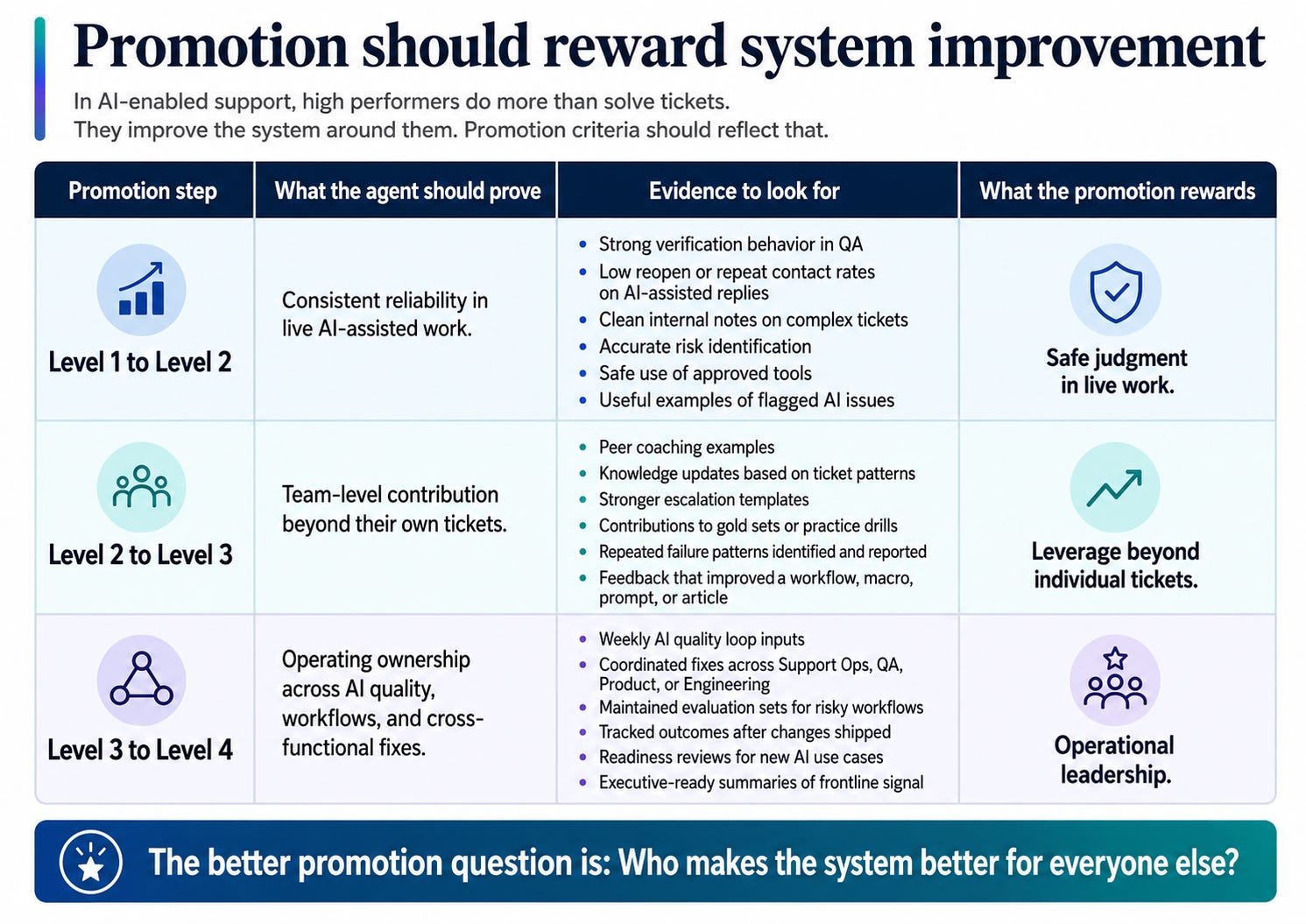
Promotion should reward system improvement
AI changes what high performance looks like.
A great agent is no longer only someone who solves more tickets with strong CSAT. That is still valuable, but it is not the full picture.
In AI-enabled support, high performers also improve the system around them. They make the next ticket easier. They make AI safer. They make escalations cleaner. They make knowledge more useful. They help managers see patterns earlier.
The promotion model can be simple: reward the behavior that improves the system, not only the behavior that clears the queue.
Managers need a readiness model, not vibes
Managers need a simple way to decide who is ready for what.
Without a readiness model, AI responsibility goes to whoever is confident, available, or already over-functioning. That is not a talent strategy. That is a slow-motion retention problem wearing a hoodie.
Use these four signals before giving someone AI ownership.
1. Judgment consistency
Does the person make sound decisions across different case types, or only in familiar workflows?
Look at QA examples, manager reviews, and escalation quality. The pattern matters more than one good ticket.
2. Source discipline
Does the person verify before acting, especially when AI sounds confident?
This matters most in policy, money, identity, eligibility, access, compliance, and legal-adjacent workflows.
3. Evidence quality
Does the person document enough context for others to act?
A strong internal note should reduce rediscovery. It should not force the next person to reconstruct the crime scene from vibes and screenshots.
4. System thinking
Does the person only fix the ticket, or do they notice what caused the ticket?
This is the difference between an agent who performs well and an operator who improves the support system.
These four signals tell you who is ready for AI ownership before the work quietly lands on whoever is most responsible.
The manager’s certification toolkit
A certification ladder only works if managers have practical tools. Keep the toolkit simple.
The AI readiness review
Once per month, managers should review a small set of AI-assisted tickets for each agent. The review should focus on behavior, not personality.
Score five areas:
Verification: Did the agent check AI output against the right source?
Judgment: Did the agent identify risk and choose the right path?
Communication: Did the customer receive clear and safe guidance?
Escalation: Did the agent include enough evidence for action?
System signal: Did the agent flag repeated issues, stale knowledge, or broken workflows?
This should connect directly to the QA rubric from Part 9.
The scenario test
Each level should include scenario-based testing. Do not test definitions. Test decisions.
Give agents realistic examples and ask them to show their work. A good scenario test should include messy customer language, partial information, an AI-generated draft, and a hidden risk.
The score should reflect the decision path:
What did they trust?
What did they verify?
What did they change?
What did they escalate?
What did they document?
What system issue did they notice?
The evidence portfolio
Agents pursuing Level 3 or Level 4 should maintain a small portfolio of examples.
This does not need to be complicated. A folder, doc, or internal profile works.
Include:
One AI issue they caught.
One knowledge or macro improvement they suggested.
One strong escalation example.
One peer coaching example.
One pattern they identified.
One outcome tied to their contribution.
This turns promotion from a popularity contest into an evidence review. Strange concept, measuring the work before rewarding it.
Career paths should branch, not trap people
A strong AI-era ladder should create multiple paths.
Not every strong agent wants to become a people manager. Not every strong operator wants to stay in the queue. Not every technical support person wants to become an engineer.
The ladder should open options.
Path 1: Senior Support Specialist
This path fits agents who want to handle complex cases and mentor others while staying close to customers.
They should own advanced casework, peer coaching, and high-risk workflow support.
Path 2: Knowledge Operations
This path fits people who are strong at documentation, policy interpretation, retrieval quality, and source maintenance.
They should own knowledge freshness, article structure, content gaps, and AI source quality.
Path 3: Support Operations
This path fits people who understand routing, queues, macros, automations, handoffs, and reporting.
They should own workflow improvements, triage logic, and operational measurement.
Path 4: AI Quality and Evaluation
This path fits people who are strong at QA, testing, pattern recognition, and risk detection.
They should own gold sets, AI response review, failure classification, drills, and calibration.
Path 5: AI Ops Leadership
This path fits people who can coordinate across Support, Product, Engineering, QA, and Operations.
They should own the quality loop, release readiness, incident inputs, and executive reporting.
This is how support becomes a source of internal talent, not a place where strong people wait until another department notices them.
How this changes team design
The certification ladder also changes how leaders assign ownership.
Instead of thinking only in Tier 1, Tier 2, and Tier 3 terms, leaders should name the work AI depends on: knowledge quality, AI failure intake, QA calibration, gold sets, escalation standards, workflow issues, and weekly quality loop inputs.
Some roles may start part-time. That is fine. The important part is naming the work, protecting time for it, and tying it to outcomes.
If this work stays informal, your best people become the system. When they leave, the system leaves with them.
What to measure
A certification ladder should connect to outcomes. Otherwise it becomes internal theater.
Track development metrics and operational metrics together.
Development metrics
Use these to understand whether the team is growing capability:
Percent of agents certified at each level.
Time from onboarding to Level 1 certification.
Time from Level 1 to Level 2 readiness.
Number of Level 3 contributors by domain or workflow.
Number of Level 4 operators supporting AI quality loops.
Manager calibration consistency across AI-era QA categories.
Operational metrics
Use these to understand whether the capability improves customer and system outcomes:
Reopen rate on AI-assisted replies.
Repeat contact rate by intent.
Misroute rate after AI handoff.
Escalation quality score.
Time to resolution for high-risk workflows.
AI failure reports with usable evidence.
Knowledge gaps closed per week.
Reduction in repeated failure patterns after fixes.
The goal is not to certify people for the sake of certification. The goal is to build a team that handles complexity with less chaos.
A 30-60-90 plan to launch the ladder
First 30 days: define the ladder.
Name the four levels, define observable behaviors, choose three to five QA categories, and build one Level 1 scenario test.
Days 31 to 60: certify the baseline.
Run Level 1 certification, identify Level 2-ready agents, create coaching plans, and start tracking one outcome such as reopen rate or escalation quality.
Days 61 to 90: build ownership.
Assign Level 3 candidates to one workflow or knowledge area, add Level 4 candidates to the AI quality loop, and have each person recommend one measurable improvement.
By day 90, the team should see the ladder as real because work, coaching, ownership, and recognition are connected.
The hard part leaders miss
The hard part is not writing the ladder.
The hard part is making room for the work.
If Level 3 and Level 4 responsibilities get added on top of full queue load, the ladder fails. If managers certify people but do not adjust responsibilities, the ladder fails. If leadership praises AI ownership but rewards only ticket volume, the ladder fails.
People believe the operating model they experience, not the one described in a meeting.
If you want agents to grow into AI operators, protect time for system work. Give them real problems to own. Let them ship improvements. Tie those improvements to outcomes. Recognize the work publicly.
Most importantly, stop treating AI quality work as a side quest for responsible people.
That is how you lose them.
The series arc
This series started with a simple premise: support work changes when AI enters the system.
First, agents need to understand their new role. Then they need verification habits, signal detection, safe mode behavior, better knowledge writing, realistic practice, data literacy, cross-functional collaboration, and QA standards that measure judgment.
The final step is turning those skills into a career model.
That matters because AI does not only change tools. It changes the shape of the job.
If leaders fail to define that shape, the work becomes confusing for agents, inconsistent for managers, risky for customers, and invisible to executives.
If leaders define it well, support becomes a stronger function. Agents see a future. Managers coach better. QA becomes fairer. Product gets clearer signal. AI improves faster. Customers get safer answers.
That is the point of the ladder.
Where this series lands
This series started with a simple shift: support staff are no longer only users of AI tools. They are operators of a live system that affects customers, workflows, knowledge, and trust.
That is why the series moved from role definition to verification, signal detection, safe mode behavior, knowledge writing, drills, data literacy, collaboration, coaching, and now career paths.
The final step is making the work visible enough to manage, coach, and reward.
Closing
AI skill should not be extra labor hiding inside strong performance. It should be visible, taught, certified, and tied to career growth.
The best support teams will not only ask whether agents are using AI. They will ask whether agents are ready to operate AI safely, improve it responsibly, and grow into the next version of support leadership.
Support does not need fewer career paths because AI exists. It needs better ones.
If you were building this ladder inside your team, which level would be hardest to define first: AI Aware, AI Reliable, AI Lead, or AI Ops Lead?