


The draft looked ready to send.
A parent had asked a simple question about whether a purchase would still qualify under the new policy. The AI reply came back polished, calm, and complete. The agent skimmed it, cleaned up one sentence, and hit send.
The mistake was buried in the middle. One line. The model had pulled the old rule.
Minutes later, the customer quoted the answer back. The ticket was reopened. A manager stepped in. Someone started checking article history to see what had changed, and whether other replies from that morning carried the same mistake.
The problem was not that the AI sounded weak. The problem was that it sounded finished.
That is the trap. Weak AI is easy to catch. Confident wrong AI is easy to ship.
Part 1 defined the shift. Support staff are now operating a live AI system, not only answering tickets. Part 2 focuses on one of the first habits that role requires: fast verification
What Changed
Support teams used to spot errors by how they looked. The reply was messy. The wording was vague. The logic felt incomplete.
AI changes the shape of the risk.
Now the answer often looks polished before it is true. It arrives fast. It sounds complete. It creates the illusion that the work is done.
But the work did not disappear. It moved.
Agents are no longer only writing responses. They are reviewing, validating, and deciding whether an answer is safe to send. That is one of the core skills of support in the AI era.
Without that habit, speed turns into rework. One wrong reply becomes a reopened ticket, a correction, a manager review, and sometimes a broader trust problem.
The goal is disciplined speed, not blind trust.
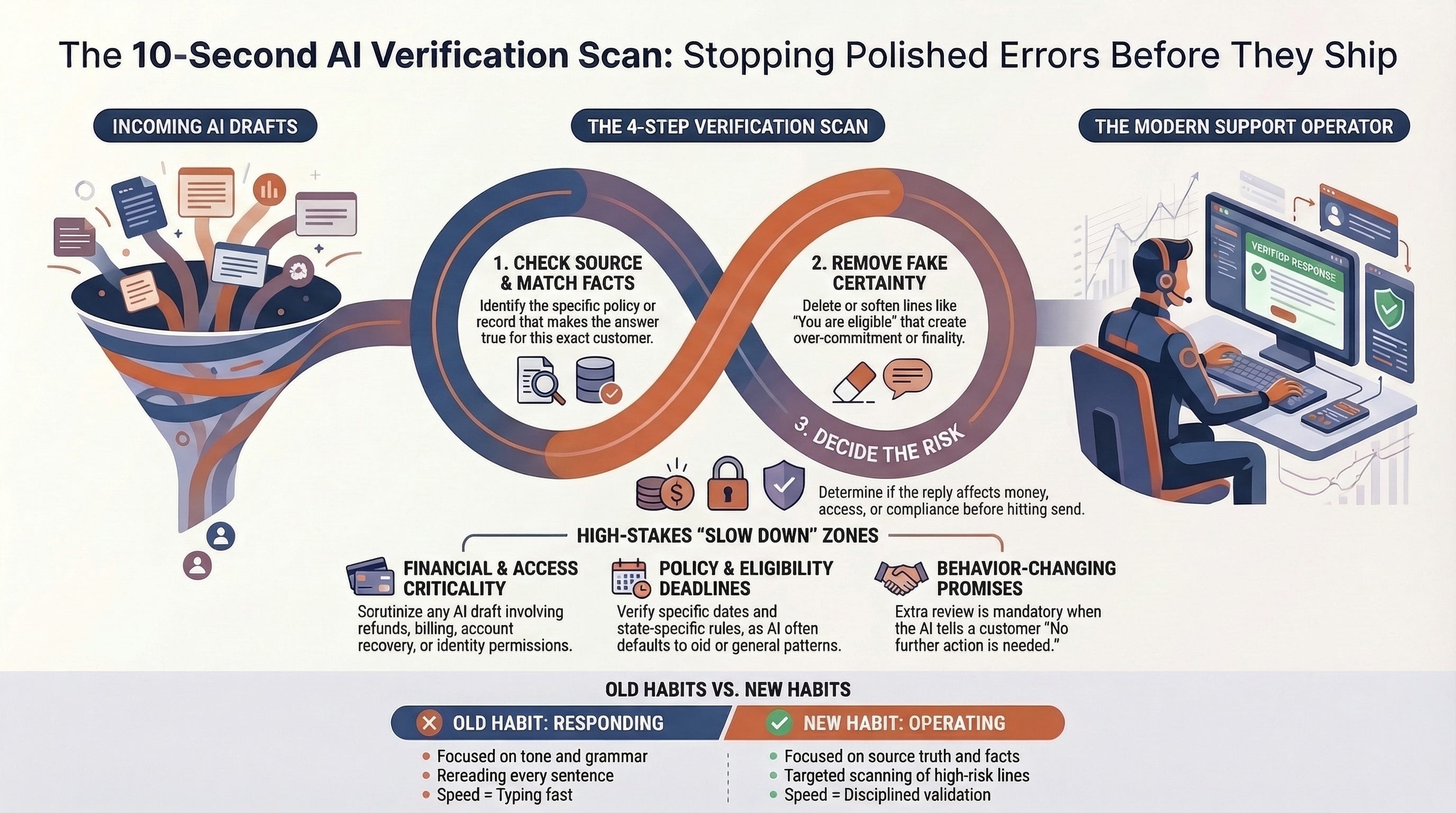
The 10-Second Verification Scan
Verification should not feel heavy.
Most teams teach it the wrong way. They make it sound like a full second pass through every line. Good verification is faster than that. It is targeted. It focuses on the parts of the reply that carry consequence.
The habit is simple:
Check source
Match facts
Remove fake certainty
Decide risk
That is the scan.
If the agent in the opening had done that, the draft would have failed in seconds.
What each step means
Check source
Ask: What makes this answer true?
Is it based on:
a current policy article
an account record
a case history
a workflow or runbook
a live system status
a product rule or eligibility requirement
If there is no clear source of truth behind the answer, the answer is not ready.
Match facts
Ask: Is this true for this customer, in this case?
AI often gets the pattern right and the case wrong. It mixes up:
state or region
dates
plan type
product rules
account status
document requirements
escalation history
A polished wrong answer is still wrong.
Remove fake certainty
Ask: Does this reply say more than we know?
This is where a lot of risk hides. The draft may be partly right, but the wording turns it into a promise.
Watch for lines like:
“You are eligible.”
“This is approved.”
“No further action is needed.”
“This will be resolved today.”
“You do not need to submit anything else.”
Those sentences change customer behavior. They create commitment, even when the system has not earned that confidence.
Decide risk
Ask: What happens if this line is wrong?
Extra review matters most when the reply affects:
money
access
deadlines
identity
compliance
trust
customer next steps
That is the point of the scan. Not to review everything equally. To catch the lines that create damage.
What to Confirm, Fast
The best agents do not reread every AI draft with the same intensity. They check in order.
1. Confirm the source of truth
Do not ask whether the sentence sounds right. Ask what makes it right.
For some replies, the source is a help center article. For others, it is the account record, the order status, the workflow, or the case history.
If the answer has no clear source behind it, treat that as a warning sign.
2. Confirm the live facts
AI is good at producing the likely answer. It is less reliable at keeping the answer anchored to the exact case in front of it.
Check the fields that matter most:
customer type
state or program
purchase date
submission status
verification status
plan or entitlement
previous actions taken
3. Confirm the level of certainty
A reply can be factually close and still operationally dangerous.
This is the difference between:
“This qualifies.”
“Based on the current rule, here is what to submit for review.”
One sounds final. The other stays accurate without overcommitting.
4. Confirm the action
Ask: What will the customer do because of this answer?
Will they:
wait
spend money
skip a document
stop following up
assume approval
assume a deadline no longer applies
Verification matters because customers act on what we send.
Which Replies Need Extra Review
Not every AI-assisted reply deserves the same level of scrutiny.
Some are low consequence. Others are one sentence away from creating a mess.
Slow down on these reply types
Money
refunds
reimbursements
credits
billing decisions
payment timing
Access and identity
account recovery
email or ownership changes
permissions
verification steps
Policy and eligibility
approvals
denials
deadlines
exceptions
required documents
state-specific rules
Escalations and incidents
outages
complaints
executive visibility
legal or regulatory language
sensitive customer cases
Behavior-changing answers
“You’re all set”
“No action is needed”
“This is complete”
“You do not need to submit anything else”
These are the moments where a five-second check protects the next five hours.
Why Old Habits Fail
Before AI, many agents focused their review on wording.
They fixed the tone. Tightened the grammar. Made the answer sound clearer.
That still matters. It is not enough.
A polished wrong answer is more dangerous than a messy human draft.
Humans trust fluency. If the reply sounds complete, we assume it came from a complete process. AI takes advantage of that weakness. It speaks with confidence even when it is guessing, blending sources, or filling gaps with the most likely pattern.
That is why verification has to happen before tone.
Not: does this read well?
Instead: is this true for this customer, right now, from this source?
How the Habit Works in Practice
Good verification is not a personality trait. It is a workflow.
The best teams build it into daily work until it becomes reflex.
1. Start with source-first thinking
Train agents to ask one question before sending anything important:
What source of truth backs this line?
If they cannot answer that clearly, the draft is not ready.
2. Review by consequence, not by sentence count
Do not treat every part of the reply the same.
Put more attention on the lines that can trigger:
loss
delay
escalation
false certainty
customer missteps
3. Soften language when certainty is incomplete
Agents need a safe middle ground between sounding evasive and sounding overconfident.
That usually means anchoring the reply to:
the current rule
the current status
the next required step
the right team or process
4. Leave a short verification note on higher-risk tickets
For risky cases, an internal note helps create consistency.
A lean version might include:
Intent
Risk tier
Sources checked
Critical field checked
That is not bureaucracy. It is a receipt for decision quality.
The Part Leaders Often Miss
Some leaders worry that verification will slow the team down.
Bad verification slows the team down more.
One weak AI-assisted reply does not stay one reply. It turns into:
a reopened ticket
a corrected response
a manager touch
another customer follow-up
a review of similar replies
a possible trust issue
That is the hidden cost. AI makes sending easier, so weak review habits scale faster too.
Verification is not about perfectionism.
It is about containment.
How to Build the Reflex
Leaders should not teach verification as a slogan. They should teach it as a repeatable sequence.
Start with one shared scan:
• Check source
• Match facts
• Remove fake certainty
• Decide risk
Then make the habit visible in daily work.
• Use real AI drafts in training, one good, one risky, one clearly wrong.
• Define the reply types that always require extra review, especially money, access, policy, deadlines, and anything that changes customer behavior.
• Add verification to QA, not only tone and resolution.
• Require a short internal verification note on higher-risk tickets, such as intent, risk tier, sources checked, and critical field checked.
• Review caught issues weekly so you learn from stops, not only from misses.
The goal is simple. Make fast verification feel normal before sending, not heroic after something goes wrong.
A Simple Team Checklist
Before sending an AI-assisted reply, ask:
What source makes this answer true?
Did I match it to the live customer record?
Did I remove any sentence that overpromises?
If this is wrong, what happens next?
If those four checks are clear, send it.
If one is not, stop.
Closing
The dangerous part of AI in support is not that it gets things wrong.
Support teams already know how to deal with wrong. They have always dealt with wrong.
The dangerous part is that AI gets things wrong in a voice people want to trust.
That is why verification matters so much. In the AI era, the strongest agents are not the ones who write the fastest. They are the ones who validate in seconds, catch the risky sentence, and stop bad output before it becomes customer reality.
The draft may look done.
The real job is deciding whether it is safe.