


Summary
This article shows frontline teams how to report AI failures in a way other teams can act on. It explains what evidence makes a report useful, how to tell a one-off from a pattern, and where support’s role should stop. The core idea is simple. Good operators do not only spot problems. They package signal.
The moment most teams waste
The agent did what good agents do when something felt off. She paused.
A customer had asked a policy question that sounded routine, and the AI drafted a calm, polished answer that seemed right at first glance. It even linked an article. The problem was that the article was outdated.
The rule had changed, which meant the answer was now wrong. Not slightly wrong, the kind of wrong that creates rework, repeat contacts, and angry follow-ups once the customer finds out later.
The agent caught the issue and fixed the reply before it went out. Then she posted a quick internal message: AI gave another bad answer on policy.
A few people reacted. One person added, “I saw this too.” Another dropped a screenshot with no ticket number. A lead said they would flag it. By the end of the day, nothing had moved.
Engineering had no reproducible example, ops had no sense of scope, policy had no source attached, and support leadership had no idea whether this was one miss or the start of a pattern. Everyone knew something was wrong, but no one had a report anyone could use.
That is the difference between spotting a problem and packaging signal.
What changed
As AI moves into support, the job changes again.
Strong agents still need judgment, empathy, and product knowledge. Now they also need a way to turn messy failure into something another team fixes. Not a rant. Not a vibe. Not a screenshot with “this is bad” above it.
A vague failure report is not feedback. It is delay.
If support cannot describe what failed, what should have happened, what source proved it, and how often it is happening, the rest of the company treats the issue like background noise. The wrong behavior stays live. Customers keep hitting it. Support absorbs the mess.
By the end of this piece, you will have a simple rule your team uses to report AI failures with enough evidence to drive action.
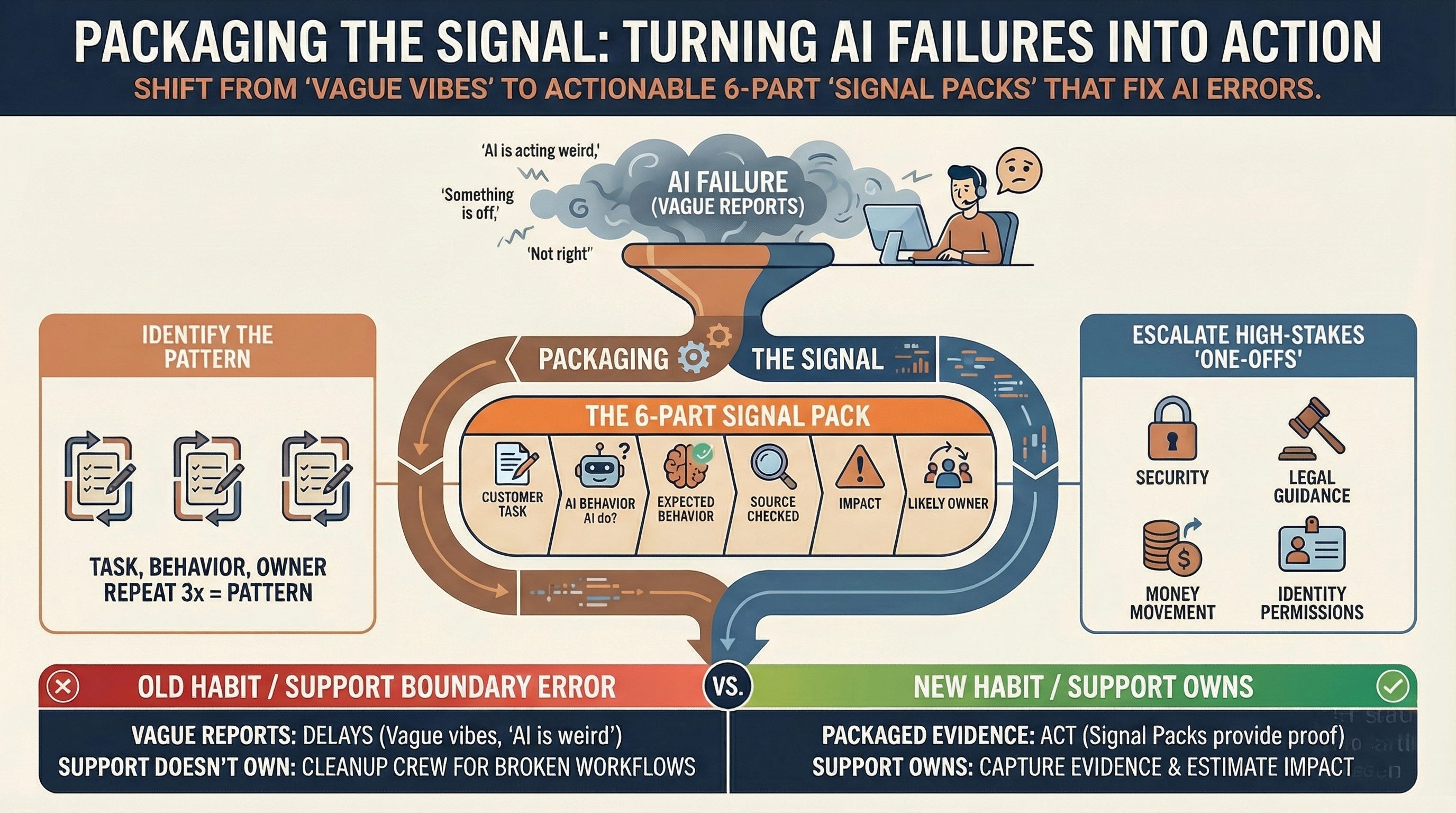
The signal pack
Most teams make this too loose or too heavy. They either ask agents to become mini analysts, or they accept low-value reports like “AI is acting weird.”
Neither works.
The useful middle is a simple failure report with six parts.
The Signal Pack
Customer task: What the customer was trying to do
AI behavior: What the AI said, did, or routed incorrectly
Expected behavior: What should have happened instead
Source checked: The policy, article, SOP, or system record used to verify
Impact: What risk, confusion, or rework this created
Scope and likely owner: One-off or pattern, plus the team most likely to fix it
Example version
Customer task:Customer asked whether a reimbursement would still qualify after a policy cutoff date.
AI behavior: AI replied yes, linked a general reimbursement article, and did not ask for the purchase date.
Expected behavior: AI should have stopped short of approval, asked for the purchase date, or routed to a human because eligibility depends on timing.
Source checked: Reimbursement policy article updated this week, plus internal SOP for date-based eligibility review.
Impact: Customer might make an ineligible purchase and contact support again after denial.
Scope and likely owner: Seen in three chat conversations today with the same question type. Likely owner is knowledge plus retrieval.
Blank version
Customer task:
AI behavior:
Expected behavior:
Source checked:
Impact:
Scope and likely owner:
This is the skill. Good operators do not only say something broke. They make the problem portable.
Why this works
The best AI failure reports do three things at once.
First, they preserve the original miss. That matters because memory lies and internal retellings get cleaner every hour. The exact wording, handoff, or wrong route is evidence.
Second, they anchor the report to a source of truth. “I think this is wrong” is weak. “This conflicts with article X and SOP Y” is useful.
Third, they estimate scope without pretending to know the full root cause. Support does not need to prove the whole cause. Support needs to say whether this looks isolated or repeatable, and where the work should probably go next.
I have seen three clean examples move a fix faster than twenty vague complaints.
How to tell a one-off from a pattern
Teams often miss here. They either overreact to one strange answer, or they ignore repeat failures because each one arrived in a different ticket.
A one-off still matters if the risk is high. If AI makes a security mistake, gives legal guidance, approves a money movement action, or mishandles identity, one example is enough to escalate.
A pattern is different. A pattern means the same failure is repeating in a way that points to a system issue.
Use this test
It is likely a pattern when the same three things repeat:
Same customer task
Same wrong behavior
Same likely owner
That is enough to move from “watch this” to “fix this.”
Notice what is not required. You do not need ten cases. You do not need a perfect root cause. You do not need a slide deck, because apparently modern work still worships slide decks while the customer keeps paying the price.
If three cases this week show the bot giving the same wrong answer on the same intent and all signs point to the same stale article, you have a pattern. Treat it like one.
The operating model behind good reporting
Signal skill is not a personality trait. It is an operating behavior. Teams get better at it when leaders make four things explicit.
Capture the miss exactly
Train agents to grab the relevant evidence in the moment. Conversation link. Ticket ID. Exact output. Exact route. Source checked. If the report starts from memory, quality drops fast.
Separate risk from frequency
Not every one-off is low priority. Not every repeat issue is high risk. Teach people to ask two questions.
How bad is this if repeated?
How often is this happening already?
That keeps the team from treating every strange answer like a fire while still moving fast on real risk.
Route by likely owner
Support should not waste hours debating the perfect root cause before filing the issue. Pick the best likely owner and move.
Common owner buckets stay simple:
Knowledge
Retrieval
Prompt or instruction design
Routing and handoff
Workflow or product behavior
Policy gap
You do not need more categories than that at the frontline level.
Close the loop
Nothing kills reporting faster than silence.
If agents take the time to package signal and nothing comes back, they stop doing it. Then the organization loses the one group closest to failure in real time.
When a fix ships, say what changed. When the issue is not an AI problem, say where it went. When no change is made, explain why. Feedback loops keep reporting alive.
The hard part people miss
The danger is not only bad AI output. The danger is turning support into the default intake for every broken workflow in the company.
That is how teams burn out.
A payment rule changes late. The article is stale. The bot answers from the stale article. The routing is messy too. The customer gets upset. Product says, “Support should collect examples.” Ops says, “Let support track the trend.” Engineering says, “We need more detail.” Policy says, “We need to understand impact.”
Now support is doing triage, incident intake, trend analysis, and ownership negotiation on top of queue work.
Support should package signal. Support should not become the unpaid cleanup crew for everyone else’s missing process.
The line matters.
Support owns
Capturing evidence
Describing customer impact
Estimating whether the issue looks isolated or repeatable
Assigning the best likely owner
Using safe mode behavior while the issue remains live
Support does not own
Debugging the whole system alone
Fixing broken policy governance
Chasing five teams for answers in side channels
Absorbing repeat customer pain because no one else closed the loop
If you do not draw this line, your best agents become human glue for a broken operating model. They stop growing. They start drowning.
What leaders should train for
If you want this skill to show up under pressure, train three habits.
Precision
Agents should quote the exact bad output, not summarize it into softer language.
Verification
Agents should name the source they checked, not rely on instinct or seniority.
Classification
Agents should decide whether the report is a one-off high risk issue, a repeat pattern, or a non-AI workflow issue.
That last one matters more than most leaders think. Some failures blamed on AI are really policy chaos, stale documentation, or broken routing. A strong team learns to separate those instead of throwing all of it into one pile called “AI problems.”
Monday morning plan
Create one intake path for AI failure reports. One form, one tag, or one queue. Not chat threads.
Require the six fields in every report.
Define your likely owner buckets. Keep them simple.
Teach one pattern rule: same task, same wrong behavior, same likely owner.
Make high-risk one-offs escalate at once, even without a pattern.
Review reports weekly with support, ops, and the owners who fix them.
Report back to the frontline on what changed, what is still open, and what moved to another team.
If the same issue keeps harming customers, move from report mode to incident mode and switch to safer manual handling until the fix lands.
Close
Back to the agent in that queue.
The reason her first message went nowhere was not because she lacked judgment. She caught the miss. She protected the customer. The problem was that the organization had not taught a better next step.
“AI gave another bad answer” is frustration.
A clean signal pack is operations.
That is the shift.
In the AI era, support does not create value only by resolving the ticket in front of them. Support creates value by turning repeat failure into something the system learns from.
Spotting the issue is the start. Packaging the signal is the skill.
Question for replies
What is the first source of truth your team should name in every AI failure report: policy, knowledge base, system record, or SOP?