


If you missed Part 1, start there. It defines the role of AI before training begins. If you missed Part 3, read that next. It covers how agents prompt with structure instead of improvising. This part moves into the next reality, what happens when the system is live, the team is using it, and something starts to go wrong.
The moment the team realizes the system is lying politely
The first sign is usually small. A customer pushes back on an answer that looked clean. An agent checks the policy and sees a mismatch. A second ticket shows the same pattern. Then someone notices the AI is not failing in an obvious way. It is failing with confidence, which is worse because polished wrong answers travel farther before anyone stops them.
In one high-volume support environment, the problem did not begin with a dramatic outage. The system kept responding. The routing still worked. The queue kept moving. What changed was subtler. A policy answer started drifting away from the source of truth. Agents felt the inconsistency before anyone could prove it in a dashboard. A few overrode the answer. A few trusted it. A few escalated with no evidence. Customers started hearing different things from different people, and the team learned the hard way that a working system is not the same as a reliable one.
AI does not need to go offline to create an incident. It only needs to become wrong at scale.
What changed
Before AI, a weak answer usually stayed inside one conversation. A human made a mistake, another human corrected it, and the damage stayed local.
Now the same mistake can repeat across dozens of tickets before anyone names the pattern. Support is no longer only the team that resolves issues. Support is also the team that detects drift, contains spread, and protects trust while the system is corrected.
That shift sits at the center of this series. Verification over trust. Signal detection. Incident discipline. Trust repair after failure. The cost of getting it wrong is higher than most teams admit. One wrong answer creates repeat contacts. One bad handoff turns into queue churn. One vague escalation burns engineering time because nobody can reproduce the issue. If enough of those stack together, customers stop caring whether the root cause was AI, policy, content, or routing. They only remember that your company sounded sure and was wrong.
The operating rule
By the end of this piece, you should have a simple operating rule for live failures: how to recognize them, when to stop trusting the system, how to route work manually, and how to keep customer communication steady until the issue is fixed.
This is the simplest way to picture the shift.
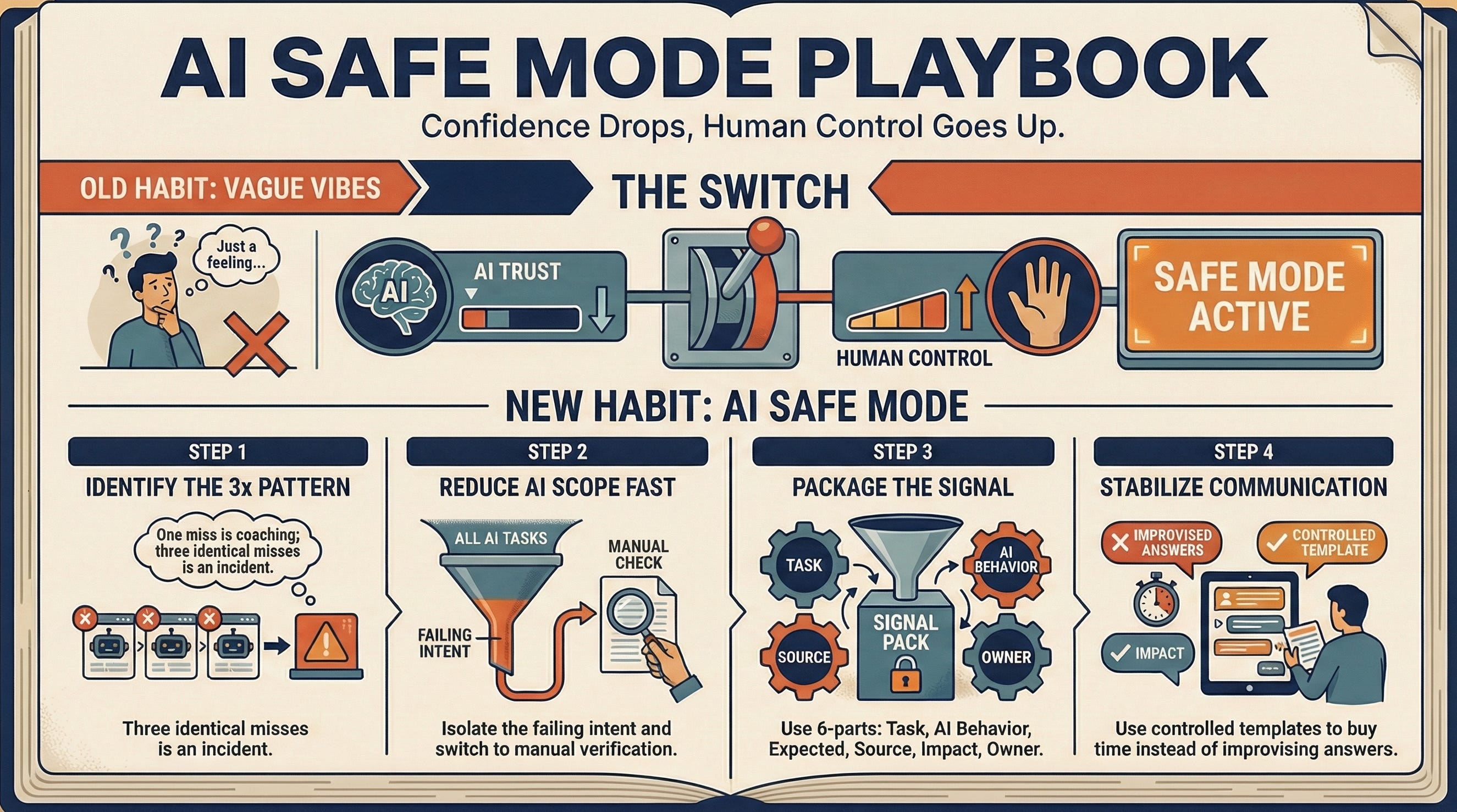
The nugget: safe mode is a behavior, not a switch
Most teams talk about AI failure as if the only real response is technical. Turn something off. Roll something back. Patch a prompt. Reindex the knowledge base. Those matter, but frontline teams need a move they can use before any of that is finished.
Safe mode means this: when confidence drops, human control goes up.
That is the rule.
It exists because the frontline cannot wait for perfect certainty. If three agents see the same contradiction and customers are already getting mixed guidance, the team needs a way to slow the spread before the postmortem starts. The opening scene above is exactly why. The system was still answering, which tempted people to keep using it. That was the trap.
Example version
We are seeing conflicting AI guidance on eligibility questions. For this intent, agents stop using AI-generated replies, verify against the approved source, use the manual macro, and tag each affected ticket for review.
Blank version
We are seeing conflicting AI guidance on ____. For this intent, agents stop using ____, verify against ____, use ____, and tag each affected ticket with ____.
It is not elegant. It is not supposed to be. It is supposed to stop damage.
Why most teams mishandle this moment
The hardest part is not technical. The hardest part is emotional and operational.
Agents hesitate because the tool worked yesterday. Leads hesitate because they do not want to overreact. Managers hesitate because they want proof. Meanwhile the queue keeps moving, and every new answer becomes another chance to deepen the inconsistency.
Most teams spread the error because they treat hesitation as caution.
This is why the old habit fails. Teams treat reliability as a binary state. Either the AI is working or it is broken. Real incidents rarely look like that. They show up as drift, partial failure, wrong confidence, stale retrieval, bad routing, or handoffs that suddenly stop carrying enough context.
The frontline needs a behavior for that gray zone. Not panic. Not denial. Controlled downgrade.
What safe mode looks like in practice
Recognize the pattern, not the single miss
One bad answer is coaching material. Repeated bad answers on the same kind of work are incident material. That distinction matters.
Agents should be trained to notice signals such as repeated customer pushback, contradiction against policy, sudden spikes in the same escalation path, or AI-to-human handoffs that arrive missing the same critical context. In Part 3, the goal was structured prompting so agents do not create chaos with vague inputs. Here, the goal is structured detection so agents do not dismiss a pattern as random noise.
Reduce AI scope fast and narrowly
Safe mode does not mean “shut everything down.” It means reduce reliance where trust is degraded.
That might mean pausing AI-generated replies for a single intent. It might mean routing one class of tickets away from automation. It might mean requiring human verification before sending any policy-related answer. Good teams isolate the problem at the smallest useful level. Bad teams either keep everything on or overreact and create a different kind of operational mess.
This is where earlier use case selection matters. If you never defined which workflows were green, yellow, and red, you will struggle to know what to pull back first when something starts drifting.
Switch to manual routing with one temporary rule
When AI is unstable, routing logic becomes part of the incident. The customer should not pay a repeat-the-story tax because the team is uncertain which queue owns the issue. One temporary rule should replace improvisation.
For example, all affected tickets move to one queue, one escalation owner, or one trained subset of agents until the pattern is understood. This is not glamorous work. It is the kind of boring discipline that keeps a messy hour from turning into a messy week.
Your workflow owner matters here. In a higher-complexity support model, this role owns routing logic, queue design, skills alignment, and the handoff from AI to human. When that ownership is vague, safe mode becomes theory instead of behavior.
Stabilize customer communication before you explain the root cause
Customers do not need a backstage tour of your incident. They need consistency, honesty, and calm.
The worst response is improvisation. One agent apologizes and guesses. Another overpromises. Another says nothing is wrong. By the time the actual fix lands, trust is already damaged because the company sounds fragmented.
A safe mode communication pattern is simpler. Acknowledge review. Set expectation. Avoid speculation. Confirm next step only when verified.
Use controlled language like this:
We are reviewing the details of your request and verifying the correct guidance before we respond further. Thank you for your patience while we confirm the right next step.
That kind of message buys time without creating new promises the team may need to unwind.
Capture evidence while the work is still live
If feedback lives in scattered chat messages, it dies there. That principle matters even more during incidents. AI ownership only works when every issue enters one visible pipeline: wrong answer, missing intent, bad escalation, bad summary, broken workflow step, knowledge gap.
During safe mode, every affected case should capture five things:
What the customer asked
What the AI did
What was wrong
What the correct resolution was
Which source of truth settled it
This is how support stops being “the team that noticed something weird” and becomes the team that hands product, engineering, or ops a reproducible problem.
It is also why a simple internal verification note is useful. In higher-risk work, agents need a receipt for their judgment: the intent, the risk tier, the sources checked, and the critical fields verified. That structure reduces guesswork and gives incident review something concrete to learn from.
The operating model behind safe mode
Safe mode works best when four roles are explicit.
Frontline agents
They detect signal early. Their job is not to diagnose the root cause. Their job is to notice drift and flag it with evidence.
Shift or escalation owner
This person decides when the pattern is strong enough to reduce AI scope. They protect the team from endless debate in the middle of live work.
Workflow owner
This person defines the temporary routing rule, queue behavior, and handoff logic while the incident is active.
Fix owner
This might be knowledge, product, engineering, or support ops, depending on the failure. Their job is to correct the source, not simply tell the frontline to be careful.
Without these roles, you get theater. People say the right things in meetings, but in the moment nobody knows who can pause usage, who changes routing, who informs the team, or who signs off on returning to normal. Governance matters here because small edits change outcomes fast. One article rewrite changes retrieval. One routing tweak changes who gets what. One macro update shifts tone and expectation. Without change control, you debug ghosts.
The hard part people miss
Most teams assume safe mode is mainly about protecting customers. It is also about protecting the team.
When agents keep working through a failure with no shared rule, the emotional load gets weird fast. Strong people start carrying invisible labor. They verify more than others. They override the tool more carefully. They rewrite more answers. They explain more edge cases. They become the unofficial safety system while everyone else keeps moving. That is how burnout hides inside “high performance.”
The modern support role needs more than product knowledge and empathy. It needs context awareness, source verification, and the ability to translate messy customer language into structured internal signal. As AI concentrates risk into fewer but harder cases, the remaining work requires stronger judgment, not lower skill.
The fix is not “tell agents to be resilient.” The fix is to give them a behavior they can rely on under pressure.
A Monday morning safe mode plan
Pick the three highest-risk AI-supported workflows in your environment and define what counts as a failure pattern in each one.
Name one decision owner per shift who has authority to reduce AI scope without waiting for a meeting.
Write one safe mode instruction for each high-risk workflow in fill-style language so agents know exactly what to stop, what to verify, and where to route the work.
Create one temporary customer message for review situations so the team does not improvise under pressure.
Use one intake path for all AI failures and require five fields: customer ask, AI output, error type, correct resolution, source of truth checked.
Review incidents in a weekly cadence, not as isolated drama. The loop only works when failures become inputs to system improvement.
Define what “return to normal” means before the next incident. Do not restore AI usage because the noise died down. Restore it only after the fix is verified against the relevant workflow.
Close
The dangerous moment is not when the AI crashes. It is when the AI keeps speaking and the team is no longer sure whether it should be trusted.
Support is not only there to clean up after a failure. Support is there to contain it, keep the customer experience stable, and hand the rest of the company a problem statement sharp enough to fix. That is what safe mode behavior really is. Not fear. Not retreat. Controlled operations under uncertainty.
When trust in the system drops, discipline in the team has to rise.
What is the highest-risk workflow in your support environment, the one where you would want safe mode behavior written down before the next failure, not during it?e next failure, not during it?