


A support article can look complete, sound polished, and still fail the moment an AI system touches it.
The human reader might scroll, infer, and fill in gaps. The model does not. It retrieves fragments. It ranks chunks. It stitches together answers from whatever structure, wording, and conflicts you left behind. When the content is vague, stale, or split across five articles that disagree with each other, the answer quality drops with it.
That changes the job of knowledge writing.
This is no longer only about helping someone browse a help center. It is about shaping the source material a live system uses to respond in real time. In other words, your documentation is no longer passive reference material. It is operational infrastructure.
Part 4 focused on what support should do when AI fails in production. This part focuses on one of the biggest upstream causes of those failures: bad knowledge. The goal is simple. Write content that a human can trust, and that an AI system can retrieve without distorting it.
The article was not missing. The answer still failed.
A team can do everything that looks responsible on paper. They publish articles. They update macros. They add internal notes. They launch AI with good intentions.
Then the system gives a customer the wrong answer anyway.
Not because the model invented policy from thin air. Not because the support team was careless. The answer failed because the knowledge was written for browsing, not retrieval.
One article explained the standard process. Another covered an exception. A third had a policy update buried halfway down. A macro used older language. An internal note contradicted the public article. A human with context might spot the conflict and pause. A retrieval system often does not. It grabs the highest-ranked chunk and moves.
That is the shift support leaders need to understand. Knowledge quality now directly affects answer quality.
What changes when content is written for retrieval
Traditional help content assumes the reader will navigate. They will click around. Compare pages. Read headings. Notice dates. Resolve contradictions with judgment.
Retrieval systems do not work like that.
They break content into chunks, rank those chunks, and pass a small set into an answer flow. The model often sees a slice, not the full page. That means knowledge writing has to become more explicit, more structured, and less dependent on human inference.
A page that feels readable to a person can still be weak for retrieval if it has any of these problems:
the actual answer appears too late
the title is broad but the rule is specific
exceptions are separated from the main procedure
multiple articles conflict without any visible precedence
freshness is unclear
one article covers too many intents
critical terms are implied instead of named directly
Support teams used to think of docs as reference material. Now they need to think of them as production inputs.
That is why knowledge writing has to change at the sentence level.
The new rule: write for the answer, not for the journey
The old habit was to build an article like a guided tour. Start broad. Add background. Explain context. Walk the reader toward the answer.
That still has value for education, onboarding, and deep product understanding. It is not ideal for retrieval.
For retrieval-heavy systems, the answer has to appear early, clearly, and in the same language the customer uses.
That means the article should tell the system, fast:
what this article is about
who it applies to
what the customer can do
what they cannot do
what exceptions exist
what source wins if there is conflict
when the article was last reviewed
This is less elegant. It is also more reliable, which is what people always seem to notice only after the wrong answer goes out.
This is the shift in one visual.
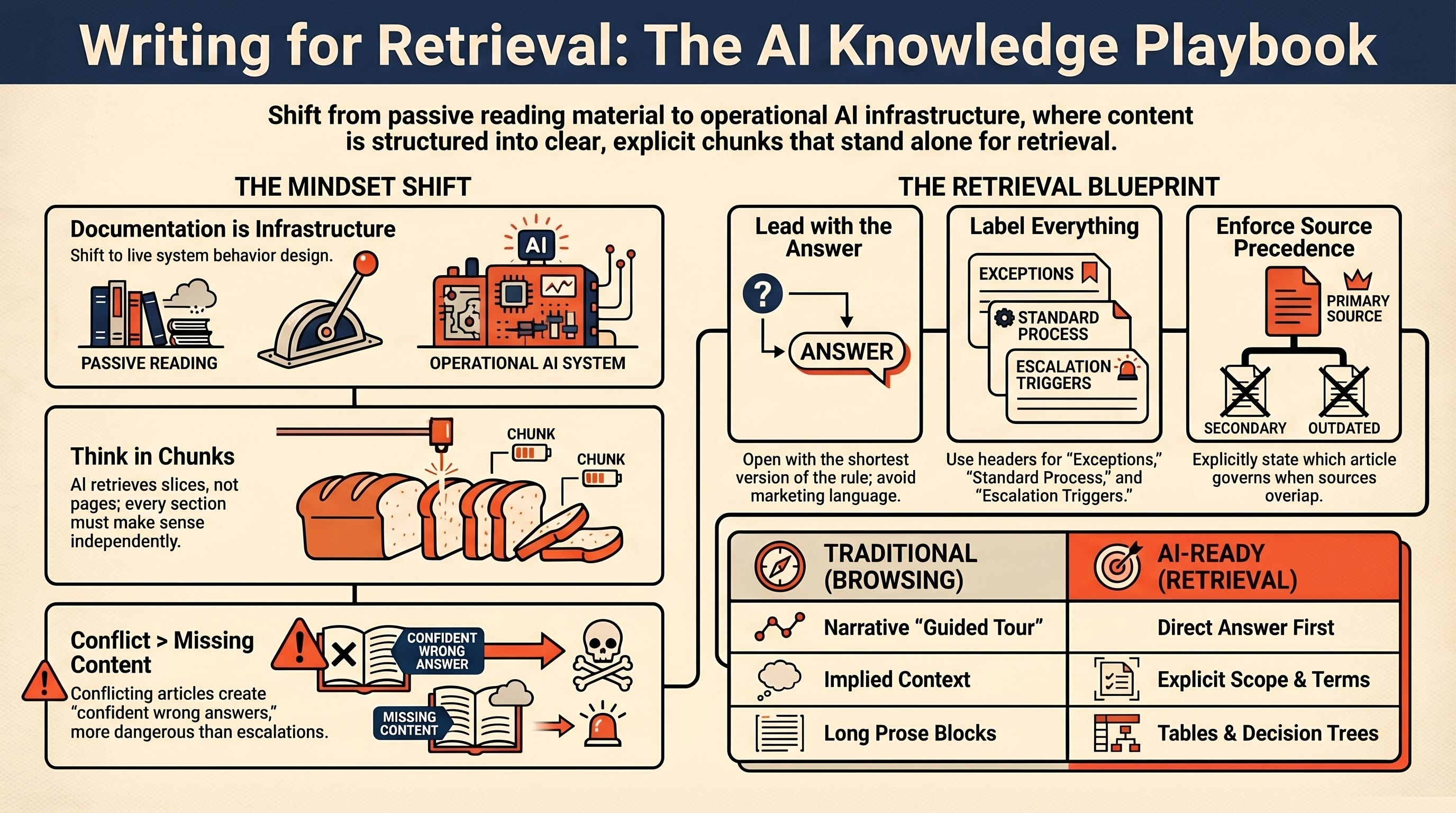
A simple structure that works better
Here is the structure I would use for most support content that needs to serve both humans and AI.
1. Start with the direct answer
Open with the shortest correct version of the rule. Not marketing language. Not product philosophy. The actual answer.
Bad:
“We are committed to making account access simple and secure for all users.”
Better:
“You can update your login email only after we verify ownership of the current account.”
The second version gives a retrieval system something usable immediately. It also helps the human reader faster, which is somehow still a nice side effect.
2. State scope clearly
Say who the article is for, what scenario it covers, and what is out of scope.
Example:
“This article covers standard reimbursement requests submitted through the parent portal. It does not apply to appeals, fraud reviews, or manual exception requests.”
That single move reduces bad matches. It helps retrieval rank the page for the right questions and stay away from the wrong ones.
3. Separate the standard path from exceptions
Do not bury exceptions in paragraph six. Label them.
Use clear headers such as:
Standard process
Exceptions
When support must escalate
This matters because retrieval systems often pull a chunk, not the whole article. If your exception is tucked inside a long paragraph, the wrong rule will win more often than it should.
4. Use explicit language, not implied logic
If customers ask, “Why was my request denied?” then use the word “denied.” If they ask about “refunds,” do not only say “reimbursement outcomes.” If they say “live agent,” do not only write “specialist support.”
Retrieval works better when your content uses the same terms users and agents use in real work.
5. Mark precedence when sources overlap
This is the part many teams miss.
If one rule is general and another is state-specific, say so. If the public article is informational but the internal runbook is the decision source, say so. If a temporary policy overrides the standing article, say so.
Use plain language:
“If this article conflicts with the current launch runbook, follow the runbook until this article is updated.”
That one sentence prevents a lot of garbage outcomes.
The hard part people miss: conflict is worse than missing content
Most knowledge projects focus on coverage. Do we have an article for this topic. Do we have enough help content. Do we need more documentation.
Coverage matters. Conflict matters more.
A missing article often leads to escalation. That is annoying, but usually safe.
A conflicting article leads to confident wrong answers. That is worse.
When one article says standard reviews take five business days, another says ten, and a macro says seven, the system has no reliable ground truth. A human might notice the mismatch. AI often turns conflict into fluency. It sounds certain while blending incompatible sources into one smooth sentence.
This is why conflict handling is now a core knowledge job, not cleanup work.
You need a visible operating rule for conflict:
One topic, one owner
Someone owns the truth for each domain.
One source of decision truth
Supporting articles can exist, but one source must govern the final answer.
One update path
Do not let temporary edits, Slack threads, macros, and side notes become parallel policy systems.
If feedback lives everywhere, the knowledge base becomes a museum of old certainty.
Freshness is not cosmetic
A last updated date used to be a nice detail. Now it is part of trust.
Humans look for it when they feel uncertain. AI systems need it indirectly because stale content keeps getting retrieved unless someone retires, rewrites, or deprecates it.
Freshness affects behavior in three ways.
First, stale content lingers in retrieval
If an old article still contains the clearest wording on a topic, retrieval may keep surfacing it even after the business changed.
Second, support teams lose confidence
Agents stop trusting AI when they keep spotting old policy language. Once that trust drops, adoption becomes theater.
Third, customers absorb inconsistency
They read one thing, hear another, and assume support is unreliable.
The fix is not glamorous. It is operational discipline.
Every high-impact article should have:
a named owner
a review date
a change log for material updates
a retirement rule when replaced
linked related articles to reduce orphan content
This is the same logic behind good governance and change control. Small edits change outcomes. One article rewrite changes retrieval. One stale paragraph changes customer guidance.
Write chunks that stand on their own
Because retrieval systems work at the chunk level, each important section should make sense without the full page around it.
That means each chunk should carry enough context to answer a real question cleanly.
Weak chunk:
“Once approved, this process can continue as normal.”
Better chunk:
“Once identity is verified, support can update the email address on the account. Do not process the change if verification fails or if fraud indicators are present.”
The better version includes subject, action, condition, and stop point. It survives extraction.
This is also why long narrative blocks often underperform in operational knowledge. They read fine. They retrieve poorly.
Tables, decision trees, and bullets are no longer optional formatting choices
People love pretending structure is a style preference. For retrieval, structure is performance.
Dense prose forces both humans and systems to infer too much. Structured content reduces ambiguity.
Use:
decision tables for eligibility rules
numbered steps for procedures
labeled escalation triggers
short bullets for required documents
examples for edge cases
separate sections for prohibited actions
A human scanning under pressure benefits from this. So does AI.
For example, this is stronger than a paragraph:
Escalate if:
identity does not match account records
the request involves money movement
two sources conflict
the issue requires a policy exception
the customer reports fraud, threat, or legal action
That structure is easier to retrieve, easier to quote internally, and easier to keep consistent with operations.
What retrieval-friendly knowledge looks like in practice
Here is a practical article skeleton for high-impact support content.
Overview
Give the direct answer in two or three sentences.
Who this applies to
State the user type, product area, state, plan, workflow, or scenario.
What support can do
List approved actions.
What support cannot do
List limits clearly.
Standard process
Use numbered steps.
Exceptions and edge cases
List them with direct handling rules.
Escalate when
Name the triggers.
Source of truth
State whether this article, a runbook, or a system record governs final handling.
Last reviewed
Add owner and date.
This is not flashy writing. It is durable writing.
The best knowledge articles now act like system controls
This is the larger point.
Support content used to sit behind the operation. Now it sits inside the operation.
It influences:
AI answers
macro quality
agent speed
escalation quality
QA consistency
customer trust
That means knowledge work is no longer a soft discipline parked next to training and content hygiene. It is a live systems function.
A weak article does not only create confusion. It can change routing, answer quality, and risk exposure at scale.
A strong article does more than explain. It stabilizes the system around it.
What leaders should do on Monday
If your team uses AI for assist, search, triage, or containment, start here:
Pick the top 10 articles tied to high-volume or high-risk intents.
Rewrite the opening of each article so the direct answer appears in the first section.
Separate standard rules from exceptions with clear headers.
Remove or merge conflicting articles on the same topic.
Add owner, review date, and source precedence to each critical article.
Replace long prose with tables, steps, and escalation triggers where needed.
Test the rewritten content against real questions customers ask.
Track which articles drive wrong answers, repeat contacts, or unnecessary escalations.
This is how support content moves from “help center maintenance” to “AI operations.”
The job changed before most teams renamed it
In Part 4, the issue was failure response. What should support do when the system starts failing in production.
This part sits upstream from that. One reason safe mode becomes necessary is that the system is often fed weak knowledge in the first place. When documentation is vague, stale, or contradictory, failure does not begin at the model. It begins at the source.
That is the lesson.
This is the shift: support content is no longer written only for browsing. It is written to guide live AI behavior too.
The teams that understand this will write differently. They will manage freshness differently. They will resolve conflicts faster. They will treat knowledge as infrastructure, because that is what it has become.
And when the answer goes right, fewer people will notice. Which, naturally, is how support usually gets rewarded for doing something well.
Start there before you blame the model.
Which part of your current knowledge base is most likely to break retrieval first: stale articles, conflicting guidance, or weak structure?