


Most support teams do not fail because they lack training. They fail because they practiced the wrong things.
They sat through onboarding. They reviewed the tool. They saw a few clean examples. They passed a quiz. Then a real issue showed up. The AI sounded confident. The customer was upset. The workflow was messy. The person on the front line had to make a judgment call with no real practice.
That is where weak training gets exposed.
If AI is part of your support operation, your team needs reps. Not generic reps. Not textbook prompts. They need practice with the same kinds of failures they will see live. Wrong summaries. Confident policy mistakes. Missing context. Bad escalations. Retrieval that pulls something close enough to sound right, but wrong enough to create risk.
This is where gold sets and drills matter.
Gold sets teach people what strong and weak AI output looks like. Drills teach them what to do under pressure. Together, they move training from theory into operating behavior.
What changed
Most training still treats AI like software onboarding. Learn the interface. Try a few prompts. Follow the workflow.
That is not enough.
Once AI enters real support work, the job shifts from generating text to making judgments. People need to know when an answer is usable, when it needs verification, when it needs editing, and when it needs to stop and escalate. If you train only for usage, you end up with polished wrong answers moving faster through the system.
The teams that get stronger with AI do not train for access. They train for judgment.
What this article gives you
By the end of this piece, you should have a simple way to design gold sets, run drills, score judgment, and keep practice tied to real operational failure modes.
Here is the full training model in one view: scenario design, scoring, timed drills, calibration, and the loop that keeps the library current.
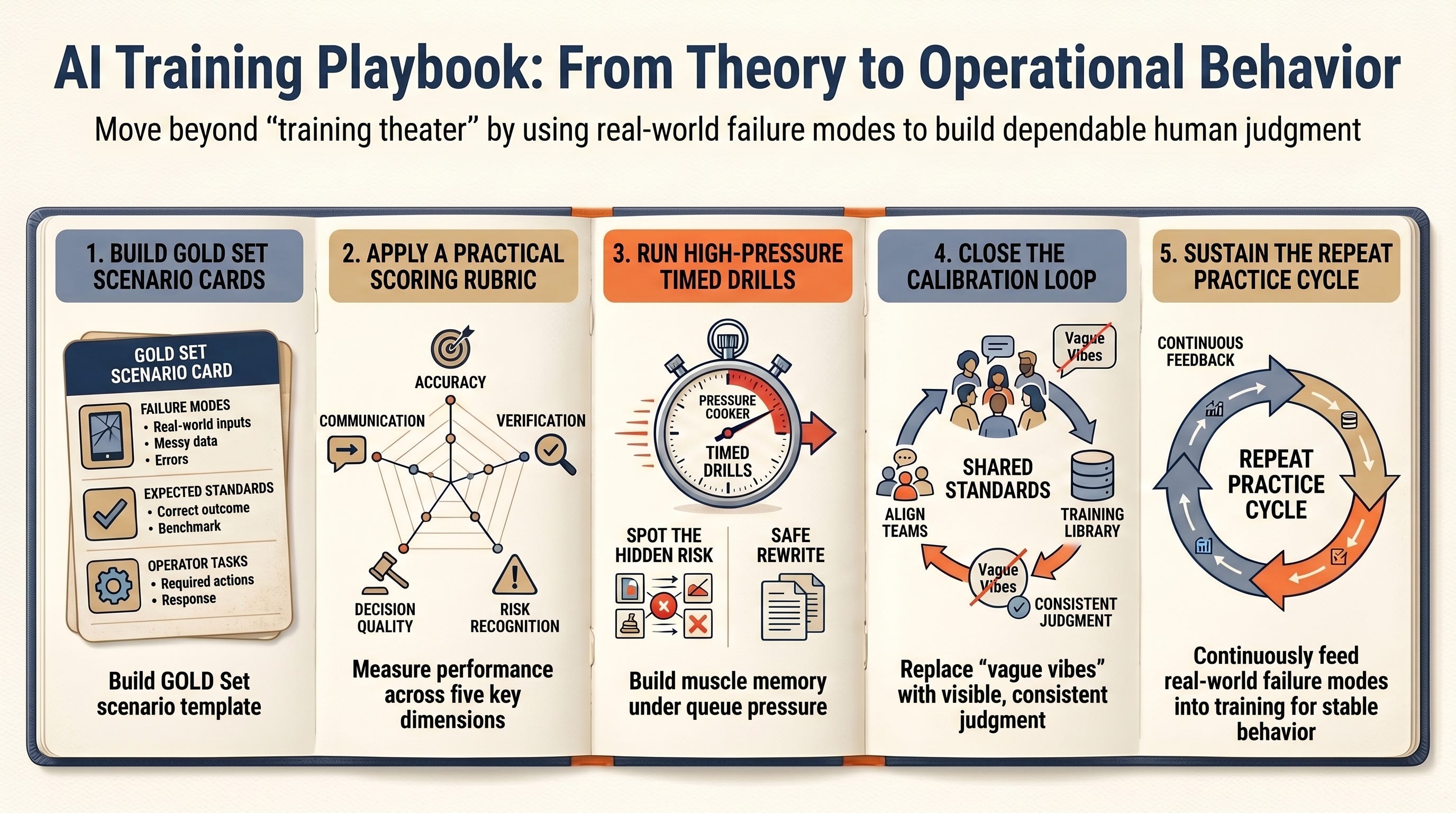
The graphic shows the full system. The rest of this article breaks down each part and how to put it into practice
What a gold set is, and why most teams build them wrong
A gold set is a curated group of scenarios with a known evaluation standard. Each scenario gives the team something concrete to judge. They review the customer input, the relevant context, the AI output, and the expected standard. Then they score the result against that standard.
Simple enough. Humans still find ways to turn simple things into theater.
The problem is that many teams build gold sets like vendor demo packets. Too clean. Too obvious. Too far from the mess of actual support work. Those sets test whether someone can spot the right answer in a perfect example. They do not test whether someone can catch a risky answer in a real workflow.
A useful gold set reflects operational reality.
Gold set: A curated scenario with a known standard used to teach evaluation and judgment.
That means the source material is messy. The customer explains the problem badly. The ticket history is incomplete. The internal note uses shorthand. The policy excerpt is real, but not perfectly packaged.
It also means the failure is believable. The AI does not produce nonsense. It produces something plausible enough to slip through. That is what makes it dangerous.
It also means the scoring standard is tied to risk. A formatting issue is not equal to a bad policy answer. A missing greeting is not equal to exposing the wrong next step on a funding, eligibility, or access issue.
The final test is simple. Does the scenario reflect a real decision? Should the agent use the answer, edit it, verify it, or escalate it? That is the job.
The shift from prompt training to judgment training
Earlier in this series, I focused on teaching agents how to prompt without turning them into prompt engineers. That still matters. People need reusable habits. They need clear structures. They need consistency.
But prompting is only the front door.
Once AI is in the workflow, the harder skill is judgment. Can the agent spot that the answer is missing a condition? Can they tell the difference between incomplete and unsafe? Can they verify the right source fast enough to stay useful during a live shift? Can they explain the issue clearly when escalation is the right move?
Gold sets train that judgment. Drills make it usable under pressure.
That is the difference between a team that uses AI and a team that operates AI.
What strong scenario design looks like
The best scenarios do not start with “write a response to this customer.” They start with the operational risk you want the team to handle well.
Start with the failure mode
Pick the thing that hurts trust, slows teams down, or creates rework.
Confident wrong answer: The AI cites a rule that sounds official but does not match the current policy.
Incomplete answer: The AI answers the surface question but leaves out the condition that changes eligibility, timing, or next steps.
Bad retrieval: The AI pulls from a similar article for the wrong state, plan, product, or customer type.
Weak escalation summary: The handoff sounds polished but omits the facts the next team needs to act.
False reassurance: The language sounds calm and helpful, but it promises something the team cannot guarantee.
These are useful because they reflect how failure shows up in real operations. Not as chaos. As subtle error.
Build the scenario from real work
Use patterns from actual tickets, QA reviews, escalation notes, and failed AI outputs. You do not need to name the customer, the program, or the platform. You do need the shape of the situation to be real.
A strong scenario package usually includes:
Customer input: The original message or call summary
Relevant context: System note, policy excerpt, or prior interaction
AI output: The draft, summary, suggestion, or routed result
Expected operator action: Approve, edit, verify, reject, or escalate
Reasoning standard: Why that action is correct
This matters because people do not work from isolated text. They work from mixed signals.
Make the wrong answer tempting
If the bad answer is obviously bad, you are not testing judgment. You are testing whether someone is awake.
The strongest wrong answers are attractive for the wrong reasons. They are fast. Polished. Empathetic. Seemingly complete. They sound like something a busy person would want to use. That is exactly why teams need practice with them.
A simple gold set structure you can reuse
You do not need a giant learning platform to do this. You need consistency. Start with a compact structure your leads and QA team can maintain.
Gold Set Card
Scenario name: Policy exception request with incomplete history
Skill tested: Source verification and escalation judgment
Failure mode: AI answer uses general rule, misses exception condition
Inputs: Customer message, prior ticket note, current policy excerpt, AI draft
Operator task: Decide whether to send, edit, verify, or escalate
Expected standard: Do not send as written. Verify the current exception policy. If the exception cannot be confirmed from a source of truth, escalate with a concise summary and customer-safe language
Scoring dimensions: Accuracy, verification, risk recognition, decision quality, communication quality
That is enough structure to create a reusable library.
How to score without turning the exercise into nonsense
Scoring should teach the team what matters. If your scoring system overweights tone and underweights risk, people will learn the wrong lesson fast.
Use a rubric with a few dimensions, not a bloated spreadsheet built by someone who thinks a dropdown menu is a management philosophy.
A practical model looks like this:
Accuracy and verification
Does the response match the current source of truth? Did the agent check the correct source before trusting the answer?
Risk recognition
Did the agent identify the hidden unsafe signal or condition that made the answer risky?
Decision and communication quality
Did the agent choose the right move, approve, edit, verify, or escalate? Did the language stay clear, bounded, and fact-based?
Standardizing “good”
Calibration should create agreement that policy risk matters more than wording elegance.
Continuous reliability
The library should be refreshed regularly to match current work, not old problems.
Not every category needs equal weight. On a low-risk knowledge scenario, completeness and clarity matter more. On a high-risk policy or account scenario, risk recognition and verification should dominate the score.
That weighting matters because training should reflect operational reality, not generic writing feedback. A beautiful answer that is wrong is still wrong.
The point is not the score. The point is calibration.
Gold sets work best when they create shared standards between agents, leads, QA, and leadership. The value is not only that one person gets an 82 and another gets a 94. The value is that the team stops arguing in vague terms and starts aligning around visible judgment.
This is what good calibration sounds like:
The answer sounded complete, but it relied on a general article, not the current exception rule.
The tone was fine, but the next step created false certainty.
The escalation was correct, but the summary buried the key condition in the third sentence.
The agent caught the policy risk quickly, which mattered more than making the wording elegant.
That kind of calibration is useful because it teaches what “good” means in your environment.
Drills are where the behavior becomes usable
A gold set is static. A drill adds time, pressure, and workflow.
Drill: A time-bound exercise that simulates real working conditions so teams practice the right response under pressure.
That matters because many agents can explain the right choice in a calm training session. Fewer can make the right move mid-shift with queue pressure, multiple tabs open, and a customer waiting.
Drills build muscle memory.
A strong drill simulates the conditions around the decision, not only the decision itself. That means you include time pressure, channel context, incomplete information, competing signals, and real follow-through. The person has to write the escalation, edit the response, or explain the hold to the customer.
This is how you prepare teams before a known risk becomes a live incident.
Three drills support teams should run regularly
Drill 1: Spot the hidden risk
Give the team an AI draft that looks solid on first read. Hide one risk signal inside the scenario, an outdated article, a conflicting account note, a missing verification step, or a state-specific exception. The task is to identify the risk, name the source of truth needed, and decide whether the answer is usable.
This drill builds the habit of not trusting fluency.
Drill 2: Safe rewrite under constraint
Give the team a flawed AI answer and ask them to rewrite it in customer-ready language without overpromising, inventing policy, or exposing uncertainty poorly. They need to preserve empathy and clarity while staying within verified facts.
This drill builds bounded communication, which matters most when AI is partially useful but not safe to send raw.
Drill 3: Escalate with signal
Give the team a messy case with customer language, system evidence, and a weak AI summary. The task is to produce a clean escalation note that the next team can act on without rereading the whole case.
This drill matters because bad escalations are one of the most expensive habits in support, with or without AI.
Repetition is the feature, not the flaw
A lot of teams run one workshop, call it enablement, and move on. Then they act surprised when performance drifts three weeks later.
Repetition is not boring. Repetition is how you create reliability.
Run the same core scenarios more than once. Change the wrapper. Shift the channel. Add a new wrinkle. See whether people still catch the same pattern. That is how you know the skill is becoming stable.
You are not trying to create novelty. You are trying to create dependable behavior.
How often to run gold sets and drills
This does not need to become a second full-time job.
Weekly
Review three to five gold set scenarios during team meetings, QA calibration, or lead coaching.
Biweekly
Run one timed drill tied to a current operational risk, policy change, product launch, seasonal spike, or recurring AI defect.
Monthly
Refresh the gold set library with real examples from recent QA reviews, escalations, and failed outputs.
After any major change
Run targeted drills after knowledge changes, routing changes, new intents, new AI releases, or high-risk launch periods.
The point is to keep training tied to live operations. People trust practice when it matches the work they are doing now, not the work someone imagined months ago.
The hard part leaders miss
Most teams know they should train. The part they miss is ownership.
Who writes the scenarios?
Who approves the standard?
Who updates them when policy changes?
Who connects training results to QA, knowledge, and AI improvement work?
If the answer is “everyone,” the answer is no one.
A workable model is simple. Support leadership owns the standard. QA or enablement maintains the rubric and calibration rhythm. Team leads run practice and coach to patterns.
Support Ops or the AI owner feeds real failure modes into the library. Policy or product partners review high-risk scenarios when needed.
Without this, drills become disconnected from the real system. People practice yesterday’s problem with last month’s article and a rubric no one trusts.
What leaders should measure
If you want to know whether this training is working, do not only measure completion. Completion is the corporate religion of people who hate evidence.
Track outcomes that reflect readiness.
Gold set pass rate by scenario type
Escalation quality on drilled scenarios versus non-drilled scenarios
Repeat error rate for known AI failure modes
Time to correct decision in timed drills
QA improvement on the specific skill being trained
Number of live incidents where staff followed the expected safe behavior
You are not trying to prove people attended. You are trying to prove they are safer and more reliable in production.
A Monday morning plan
If you want to put this in place without building a giant program, start here.
Pick the top five AI failure modes from recent QA, escalations, or customer complaints.
Turn each one into a gold set card with inputs, expected action, and scoring standard.
Create a simple rubric covering accuracy, verification, risk recognition, decision quality, and communication quality.
Run one calibration session with leads and QA before using the set broadly.
Start a biweekly drill tied to one real operational risk.
Feed drill patterns back into the same loop used for knowledge, workflow, and AI fixes.
Refresh the library every month with recent examples from production.
That is enough to change team behavior.
Train the job people now have
The biggest mistake companies make is assuming AI training is tool training. It is not. The real job is learning how to operate around a system that is useful, fast, inconsistent, and occasionally wrong.
Gold sets teach people what to trust, what to challenge, and what to stop. Drills teach them how to do it when the work gets real.
Your team should not meet a failure mode for the first time in front of a customer. By then, the cost is already higher.
The teams that handle AI well do not wait for failure to teach the lesson. They practice the hard parts before the launch, before the drift, and before the polished wrong answer becomes a trust problem.
Where is your team weaker today:
Spotting weak AI output, or responding correctly once they spot it?