


Support teams do not need another place to complain about AI. They already have plenty:
Slack threads
Ticket comments
QA notes
Manager DMs
Escalation meetings
Random screenshots dropped into channels with “FYI” attached, the official language of organizational surrender
The problem is not that frontline teams miss AI issues. They see them first. They see the wrong answer before Product sees the trend. They see the bad handoff before Engineering sees the defect. They see the knowledge gap before anyone updates the article. Then, too often, they watch the issue disappear into Slack like a sock in a dryer.
An agent flags that the AI gave the wrong answer on a policy question. Someone replies, “Thanks, we’ll look into it.” A week later, the same issue comes back through another customer. Then another. Then someone asks why Support did not escalate it sooner, because apparently time travel is now part of the job description.
This is how AI quality breaks down after launch. Not because nobody cares. Because the loop is scattered.
Support sees the failure. Product hears a theme. Engineering gets a vague bug. QA scores a sample. Knowledge gets updated later. Leadership sees a metric move and asks for a summary.
Everyone has a piece. Nobody owns the loop.
That is the skill this part focuses on: collaboration across Support, Product, and Engineering as one operating rhythm, not a collection of disconnected meetings.
What changed
Before AI, Support often escalated individual customer issues:
A bug
A missing feature
A confusing policy
A broken workflow
After AI, Support is also escalating system behavior:
The AI answered from the wrong source
The AI missed a constraint
The AI escalated too late
The AI summarized the issue incorrectly
The AI routed the ticket to the wrong team
The AI created customer confidence where caution was needed
That shift matters because AI does not fail one ticket at a time. AI repeats patterns. One bad answer becomes many bad answers. One unclear article becomes a retrieval problem. One messy workflow becomes a broken handoff. One poorly defined intent becomes a reporting lie with better formatting.
As AI handles more routine work, the remaining support work becomes higher risk. That means the signal from Support matters more, not less. A bad handoff is no longer only an internal annoyance. It becomes repeat contact, rework, customer confusion, and a system that keeps making the same mistake at scale.
Support cannot fix all of that alone. Product cannot prioritize it without evidence. Engineering cannot debug it without a clear failure shape. QA cannot measure it if nobody agrees what “good” means. Knowledge cannot update the source if nobody knows which source failed.
This is why collaboration becomes a frontline skill. Not soft collaboration. Not “let’s align” collaboration, the corporate fog machine. Operational collaboration.
Evidence in. Decision made. Fix shipped. Result checked. Team informed.
The core rule
If an AI failure does not move through one shared loop, it becomes organizational gossip.
Most companies do not have an AI quality problem at first. They have a translation problem.
Support says, “The bot gave the wrong answer.” Product asks, “How often is this happening?” Engineering asks, “What exactly did it retrieve?” QA asks, “Was this a policy failure or a tone issue?” Leadership asks, “Is this material?”
The agent hears all that and thinks, “I already gave you the ticket number. Do I also need to bring snacks and a court transcript?”
The fix is not asking agents for perfect technical reports. The fix is giving everyone one shared structure.
The AI quality loop, in plain language
The loop has five parts:
Capture the failure: Support records what happened with enough context for someone else to understand it.
Classify the failure: The issue gets labeled by failure type, not by who is annoyed.
Route the owner: The right team owns the next action based on the failure type.
Ship the fix: The fix goes into the right system: prompt, workflow, routing, knowledge, QA, or product behavior.
Close the loop: Support hears what changed, QA checks whether it worked, and the frontline stops reporting the same issue into the void.
That last part matters more than leaders think. When agents report AI failures and never hear back, they stop reporting. Then leaders lose the earliest signal they have. Then everyone acts surprised when quality drops. Humanity continues its proud tradition of ignoring smoke until the room has personality.
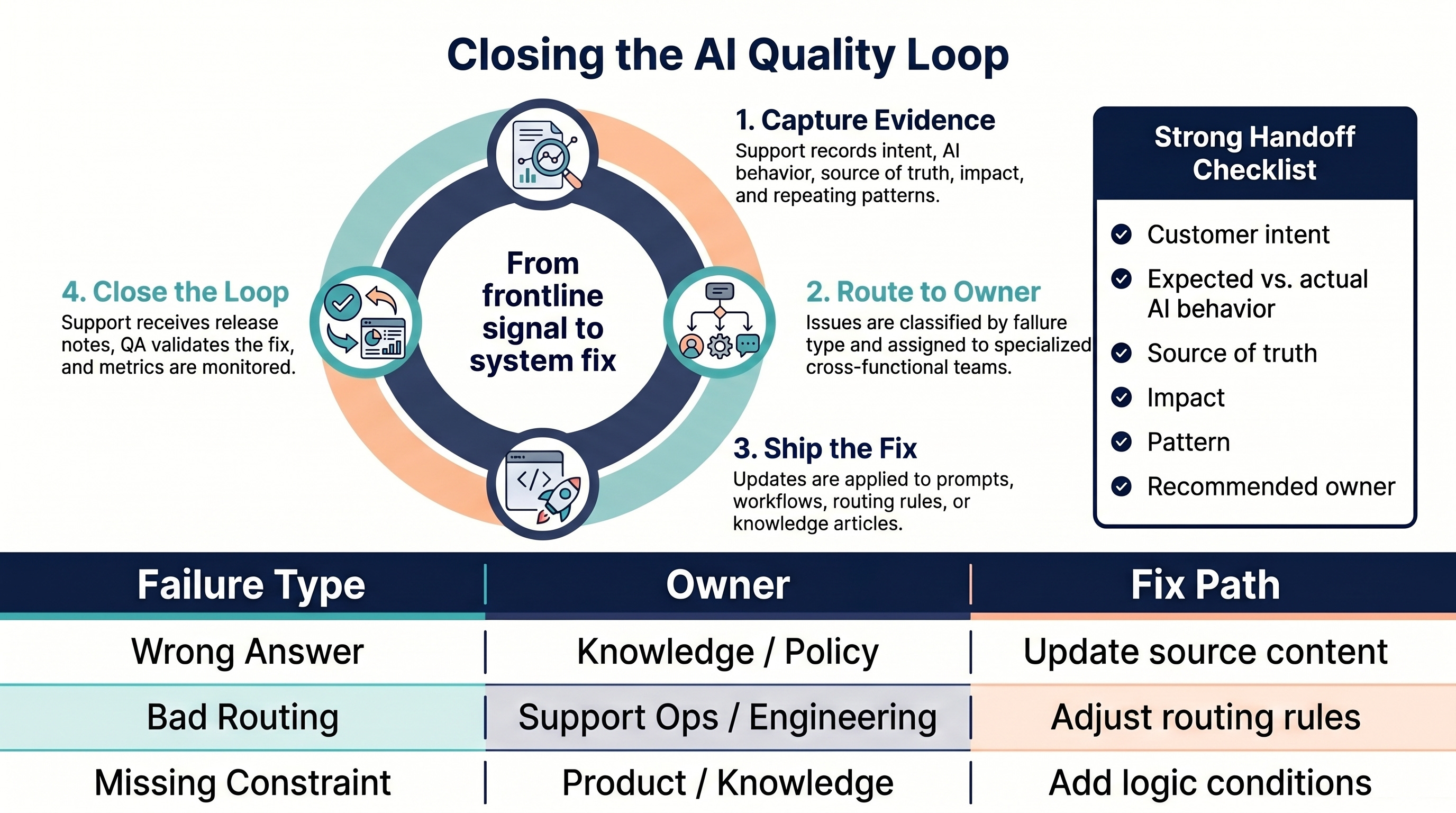
What Support should hand off
Support does not need to diagnose the model. Support needs to package the evidence.
A good AI failure report should answer five questions:
What was the customer trying to do?
What did the AI do instead?
What source, rule, or workflow should have applied?
What was the customer impact?
Is this isolated, repeating, or high-risk?
That is enough to make the issue actionable.
A weak handoff
“The AI gave the wrong answer again.”
This is emotionally honest and operationally useless. Nobody knows which answer, which customer type, which policy, which source, which workflow, or whether the issue happened once or ten times.
A strong handoff
“Customer asked whether a reimbursement item was eligible. AI answered yes, but the policy article says this category requires manual review before approval. Ticket reopened within 24 hours after the customer followed the AI guidance. I found three similar tickets this week under the same intent.”
That report gives Product and Engineering something to work with. It has intent, expected rule, actual behavior, impact, and pattern.
The goal is not to make agents write novels. The goal is to make reports useful enough that the next team does not need to start from zero.
The handoff template
Use this inside tickets, QA notes, or your AI failure intake form.
AI Failure Report
Customer intent: Customer asked whether a reimbursement item was eligible before submitting.
Expected behavior: AI should explain that this category requires manual review and point to the official policy article.
Actual AI behavior: AI answered as if the item was automatically eligible.
Source of truth: Policy article: Reimbursement Eligibility Guidelines. Runbook: Manual Review Escalation Rules.
Customer impact: Customer submitted based on incorrect guidance and reopened the ticket within 24 hours.
Failure type: Missing constraint.
Pattern: Three similar tickets found this week under the same intent.
Recommended owner: Knowledge and Product, with QA follow-up after the source is updated.
Blank version
Customer intent: What the customer was trying to do
Expected behavior: What the AI should have done
Actual behavior: What the AI did instead
Source of truth: The article, policy, runbook, system record, or workflow that should have guided the answer
Customer impact: What happened because of the failure
Failure type: Wrong answer, missing constraint, bad escalation, bad routing, poor summary, stale knowledge, unsafe tone, or unclear ownership
Pattern: One-off, repeated, increasing, or high-risk
Recommended owner: Support Ops, Product, Engineering, Knowledge, QA, Policy, or Leadership
That template is not glamorous. Neither is flossing. Both prevent expensive decay.
The loop works when each team owns its part
Support should not diagnose every system issue. Product should not treat every complaint as a feature request. Engineering should not receive mystery tickets. QA should not score only the human. Knowledge should not wait for a quarterly cleanup.
Each team needs a clear role in the loop.
Product decides whether the failure is an experience problem
Product should not treat every AI failure as a bug report. Some are product issues. Some are policy issues. Some are workflow gaps. Some are knowledge gaps. Some are unclear experience design. Some are the system doing exactly what it was told to do, which is always a fun little tragedy.
Product’s job in the loop is to decide whether the failure reveals a broken customer experience.
Product should look beyond the single ticket and ask:
Is this a confusing product path?
Is the policy unclear?
Is the customer being forced into support because the product does not explain the next step?
Is AI exposing a gap that humans used to absorb manually?
Is the handoff to a human happening too late?
Is the workflow asking the customer to repeat information already available?
The best Product partners do not ask Support for “more examples” forever. They define the decision threshold:
One high-risk failure: Review immediately
Three repeated failures in one week: Add to the AI quality backlog
Ten or more contacts under the same intent: Review product or workflow design
Repeat contact rate rises after AI answer: Treat as a customer experience defect
Product should turn frontline evidence into product decisions, not park it in the museum of interesting anecdotes.
Engineering needs reproducible signal
Engineering needs reproducible signal.
“AI is bad at this” is not reproducible.
“This intent retrieves Article A, but Article B is the correct source when the customer is in this state and has this account status” is reproducible.
Support and Product should not dump mystery meat into Engineering’s queue. Engineering should not require frontline agents to know system architecture before taking the issue seriously.
The middle ground is a clean technical handoff. Engineering needs:
The trigger: What customer phrase, intent, workflow, or condition started the issue
The wrong behavior: What the AI produced or routed
The expected behavior: What should have happened
The source conflict: Which docs, prompts, rules, or systems disagree
The impact: How often this appears and what risk it creates
Engineering then decides where the fix belongs:
A prompt update
A retrieval rule
A routing change
A workflow condition
A source priority adjustment
A product fix
A logging improvement
A rollback
This is where many teams break the loop. They treat every AI failure like a model problem.
Most AI failures in support are not model problems. They are messy process problems wearing a model costume.
QA scores the system, not only the agent
QA should not only score agent replies anymore. QA should score the system around the agent.
That includes:
Did the AI retrieve the right source? If the wrong article shaped the answer, the agent is already working uphill.
Did the AI identify the right intent? A misclassified intent corrupts routing, reporting, and trend analysis.
Did the AI escalate at the right moment? Late escalation creates customer frustration and internal rework.
Did the agent verify the right fields? The agent still owns judgment, especially in higher-risk workflows.
Did the final answer match policy and customer context? Polished language means nothing if the answer is wrong.
A confident wrong answer is not quality. It is a nicely dressed liability.
QA becomes the bridge between frontline judgment and system improvement. A good QA review should produce coaching for the agent and signal for the system.
If QA only says, “Agent should have verified,” you miss half the issue.
Better:
“The agent should have verified the policy before sending, but the AI also surfaced the outdated article first. Add this to knowledge cleanup and include this case in the next gold set.”
That is the loop working.
Knowledge fixes the source layer
Knowledge is not a library anymore. Knowledge is infrastructure.
Every unclear article becomes a bad AI answer waiting for a customer. Every stale macro becomes a tone or policy risk. Every duplicate source teaches the system to gamble. Every exception hidden in someone’s head becomes a future escalation.
Knowledge owners should use AI failure reports to update the source layer.
That means asking:
Which source did the AI use?
Was the source accurate?
Was the source specific enough?
Was there a missing exception?
Were two sources in conflict?
Did the article answer the customer’s real question?
Did the article explain when to escalate?
The best knowledge fixes are not longer articles. They are clearer decision points.
Add conditions. Add exclusions. Add examples. Add freshness dates. Add escalation rules. Remove contradictions.
The AI quality loop should feed knowledge updates every week, not only during big cleanup projects when everyone suddenly discovers the knowledge base has become a haunted filing cabinet.
What leaders need to put in place
This loop needs structure. Otherwise, it turns into vibes with recurring calendar invites.
One intake
Every AI issue should enter through one place. Not five Slack channels. Not manager DMs. Not screenshots in a meeting deck. Not “I think someone mentioned this last week.”
One intake creates one record of truth.
The intake should collect the handoff template from earlier:
Customer intent
Expected behavior
Actual behavior
Source of truth
Customer impact
Failure type
Pattern
Recommended owner
One weekly review
Hold one weekly AI quality review. Keep it short. Thirty minutes is enough when the intake is clean. If it takes ninety minutes, the meeting is doing the work your process failed to do earlier. Classic.
The review should cover:
New high-risk failures
Repeated failure patterns
Fixes shipped last week
Fixes blocked
Metrics that moved
What frontline teams need to know
This is not a debate club. It is a decision meeting.
One backlog
Every accepted issue goes into one backlog.
The backlog should show:
Failure type: What went wrong
Owner: Who is responsible
Fix path: Prompt, knowledge, workflow, routing, QA, product, or engineering
Priority: Based on risk, volume, and customer impact
Status: New, investigating, fixing, shipped, validating, closed
Result: What changed after the fix
Without one backlog, teams keep rediscovering the same issues in different rooms.
One release note
When something changes, tell the frontline.
This part gets skipped constantly. A prompt changes. A workflow changes. A knowledge article changes. Routing changes. The people answering customers find out when the customer asks a new question.
That is not enablement. That is workplace archaeology.
Every shipped fix should include a short release note:
What changed: AI now escalates reimbursement eligibility questions when manual review conditions appear.
Why it changed: AI previously answered some manual review cases as automatically eligible.
Who it affects: Parent support, reimbursement support, QA, and escalation owners.
What agents should do: Verify eligibility status before confirming next steps. Use the updated macro when the case requires manual review.
How QA will check it: QA will sample ten cases under this intent next week and review repeat contact rate.
This is how the loop closes.
The failure modes this loop should catch
The loop should classify failures into clear categories. Do not invent fifty labels. Support teams have jobs, allegedly.
Start with these:
Wrong answer: The AI gave guidance that conflicts with the source of truth.
Missing constraint: The AI gave a general answer but missed a condition, exception, state, role, date, or eligibility rule.
Bad escalation: The AI should have handed off sooner, or it escalated without enough context.
Bad routing: The issue went to the wrong team, queue, skill, or workflow.
Poor summary: The AI summary missed key facts, invented details, or created confusion for the next person.
Stale knowledge: The AI used outdated, incomplete, duplicated, or conflicting content.
Unsafe tone: The AI sounded too certain, too dismissive, too casual, or too apologetic for the situation.
Unclear ownership: Everyone agrees something broke, but nobody knows who owns the fix. A beautiful little monument to modern work.
These labels matter because they point to different owners:
Wrong answer might go to Knowledge or Policy.
Bad routing might go to Support Ops or Engineering.
Poor summary might go to prompt tuning and QA.
Missing constraint might go to Product, Knowledge, and QA.
Unclear ownership goes to leadership, because that is where ambiguity goes to pretend it is strategy.
The hard part people miss
Most teams say they want frontline feedback. They do not always want the responsibility that comes with it.
Frontline feedback only creates trust when the organization responds with a visible decision.
When agents provide evidence, the organization owes them a response. Not always agreement. Not always immediate action. But a visible decision:
Accepted
Rejected
Needs more evidence
Blocked
Shipped
Watching metric
Without that response, feedback becomes emotional labor. Agents keep reporting issues, but nothing changes. Then leaders complain that the team is disengaged. Stunning detective work.
The loop protects trust internally.
It tells Support their signal matters. It tells Product their decisions should reflect customer reality. It tells Engineering they will get scoped issues, not vague complaints. It tells QA their reviews improve the system, not only the agent. It tells Knowledge their content drives behavior, not page views. It tells Leadership AI quality is an operating rhythm, not a launch milestone.
That is the point.
A Monday morning implementation plan
Start with one workflow. Prove the loop works before you scale it.
Pick one high-volume or high-risk AI-assisted workflow.
Create one AI failure intake using the handoff template.
Define five failure types to start: wrong answer, missing constraint, bad escalation, bad routing, stale knowledge.
Assign default owners for each failure type.
Hold a 30-minute weekly review with Support, Product, Engineering, QA, and Knowledge.
Ship one fix per week, even if it is small.
Send one frontline release note after each fix.
Track one outcome metric tied to the workflow, such as repeat contact rate, reopen rate, escalation rate, or AI-to-human handoff success.
Do this for four weeks. By week four, you will know whether you have an AI quality loop or a complaint collection hobby.
What good looks like
A strong loop does not eliminate AI failures. That is fantasy. We have enough fantasy in roadmaps already.
A strong loop makes failures smaller, faster, and more useful:
Support knows how to report.
Product knows how to prioritize.
Engineering knows what to inspect.
QA knows what to sample.
Knowledge knows what to update.
Leadership knows what changed and why.
The result is not perfection. The result is a system that learns.
That is the real skill shift for support teams in the AI era. Frontline work is no longer only about resolving the customer in front of you. It is about turning that customer interaction into signal the whole company uses to improve the next one.
The operating model is simple:
Support becomes the sensor layer.
Product becomes the decision layer.
Engineering becomes the system repair layer.
QA becomes the confidence layer.
Knowledge becomes the source layer.
Leadership becomes the ownership layer.
If one layer breaks, the loop slows down. If every layer works, AI quality becomes something the organization operates, not something everyone hopes stays fine.
Because hope, as usual, is not an operating model.
Closing
The frontline will always see the truth first.
They will see where AI sounds confident but wrong. They will see where customers get confused. They will see where workflows break, where policies conflict, and where handoffs fail.
The question is whether the organization knows how to use what they see.
If Support feeds evidence into one loop, Product and Engineering respond with clear ownership, QA checks the result, and Knowledge updates the source, AI gets better in production. Not in theory. Not in a demo. In the actual messy work where customers live.
The best AI support teams will not be the ones with the most feedback. They will be the ones with the cleanest loop from feedback to fix.
What is the first AI failure your team should put into one shared loop: wrong answers, bad escalations, stale knowledge, or broken routing?